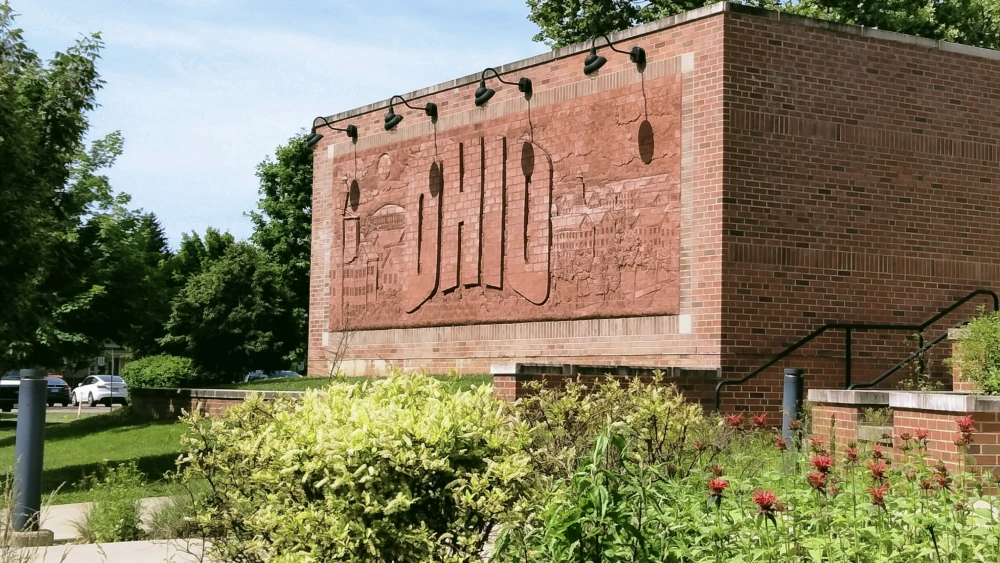
On March 26, the “Toxic Masculinity Tour,” featuring political commentator Myron Gaines, made its way to Ohio University in Athens, where Gaines greeted students with the Nazi salute and claimed that “women are stupid, Jews control America and Blacks are criminals,” according to The Post, the university’s student newspaper.
Gaines, who is the co-host of the male self-improvement podcast, Fresh&Fit, and a former special agent with Homeland Security Investigations, wrote the No. 1 bestselling book, “Why Women Deserve Less,” and has a history of antisemitic and misogynistic speech, which got him banned on Instagram and demonetized on YouTube.
Juli Goodman, executive director of Hillel at Ohio University, told the Cleveland Jewish News that Gaines’ tour, which is in partnership with Uncensored America, pushes the limits of free speech, as Gaines was seated under a tent by a sign that read “Bring back slut shaming: prove me wrong.”
“It’s pretty terrifying to see a speaker walk onto campus giving a Nazi salute, and seeing the hatred that he carries,” she said.
Goodman, who called Gaines an “instigator,” said that during Gaines’ debate, Hillel hosted a lunch to offer students an alternative during that time period. Many students didn’t want to give much attention to Gaines, as they suspected that his goal was to get a rise out of the students on campus and didn’t want to play into that narrative, she said.
“We worked to create a space here at Hillel for Jewish students to have an opportunity to avoid interacting with his hateful rhetoric,” Goodman said. “We’re disappointed that this type of thing, to put it mildly, would go on in our campus community, which, in general, is a welcoming environment for Jewish kids.”
According to Goodman, Hillel at OU has a “strong relationship” with the university’s administration, which let them know ahead of time that Gaines would be coming to campus.
“It’s an unfortunate reality, and not just on college campuses, that antisemitism is rising in America across the board, and there’s a lot of steps that need to be taken in a systemic way to mitigate that,” Goodman said. “One of the most profound steps that can be taken on a local level is, ‘What’s going to be done about it?’ I’m very proud to say that OU Hillel and the university have a very positive relationship that is built on mutual respect and trust.”
Prior to April 1, many had taken to social media calling for the administration to stand up for Jewish students on campus, such as Israel War Room on Facebook, which shared a letter asking community members to demand that the administration “publicly condemn antisemitism,” with comments reading, “Shame on the university for not condemning this!!!!”
Upon request, Ohio University Senior Director of Communications Daniel Pittman provided the following statement on behalf of the university to the CJN on April 1: “Ohio University has a longstanding legacy of free speech and civic engagement, and we believe that an expressive campus environment—one in which everyone can convey their views—is a sign of an engaged community and a diversity of perspectives.
“Last week, an external speaker was invited to campus by a registered student organization, and during the visit, a variety of viewpoints were expressed, both by the speaker and those who chose to attend. Prior to the event, the university reminded the host student organization of the expectations and guidelines within the University’s Freedom of Expression and Use of Outdoor Space policies.
“While the University is not legally permitted to prohibit free speech, including controversial speech, on its public grounds, appropriate steps were taken to preserve peace and ensure unrestricted travel on campus while it took place. The university is also aware of the ways in which some instances of protected speech can personally impact various members of our community, and we remain committed to addressing these impacts when appropriate. For example, the university has been in contact with our partners at Hillel and Chabad and is actively working to share the various resources available to support impacted students, faculty and staff.
“Moving forward, we remain committed to working alongside our University community, and within the established boundaries of the law, to foster a respectful campus environment that furthers our institutional mission and supports the success of our students, faculty and staff.”
Kelly Fishman, regional director of the ADL Ohio River Valley, told the CJN that giving Gaines a platform under the guise of free speech and debate sends a chilling message to both Jewish and female students on campus – one that says that their campus and peers will not protect them.
“Amrou Fudl, aka Myron Gaines, has a history of promoting antisemitic conspiracy theories, denying the Holocaust and promoting violent misogyny to his audience,” Fishman said. “When universities allow extremists like Gaines to speak on their campuses, they lend institutional legitimacy to the dangerous lies he spreads to build notoriety through infamy.
“At a time when Jewish students are facing heightened fears about their safety and when women still face the real threat of sexual assault on campus, platforming Gaines under the guise of ‘debate’ sends a chilling message: that the institution considers his views worth elevating. When Gaines spouts antisemitism to cheering crowds, Jewish students hear that their campus will not protect them. When he degrades women to applause, women on campus hear the same.”
Justin Kirschner, regional director of AJC Cincinnati, which covers southern Ohio, said in a statement provided to the CJN: “Myron Gaines is a provocateur who is exploiting antisemitism and Holocaust denial to court attention, doing so at a moment of profound vulnerability for the Jewish community – making his actions especially reprehensible and dangerous. He is cynically leveraging universities’ commitment to open inquiry to legitimize and amplify hateful rhetoric. AJC stands with the students who are courageously speaking out against this rhetoric, and we remain ready to partner with campus leaders to uphold open dialogue, the dignity and safety of all members of the campus community, and to ensure inclusive learning environments.”
This article originally appeared in the Cleveland Jewish News.