


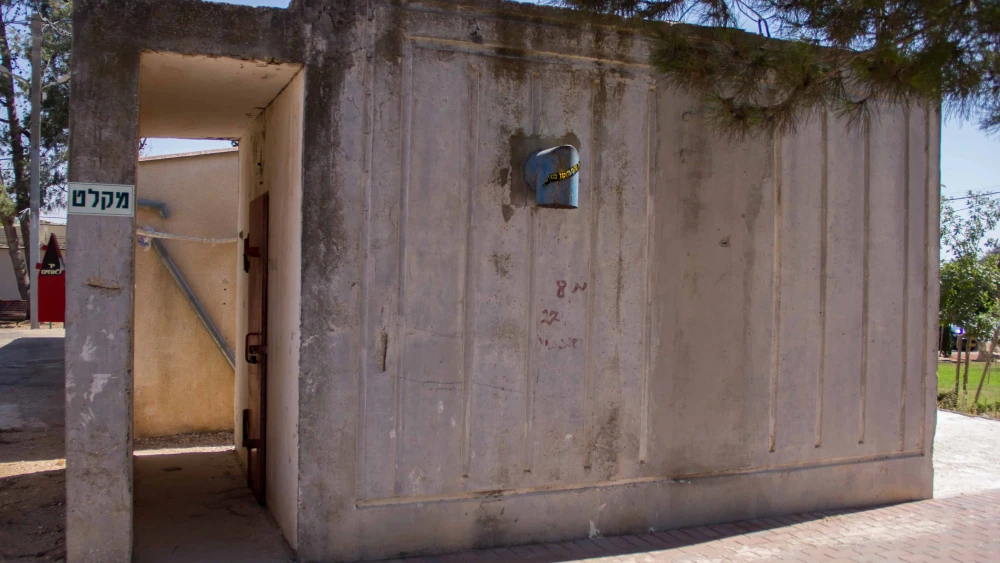
Israeli Attorney General Gali Baharav-Miara attacked Prime Minister Benjamin Netanyahu’s government on Monday over a decision to place portable bomb shelters, known in Hebrew as miguniot, in Judea and Samaria towns that have not been formally recognized by Jerusalem.
According to Baharav-Miara, the government’s decision to provide Israeli citizens in unrecognized outposts throughout Judea and Samaria with shelters was illegal, as it was made by members of the Cabinet without requesting professional advice from the security establishment.
“A determination regarding shelters should be a professional decision and not a political decision,” the attorney-general wrote to Netanyahu. “Improper conduct in these sensitive contexts may harm security needs.
“The Cabinet cannot be a city of refuge [“ir miklat”] for improper decision-making; you are responsible,” the Israeli legal adviser added, using a biblical term that can also mean “shelter” in modern Hebrew.
Netanyahu’s office responded, “The adviser’s letter consists of claims disconnected from reality. This concerns placing portable shelters in young settlements, where thousands of residents live without private or public bomb shelters, and are thus exposed to life-threatening danger.”
“It should be emphasized that in recent attacks, hundreds of rockets and missiles were launched in the direction of Judea and Samaria. Do these Israelis have no right to protection?” added the Prime Minister’s Office.
It emphasized that the decision-making process was “completely normal” and proper procedure was followed, including a professional opinion from Israel’s Defense Ministry. The move was also said to have been coordinated with the National Security Council.
“It is regretful that the legal adviser to the government chooses to engage in empty claims when it concerns the actual preservation of human lives,” according to the statement from the premier’s office.
According to Israeli law, the attorney general technically does not work for the prime minister, as opposed to in the United States, where the attorney general is an agent of the executive branch. Netanyahu and other ministers have often clashed with Baharav-Miara, who was appointed by the government led by then-premier Naftali Bennett.
Following Iran’s unprecedented Oct. 1 attack—in which some 180 ballistic missiles were launched at Israel, triggering alerts throughout the Jewish state, including in Judea and Samaria—residents of the area complained to Arutz 7 that many outposts were left unprotected.
“When missiles started flying from Iran, people had no safe place to evacuate to,” the Israeli news outlet cited residents of nascent towns as explaining. “The young settlement primarily consists of families living in mobile homes—there is simply no protection against the missile threat.”
The Yesha Council, which represents the some 500,000 Israelis in Judea and Samaria, hailed the Oct. 10 Cabinet decision as a “welcome step,” charging that “pioneers and residents of young settlements deserve services and infrastructure like every citizen of the State of Israel.”
In late 2023, the Israeli Cabinet voted to allocate 75 million shekels ($20 million) to bolster the security infrastructure in Judea and Samaria. The decision provided funds to purchase bomb shelters, generators, security cameras, lighting and other security equipment to new communities.
The Jewish population in Judea and Samaria has surpassed half a million people, according to a report published earlier this year. There were 502,991 Jews living in Judea and Samaria as of Jan. 1, according to the document, which culled data from Israel’s Interior Ministry.
The 500,000-plus Jews living beyond the 1967 Green Line account for some 12% of all Jews in Israel. The natural growth of the Jewish population in Judea and Samaria is expected to exceed 600,000 by 2030, 700,000 by 2035 and one million by 2047, the report added.


