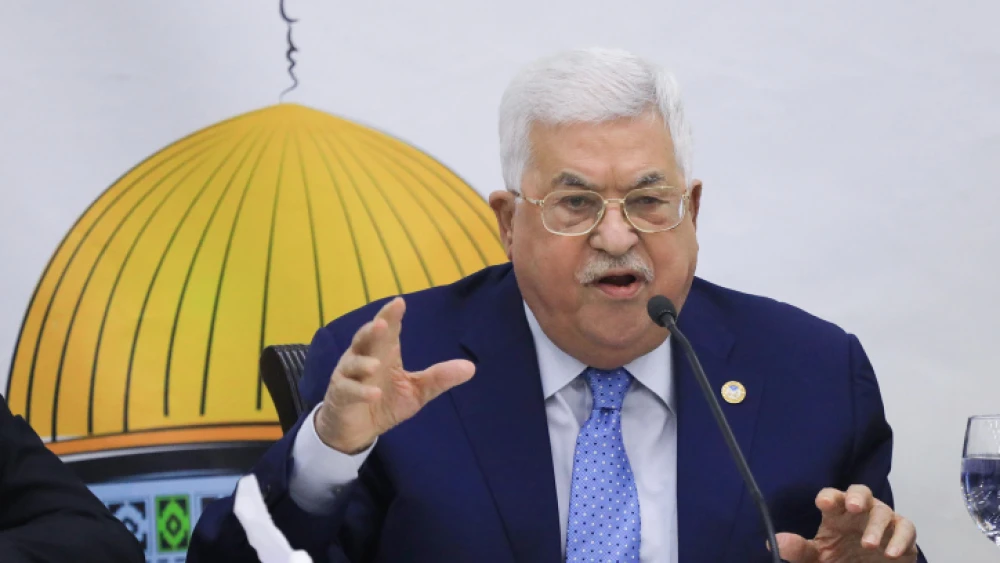
Palestinian Authority Chairman Mahmoud Abbas has decided to fire as many as 35 of his foreign envoys, Arab media reported on Sunday, continuing an administrative overhaul that already saw 12 P.A. governors removed from their posts.
In a press release quoted by the pan-Arab media outlet Al-Araby Al-Jadeed, the P.A. Ministry of Foreign Affairs and Expatriates confirmed that Ramallah had informed “a number of ambassadors who have reached or exceeded the retirement age that the retirement procedures for them will begin within a period of time and according to the rules.”
The London-based publication cited anonymous sources as saying that Abbas sacked 17 PLO envoys over the age of 70, and 18 over the age of 65. While P.A. law sets the retirement age for diplomatic personnel at 60, Palestinian representatives usually continue to serve well past that age.
Palestinian political analyst Mohammed Daraghmeh told local journalists that Abbas’s recent firings are only the beginning of a series of steps aimed at improving the Palestinian Authority’s declining power and legitimacy.
The overhaul was suggested to Abbas by P.A. Prime Minister Mohammad Shtayyeh, Dubai daily Al-Bayan said on Sunday.
The 87-year-old Abbas is deeply unpopular among the Palestinian public, who increasingly support terrorist groups, recent polling shows. The octogenarian leader is in the 19th year of his four-year term and has not heeded repeated calls to hold elections.
On Aug. 10, Abbas issued a decree removing 12 of his 16 regional governors from their posts.
In Judea and Samaria, Abbas ordered the forced retirement of the heads of the P.A.'s governorates of Jenin, Nablus, Qalqilya, Tulkarm, Bethlehem, Hebron, Tubas and Jericho (the latter includes a large section of the Jordan Valley).
In the Gaza Strip, which has been ruled by the Hamas terrorist organization since 2007, Abbas fired the P.A. representatives for North Gaza, Gaza City, Khan Younis and Rafah.
Only the governors of Jerusalem, Salfit and Ramallah/al-Bireh remain in their posts. The governor of Deir el-Balah in Gaza, Abdullah Abu Samhadana, died in 2020, and Abbas has yet to appoint a successor.
The P.A.'s Wafa news agency cited no reason for the overhaul. Its report claimed Abbas had ordered the creation of a committee, consisting of “leading figures,” that would present him with candidates to fill the vacant positions.
The U.S. Office of Palestinian Affairs offered “no comment” on Abbas’s firing of the 12 governors and advised JNS to “reach out to the Palestinian Authority officials/bodies directly.”
The White House, State Department and U.S. National Security Council likewise did not respond to requests from JNS for comment.