Newsletter
Newsletter Support JNS

Human-rights commission launches investigation into UK Labour Party on handling of anti-Semitism cases

It will evaluate the party’s handling of multiple acts of anti-Semitic discrimination and victimization detailed in dossiers since July 2018.

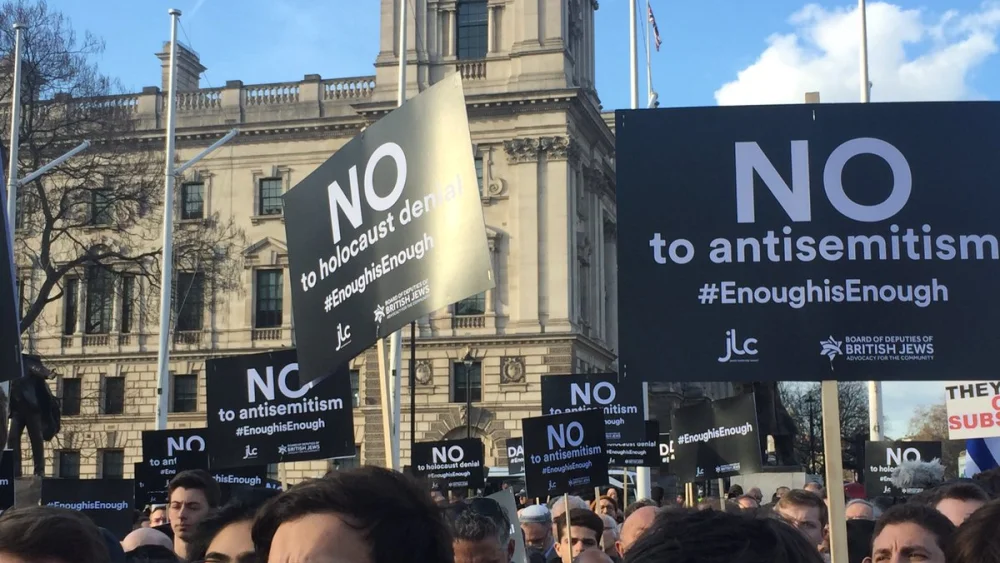
Thousands gather outside of Parliament in London to protest anti-Semitism in the British Labour Party, Sept. 3, 2018. Credit: Labour Against Anti-Semitism via Twitter.

The Equality and Human Rights Commission has launched a full statutory investigation into anti-Semitism in the United Kingdom’s Labour Party following a formal referral and detailed legal representations from Campaign Against Antisemitism, which is the complainant.

The investigation will evaluate the Labour Party’s handling of multiple acts of anti-Semitic discrimination and victimization detailed in the dossiers that the Campaign Against Antisemitism has provided in submissions since July 2018.

The commission, which was created by a Labour government in 2006, is tasked with enforcing and human-rights laws. It does not deal with such cases in Northern Ireland, which has its own Equality Commission and Human Rights Commission in accordance with the Good Friday Agreement.

The decision to launch a statutory investigation under section 20 of the Equality Act 2006 unlocks the commission’s full range of enforcement powers, allowing it to compel the Labour Party to reveal details of its handling of anti-Semitism in recent years, including internal communications such as text messages and emails.

The commission can also seek court injunctions against the party to prevent further anti-Semitic discrimination, harassment and victimization, and it can also impose an action plan on the party and enforce compliance through the courts.

The commission has made the move following a pre-enforcement engagement process with Labour that left it convinced that the party could not be trusted to resolve its anti-Semitism problem on its own.

During the pre-enforcement engagement process, numerous senior Labour figures called for the commission to investigate, including Deputy Labour leader Tom Watson, Shadow Foreign Secretary Emily Thornberry and former Justice Secretary Lord Falconer.

U.S. Central Command stated that the “precision strike” targeting Ali Husayn al-Ulaywi was part of ongoing efforts to eliminate terrorists threatening Americans and U.S. allies.
“Wikipedia’s administrators showed that they are above trivial details like formal charges, a designated prosecutor, basic decorum, distinction between prosecution and judge, dispassionate adjudication and so forth,” Larry Sanger told JNS.
“We want to hear from our partners. We want to make sure that their views are taken into account,” the U.S. secretary of state told reporters at Al Bateen Executive Airport in Abu Dhabi.
The decision follows a U.N.-commissioned investigation into allegations of sexual misconduct and comes ahead of a July 24 vote by ICC member states on whether to remove Khan from office.
“It’s difficult to stand among ancient stones and not recognize the power of a people maintaining a connection to places that have shaped their story for thousands of years,” said one participant.
Panelists at JNS Summit call for a strong response to international legal challenges facing Israel.
Benny Gantz, JNS editor-in-chief Jonathan S. Tobin, Gilad Erdan, Mosab Hassan Yousef, Nissim Black and leading voices in security, diplomacy, media, law and Jewish communal affairs headline the summit’s third day in Jerusalem.