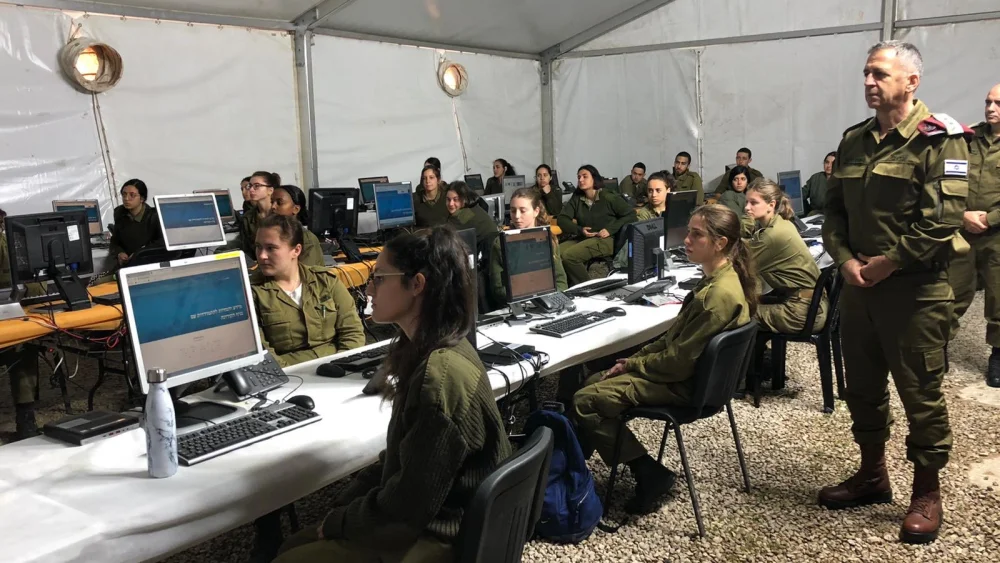
Israel Defense Forces’ Chief of Staff Lt. Gen. Aviv Kochavi called on Israeli Prime Minister Benjamin Netanyahu to allow the military to take over the management of the coronavirus crisis, as it constitutes a national emergency, Israel Hayom learned on Sunday.
Kochavi’s remarks were sent in a letter to which only a handful of senior officials were privy, as the chief of staff does not want to be perceived as weighing in on the political loggerheads between Netanyahu and Bennett.
Israeli Defense Minister Naftali Bennett said on Saturday that the coronavirus crisis constituted a “war,” and that responsibility for dealing with it should therefore be transferred immediately to his office.
“If we want to cope with this [pandemic], if we want to reopen the Israeli economy, then all responsibility for managing the coronavirus crisis—from A to Z—must be transferred to the IDF and the Defense Ministry as quickly as possible,” Bennett told Channel 12 News. “We’re at war. We’re fighting a tough biological war, against nature, but it’s a war with colossal logistical issues.”
Under Israeli law, if the government declares a national state of emergency, the IDF Home Front Command is authorized to assume responsibility for crisis management in civilian authorities. The military’s mandate over local authorities ends immediately when the state of emergency is lifted.
In Kochavi’s letter, the chief of staff names eight issues he believes the IDF should assume responsibility for immediately. Among them are coronavirus testing—an area where the IDF can utilize its considerable logistical abilities to increase testing, and information management, where the military could use its extensive capabilities to collect and analyze information on the virus. He noted several other areas in which he said the military has a distinct advantage over civilian authorities in terms of crisis management.
The IDF has been gearing up for the possibility that the Home Front Command will be asked to step in, a move the top military brass believes should have been made weeks ago. So far, the IDF has only taken command of several ultra-Orthodox cities where the public has flouted Health Ministry directives.
Defense officials said that Kochavi’s letter expresses the disapproval among the IDF’s general staff of the way the coronavirus crisis is being handled. This does not mean he is siding with the defense minister—only that he seeks to sound the alarm, one source told Israel Hayom.
‘An ongoing dialogue with the political echelon’
Similar sentiments have been expressed over the past week by almost everyone involved in the coronavirus crisis—top officials in academia, health care, economics and the high-tech industry, generals past and present, and communications experts, all of whom agree that while the government is taking important steps to curb the pandemic, the overall crisis is being mishandled.
There is a consensus that the current captains of the Health Ministry are out of their depth, one official said.
One of the most disturbing examples of the Health Ministry’s mismanagement of the situation is the insufficient number of daily coronavirus tests that, despite explicit orders from Netanyahu, has yet to cross the 10,000 mark per day, and in fact, averaged half that number.
But every other aspect of the country’s response to the pandemic—from logistics and procurement, to protecting nursing homes, to enforcing directives concerning those returning from abroad—has been encountering hurdles placed by the Health Ministry itself, seemingly backing the claim that it is simply not up to the task.
This concern grew last week when Health Minister Yaakov Litzman was diagnosed with the virus, sending dozens of officials, including Netanyahu, into mandatory self-isolation. While the prime minister tested negative, Israeli media later reported that Litzman had violated his ministry’s social-distancing orders.
The ministry’s detractors argue its failures are driven by its officials’ egos, while its defenders say that even the most talented individuals can’t do much given the poor means that ministry has at its disposal.
The experts agree that the first order of the day should be naming a “coronavirus Cabinet,” which will include the prime minister and the defense, health, finance, economy, welfare and public security ministers, and will convene daily.
They further suggest naming a government point-person who will report directly to Netanyahu, and transferring responsibility to the Home Front Command and the Defense Ministry’s National Emergency Authority.
The IDF Spokesperson’s Unit said in response to the news of Kochavi’s letter that “the IDF maintains an ongoing dialogue with the political echelon throughout the crisis, with a perception of expansive responsibility. We will not comment on the nature of the dialogue.”
This article first appeared in Israel Hayom.