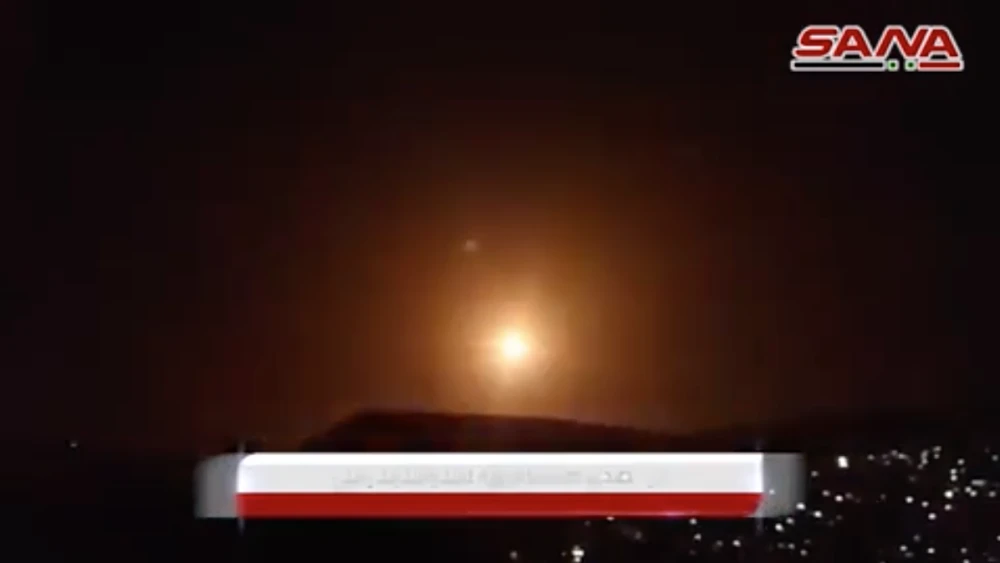
An S-300 Russian-made surface-to-air missile battery fired on Israeli Air Force jets during a reported Israeli strike on May 13, Channel 13 said in a report on Monday.
The report claimed that the S-300 battery is “operated by the Russians,” and that it constituted the first time that Russian forces fired on the IAF.
Five people were killed and seven injured on Friday in an alleged Israeli airstrike in Hama province in west-central Syria on Friday, according to Syrian state media.
Israel launched “bursts of missiles” from over the Mediterranean at 11:20 p.m., triggering air-defense systems, according to the Syrian Arab News Agency, or SANA.
“The Syrians, as is their tendency, fired all their missiles, and when IAF jets began moving away from the attack area, the Russian battery fired a number of missiles into the air,” said the report. “The missiles did not constitute a threat on IAF planes and there was no lock by the battery’s radar on the planes, but this is a dramatic precedent.”
However, the Alma Center, an Israeli defense research organization, noted that the base allegedly struck on 13 May contains S-300 batteries that were transferred to Syrian possession by Russia.
According to Tal Be’eri, head of research at Alma, the transfer of the batteries from Russia’s Hmeimim Air Base to the Syrian base in Hama occurred in February 2018. “The batteries were not under Russian activation,” he said. “The Russians gave their approval in principle for the batteries to be activated a while ago. These batteries can provide an aerial-defense envelope for all Syrian territory. The base is being defended by the Pantsir missile system.”
Four members of the Syrian regime’s air-defense personnel, including a lieutenant, were among those killed, according to the U.K.-based Syrian Observatory for Human Rights (SOHR), a pro-opposition group that aims to document human-rights abuses in Syria.
“A clear equation exists,” said Be’eri. “A battery that conducts fire on the attacking aerial force will be attacked in return and it will be struck.”
Last week, the Alma Center assessed in a new report that Russia likely turned a blind eye to Syrian and Iranian transfers of Russian-made weapons to Hezbollah in Lebanon.