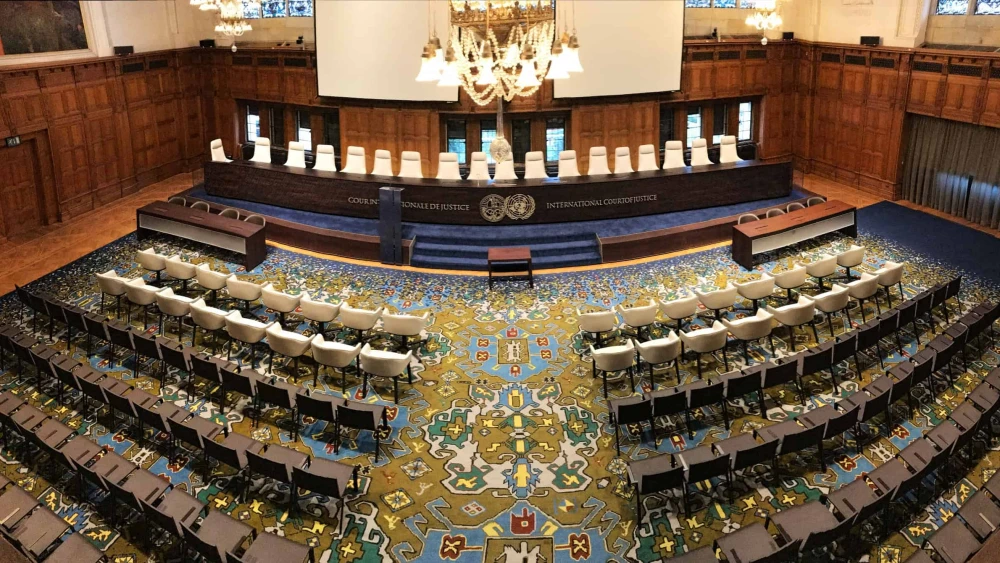

There has been widespread concern in Israel and among its supporters over the International Court of Justice’s recent ruling that Myanmar committed genocide during a large anti-terrorist operation that targeted the country’s largely Muslim Rohingya minority.
Many believe that, to an extent, the fix was in, though not because Myanmar was necessarily innocent. Rather, it’s because the case is seen as a dress rehearsal for convicting Israel of genocide in a pending case brought by South Africa.
The reasons for such concerns were elucidated by Yonah Jeremy Bob in a Jerusalem Post article, which focused on the fact that the ruling was marked by the ICJ’s efforts at “lowering the standard of proof needed to determine genocide against a country.”
Bob notes that “The ICJ ruled that Myanmar’s killing of 1.2% of the Rohingya population—10,000 out of 815,000—is sufficient grounds for genocide. This significantly downscales the definition of genocide, given its previous applications to the Holocaust, in which six million Jews were killed, or Rwanda, where more than 800,000 people were killed.”
“The ICJ also moved from its usual strict standards to a more lenient one,” he states. “In this case, the ICJ, rather than establishing a pattern of conduct, looked at the broader circumstances connected with the killings” by going “far beyond the traditional focus of a genocide … which exclusively looks at how many people were intentionally massacred.”
For example, the ICJ concentrated on systematic sexual assault, mass displacement, a history of past discrimination and “widespread destruction of housing” as indications of genocide.
In addition, “When examining acts of incitement, the ICJ used a relatively low standard to analyze provocative speeches to conclude that they were evidence of intent to commit genocide.” “Intent” being the all-important key to determining whether acts were genocidal rather than atrocities or war crimes.
Whether the definition of genocide was deliberately flattened by the court with an eye toward unjustly convicting Israel or not, there is clearly an epochal irony at work. Because the verdict makes it clear that the Hamas-led attack in southern Israel on Oct. 7, 2023 was an act of genocide, it is the Palestinians, not Israel, who are the guilty party.
There are several reasons for this.
First, the ICJ now considers numbers irrelevant. It doesn’t matter how many people were killed for conduct to constitute genocide. Thus, the 1,200 Israelis and others murdered on Oct. 7 can easily be seen as evidence of genocide and genocidal intent.
Moreover, the Palestinians’ more general conduct constitutes damning evidence of “broader circumstances” at work.
For example, on Oct. 7, the widespread destruction of housing occurred, as did the mass displacement of thousands of Israelis.
Decades of “provocative speeches,” to say the least, preceded the attack, as did long years of terrorism that murdered numerous Israelis.
If genocidal intent can be inferred from general behavior, then the Palestinians were unquestionably guilty of it.
Thus, it is clear that, by the ICJ’s own standards, the Palestinians—through consistent and deliberate genocidal rhetoric—had laid the groundwork for what occurred on Oct. 7 and acted with genocidal intent.
In addition, the mass sexual violence that occurred on Oct. 7 is particularly important, as it is echoed in the ICJ’s finding that Myanmar’s soldiers committed “widespread rape of the Rohingya.”
So, if genocidal intent can be inferred from general behavior, then the Palestinians were unquestionably guilty of it.
With the Palestinians having been convicted of genocide by implication, Israel must immediately get out ahead of the ICJ’s likely ruling against the Jewish state by exploiting this fact to the utmost.
First, there must be a change in official and unofficial Israeli rhetoric. Israel must begin to speak the truth that the ICJ has declared. It should stop calling Oct. 7 a “massacre” or “terrorism” and start calling it a genocide. The universal term should now be “the Palestinians’ Oct. 7 genocide.”
Israel should also use the same laws that the international establishment so often wields against Israel. This should be done by bringing a case before the ICJ that charges the Palestinians with genocide.
The first argument against such a case would be that Israel is not a member of the ICJ. This is irrelevant, however, as the ICJ, by agreeing to hear South Africa’s case against Israel, has already claimed jurisdiction over Israeli conduct.
Moreover, this decision was based on the supposed existence of a “state of Palestine,” which, despite not existing, has been recognized by several countries and international bodies like the United Nations.
Accepting the existence of this “state” for the sake of argument, Israel should urge friendly countries like India or Argentina that are members of the court to bring genocide charges against the “state of Palestine” that the international establishment and the ICJ insist exists.
No doubt the response would be that Hamas committed the Oct. 7 atrocities, rather than the Palestinian Authority, which is widely considered the ruling body of the “state of Palestine.” This, however, would also be irrelevant, as Hamas ruled Gaza for years, and thus can be considered at least one of the governing bodies of that state.
The counterargument then would be that Israel itself does not recognize such a state. Thus, Israel should point out that, if the international establishment insists on recognizing such a state, then it must hold that state responsible for its actions if the establishment wishes to avoid the most redolent hypocrisy.
It is, of course, all but impossible that the ICJ would agree to consider hearing a genocide case against the Palestinians, but that is not the point. The point is that bringing such a case would, in and of itself, go a long way toward discrediting the court’s likely ruling against Israel.
Israel should begin preparing such a case now and laying the diplomatic groundwork for it to be brought before the ICJ. It should do so immediately, because the friendly governments that might bring the case will not be in office forever, and Israel must exploit the opportunity while it still exists.
Our ancestor Abraham once asked God, “Will not the judge of all the earth do right?” It is time for Israel to ask the international establishment, “Will not the judges of this earth do right?”
If the answer is no, as it likely will be, at least the world will know it and find itself forced to face the only verdict that truly matters: that of history itself.