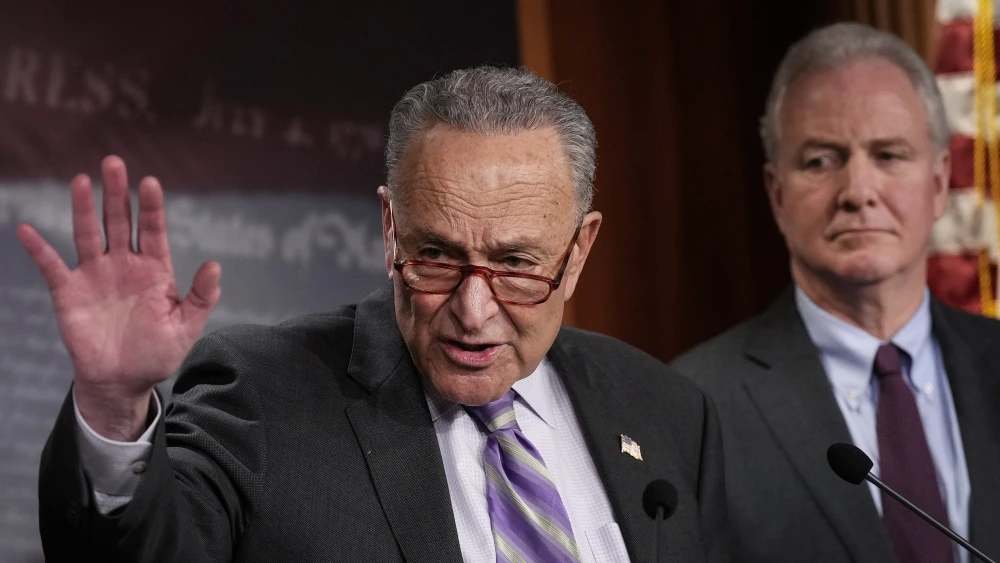

There’s only one week to go before the Senate Democratic caucus—a group that, as a result of the party’s midterm landslide, now forms a majority—has a scheduled vote for majority leader on Dec. 1. As it now stands, the smart money is still on current Minority Leader Chuck Schumer (D-N.Y.) holding off a spirited challenge from Sen. Chris Van Hollen (D-Md.).
It would be unprecedented for a congressional party to reject its existing leader after he had led them to take control of the upper body. Indeed, it would be astonishing if such a thing were to happen after a victory of the dimensions the Democrats just experienced when they flipped nine seats from red to blue in their midterm rout of the Republicans.
Yet as a feature published by PBS, an always reliable indicator of liberal opinion, pointed out, there’s a certain inconsistency involved in a party that ran on a platform of “change” handing the reins to an individual like Schumer. He has served as a Democratic leader for 10 years, been in the Senate for 28 years and held elected public office continuously since 1975—the polar opposite of that concept.
The definition of ‘change’
While most of the Democrats advocating for “change” in the Senate use that word these days, they aren’t solely or even primarily focused on age. If they were, that would make little sense since, although Schumer is a spry 76-year-old, Van Hollen will turn 68 in January, not exactly anyone’s idea of youth. Nor is it about transforming the party from an essentially moderate one to a faction more focused on opposing President Donald Trump or tilting further to the left on most issues; after all, Schumer bows to no one in his intransigent opposition to the administration or his willingness to kowtow to his party’s radicals.
Most leadership votes, such as this contest in the Senate, aren’t about ideology. As a general rule, they are primarily driven by the personal relationships that exist among members of the most exclusive and arguably the most powerful club in the world. In this case, the issue that may be driving this leadership race is the respective candidates’ attitudes toward Israel.
At first glance, that also doesn’t seem to make much sense.
Schumer has been highly critical of Israel’s government since the war that began with the Hamas-led Palestinian Arab terror attacks on southern Israeli communities on Oct. 7, 2023. Indeed, he has done much of the heavy lifting for the Democrats in denouncing Prime Minister Benjamin Netanyahu and advocating for a halt to the conflict before Hamas or its Hezbollah allies or Iranian paymasters are conclusively defeated. He’s also been AWOL from the battle against the left-wing antisemitism that has surged since then, even telling the leadership of Columbia University that only Republicans care about the issue.
A Jewish test
Most of all, Schumer has done nothing to halt his party’s drift not only to the far left, but to quarantine it from the Jew-hatred that has spread across the globe these past three years. That was made obvious by his disgraceful endorsement and substantial financial contributions to Dr. Abdul El-Sayed, who won a Michigan Senate seat with his help.
After decades of pretending to be the shomer, or “guardian,” of Israel and the Jews in Congress, it appears that the only people who still view him that way are those who wish to destroy the Jewish state. With respect to El-Sayed and many other radicals, Schumer has made a devil’s bargain
The main issue separating Schumer and Van Hollen is that the latter is far more willing to accommodate and echo the antisemitic left than the Democratic leader.
Radical actor Mark Ruffalo may not speak for the faction in the Senate that is backing Van Hollen’s challenge. But his controversial statement that essentially said Schumer should be considered ineligible for the leadership of the Senate because he’s a Jew sums up the current problem with a Democratic Party increasingly under the sway of its intersectional anti-Zionist and increasingly antisemitic left wing.
Ruffalo may have hurt Van Hollen more than he helped him by explicitly stating that an acknowledgement of Jewish rights, coupled with the historic and religious rationale for the existence of the one Jewish state on the planet in the ancient homeland of the Jews, is disqualifying for high public office.
At the moment, of those Senate Democrats who have stated their preference in the leadership vote, Schumer has the endorsement of 15 senators. Van Hollen has only five. A master of political maneuvering and of using campaign contributions to collect IOUs, a lot of his fellow Democratic senators owe Schumer some favors. That is especially true of the dozen Democrats who will be part of the Senate’s freshman class next year.
Still, at least two of them—El-Sayed and Minnesota Senator-elect Peggy Flanagan—have already endorsed Van Hollen.
The left sends a message
Even if he wins, as is likely, Schumer is being sent a message by his party’s left wing. That will impact how he uses his enormous leverage over legislation that the new majorities in the House and Senate will attempt to pass, as well as over confirmations of federal appointments.
Former mayor of Chicago Rahm Emanuel has a similar stance to Schumer as a liberal Jew who bashes Israel though doesn’t oppose its existence. He also harbors some unrealistic ambitions about becoming president. But he spoke for many Democrats when he advised Schumer to plan on getting out of the way soon, even if he manages to hold onto his current job.
Emanuel proposed that Schumer pledge to leave the leadership in two years, so as to mollify the Democrats’ radical wing. Whether or not such a gesture would work isn’t clear, as there really is a fundamental split among Democrats that can no longer be papered over by their mutual antipathy for Trump and the GOP. And the left’s anger about Israel rests at the heart of it.
The Democrats’ leader in the House of Representatives isn’t having the same problem as Schumer for obvious reasons. Current Minority Leader and future Speaker of the House Rep. Hakeem Jeffries (D-N.Y.) was re-elected nearly by acclamation by his caucus. At 56, Jeffries isn’t all that old. And the notion that even left-wing Democrats would reject the man who stands to be the first African-American Speaker of the House was absurd. He’s also not Jewish.
Jeffries, who, like Schumer, was long regarded as an ally of the pro-Israel community, has changed his views somewhat as well to avoid conflicts with his party’s intersectional base.
While not going as far as to endorse the “genocide” blood libels hurled at the Jewish state that are now widely accepted by most Democrats, including Van Hollen, Jeffries has made it clear that he will not oppose efforts to sanction Israelis who live in Judea and Samaria as part of the false “settler violence” narrative that liberal American Jews and Israelis have endorsed to demonize Netanyahu and the Israeli right. He may be open to further efforts to restrict military aid to Israel (which is unlikely to be eliminated by Trump in the coming year, despite his announcing that he plans to do so) or to stop arms sales.
Schumer will do the same. Indeed, the vast majority of Senate Democrats have already embraced such a stance. From there it will, either in this Congress or the next, be a short leap from such discriminatory measures to broader ones that will resemble antisemitic BDS efforts to isolate, and ultimately eliminate, Israel.
While Jeffries will likely hold onto his leadership post as long as he wants it, Schumer’s time as Senate leader is coming to an end. The reason for that has less to do with the calendar (Mitch McConnell hung as GOP leader until he was 82 and in poor health) and more with the changing culture of the Democratic Party with respect to Israel and the Jews.
A deal with the devil
Other Democrats may not currently be going as far as El-Sayed when it comes to brazen calls for the end of the Jewish state, as he did this past weekend on NBC’s “Meet the Press.” That’s a demand that would, in one way or another, require or result in Jewish genocide, if it were to happen.
The majority of them are clearly on board with the premise of his vile stands, which rests on lies about “genocide” and “apartheid” that have been mainstreamed and normalized by liberal media since Oct. 7. To that end, figures like Schumer, whose career has always rested on positioning himself wherever his party’s voters are at any moment, are adjusting their once-stalwart support for Israel and Jewish rights so as not to be out of sync with his voters, activists and congressional colleagues.
While such pragmatism is part of any successful political career, Schumer’s expectation that he will be the one in charge and control El-Sayed is unrealistic. What Schumer and other Democrats are doing is making a deal with the devil that will come due sooner than they think.
The speaker may believe that signaling opposition to Jerusalem will hold off the growing ranks of Democrats who no longer support the Jewish state from supplanting him. But in the long run, they will discard him as they have others in the party whose impeccable liberal credentials didn’t save them from defeat if they weren’t willing to validate smears of Israel.
If Schumer runs for re-election to a sixth term in the Senate in two years, he’s more than likely to be defeated in a primary by someone like House “Squad” leader Rep. Alexandria Ocasio-Cortez (D-N.Y.) if she doesn’t choose to run for president instead. Or that challenge can come from another left-winger.
That won’t be so much a generational shift as an ideological purge, as each new class of congressional Democrats manifests increasing hostility to Israel. Just as important, the willingness of the party to follow a Jew, especially one so outspoken about his identity as Schumer was in the past, is changing, too.
As Pennsylvania Gov. Josh Shapiro learned two years ago when the staff of then-Vice President Kamala Harris asked him if he was an Israeli agent when they vetted him to be her running mate, prejudice against Jews has become business as usual among Democrats. Though Shapiro won’t be the only Jewish Democrat vying for his party’s presidential nomination in 2028, Ruffalo’s antisemitic religious test for office will affect him as well as the others.
What the country is witnessing in the Democratic Party is a process by which even popular and successful politicians are being subjected to a religious/ethnic test that no Jew connected to the Jewish community or Israel can pass. While it may not fell Schumer this time, there’s little doubt that those who would impose such a test are gaining ground and may be in charge of the party before long.
If so, legislators such as Schumer, who had the power to speak up to oppose and isolate the radicals before it was too late, will discover that all of their political skills weren’t sufficient to save themselves from this purge. And, like so many victims of antisemitism in the past, efforts to appease these Jew-haters to co-opt them or to broker compromises always fail.
Jonathan S. Tobin is editor-in-chief of JNS. Follow him: @jonathans_tobin.