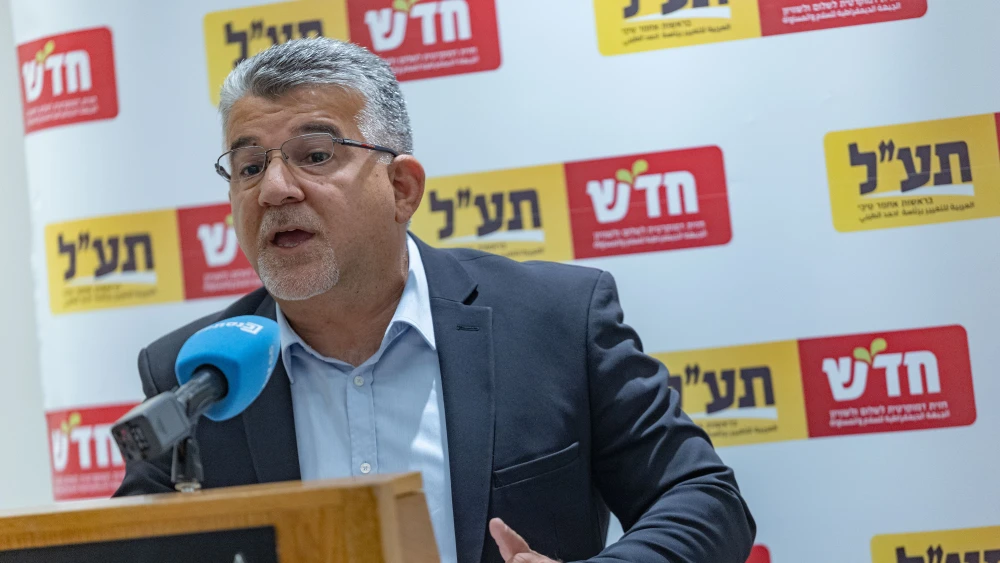

In a recent interview on a Haaretz podcast, professor Yousef Jabareen, leader of the Israeli-Arab Joint List Party, spoke repeatedly about hope, change and what he considers his historic responsibility to help replace the government of Israeli Prime Minister Benjamin Netanyahu.
Throughout the interview, I was left with two related questions: What responsibilities is Jabareen prepared to assume in helping shape Israel’s political future? And how does he reconcile his commitment to Palestinian national aspirations with his responsibilities as an elected representative of Israeli citizens?
For many Israelis, a change of government means more than replacing Netanyahu. It means improving democratic institutions, addressing internal divisions, strengthening national security, and promoting economic stability and growth.
For Jabareen, political change also appears to offer an opportunity to advance Palestinian national aspirations concerning Judea, Samaria, the Gaza Strip—and eventual statehood.
These objectives are not necessarily incompatible. But reconciling them requires more than a shared desire to remove the present government.
Jabareen expressed his willingness to help sustain a government led by opposition head Gadi Eisenkot from outside a coalition while ruling out participation in the government itself. He explained his objections to assuming responsibility for policies he opposes, particularly military operations and policies concerning Judea and Samaria.
But can a party provide the parliamentary support essential to a government’s survival while distancing itself from responsibility for its decisions? What would happen if an Eisenkot government faced another military confrontation? Would the Joint List continue supporting it even when it strongly disagreed with its security policies? And how could such an arrangement provide the stability needed to govern?
These questions are not arguments against Arab participation in Israeli politics. Arab citizens have long participated in Israel’s democratic system, and their elected representatives have the same parliamentary rights as other representatives.
The issue is what responsibilities political parties accept when they seek to influence the formation and survival of a government, especially one that must make difficult decisions about national security.
Jabareen discussed conditions facing Arab citizens of Israel. He emphasized discrimination, unequal resources, housing problems and the serious problem of organized crime.
These concerns deserve attention. Still, they are longstanding problems that did not originate with Netanyahu’s government, and efforts to address them have been undertaken by successive governments. Recognizing persistent inequalities should not prevent us from acknowledging the considerable progress Arab citizens have made within Israeli society.
Although significant inequalities remain, progress in education, employment and professional life reflects the individual achievements of Arab citizens, coupled with government policies, public investment and institutional support that have helped facilitate their integration into Israeli society.
The extent of their professional integration is particularly noteworthy. According to research using 2023 employment data, Arabs constituted approximately 25% of Israel’s physicians, 27% of nurses, 27% of dentists and 49% of pharmacists. Their representation in the civil service reached 15.2% in 2023.
These achievements do not eliminate discrimination or economic disparities. They do, however, offer a more complex picture of Arab participation in Israeli society than one defined primarily by exclusion.
This brings me to another question: What does it mean for the future of Israeli society when Arab citizens identify themselves nationally as Palestinians?
Such identification raises questions about the relationship between Palestinian national aspirations and a shared Israeli civic framework. The slogan “From the river to the sea, Palestine will be free,” for example, has been understood in different ways, including interpretations that challenge Israel’s continued existence as a Jewish state.
I’d like to hear Jabareen explain how he reconciles Palestinian national aspirations with Israel’s existence as a Jewish and democratic state. Does his political vision encourage a shared commitment to citizenship and responsibility within Israel, or might it deepen the division between its Jewish and Arab populations?
Jabareen advocates a Palestinian state alongside Israel based on the 1967 borders. But borders alone or ending the occupation cannot guarantee peace. Any territorial agreement must also address Israel’s security, mutual recognition and the prevention of renewed violence.
He repeatedly refers to the Arab League peace initiative, Saudi Arabia, France and international involvement as possible paths toward normalization and Palestinian statehood. Such diplomatic initiatives may play a role, but they are primarily external solutions to a conflict that requires profound internal transformation. They cannot, by themselves, produce reconciliation between peoples.
It is crucial to show a more complex picture of Arab participation in Israeli society than one defined primarily by exclusion.
What struck me was how frequently he spoke about change and hope, yet almost all the changes he described were ones Israel would have to make.
I heard much less about the changes Palestinian society and its political leadership would need to embrace to achieve lasting peace: rejecting violence; accepting Israel’s continued existence; and preparing their own communities for a genuine commitment to coexistence. Peace cannot depend solely on concessions or decisions by one side.
Jabareen has every right to advocate for Palestinian self-determination. But as an Israeli parliamentarian seeking influence over an Israeli government, he should also explain how his proposals would safeguard the security of the citizens that government is responsible for protecting.
The same applies to his criticism of Israeli military operations. Those operations are legitimate subjects for scrutiny, including their necessity, proportionality and consequences. But a serious discussion must also address the attacks and threats that prompted them, as well as measures needed to prevent their recurrence.
One of the most revealing aspects of the interview was Jabareen’s insistence that removing Netanyahu was a historic responsibility.
Agreement on replacing a prime minister does not necessarily establish agreement on the fundamental responsibilities of government. An Eisenkot government would have to make decisions concerning Israel’s security, its democratic institutions, its economy, relations between Jewish and Arab citizens, and the future of the Israeli-Palestinian conflict.
The parties sustaining that government would not need to agree on every policy. Coalition politics inevitably requires compromise. But they would need some shared understanding of the state’s fundamental interests and of their responsibilities when those interests are threatened.
I welcome serious discussion about greater Arab participation in Israeli political life. I also believe that such participation presents an opportunity to strengthen relations between Jewish and Arab citizens. But that opportunity requires clarity about mutual obligations, not merely a temporary parliamentary arrangement built around opposition to Netanyahu.
Jabareen speaks persuasively about hope. What remains unclear is whether his vision of change includes the political commitments and shared responsibilities necessary to turn that hope into a stable government and a more secure future for all those living in Israel.