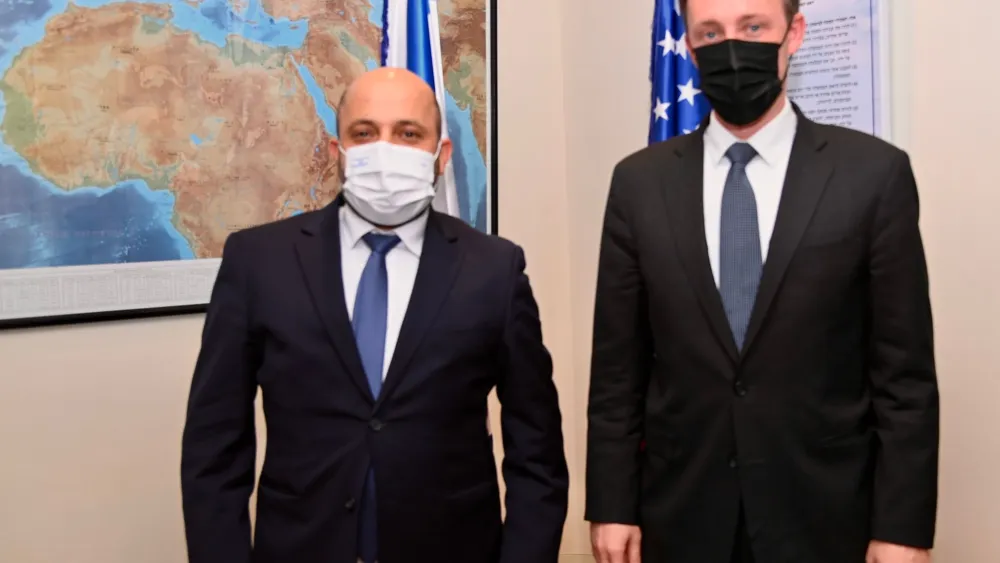
U.S. National Security Advisor Jake Sullivan met with his Israeli counterpart, National Security Adviser Eyal Hulata, at the White House on Wednesday amid the backdrop of the Iran negotiations and tensions between Russia and Ukraine.
According to a White House readout, the pair discussed security challenges impacting the Middle East, including the threat posed by Iran and its proxies.
Sullivan reiterated to Hulata the Biden administration’s “unwavering” support for Israel’s security and for ensuring that Iran never obtains a nuclear weapon. Israeli Prime Minister Naftali Bennett has warned that Israel would retain its freedom to act “in any situation” whether an agreement between Iran and world powers is signed or not.
The two national-security heads also “exchanged views on security challenges outside the Middle East, including the potential for further Russian aggression against Ukraine,” said the White House.
Both officials said they aim to deepen cooperation in science and technology while agreeing to maintain close coordination on a range of global and regional security challenges.
Hulata also met with U.S. Deputy Secretary of State Wendy Sherman on Wednesday.
According to a U.S. State Department readout, Sherman and Hulata discussed “U.S.-Israeli coordination on important global security challenges, including Iran and Russia’s unprovoked military build-up on Ukraine’s borders.”
Sherman also reiterated to Hulata the administration’s “ironclad” support for Israel. She further emphasized “the importance of Israelis and Palestinians enjoying equal measures of security, freedom and prosperity, and reaffirmed the commitment of the United States to a two-state solution.”