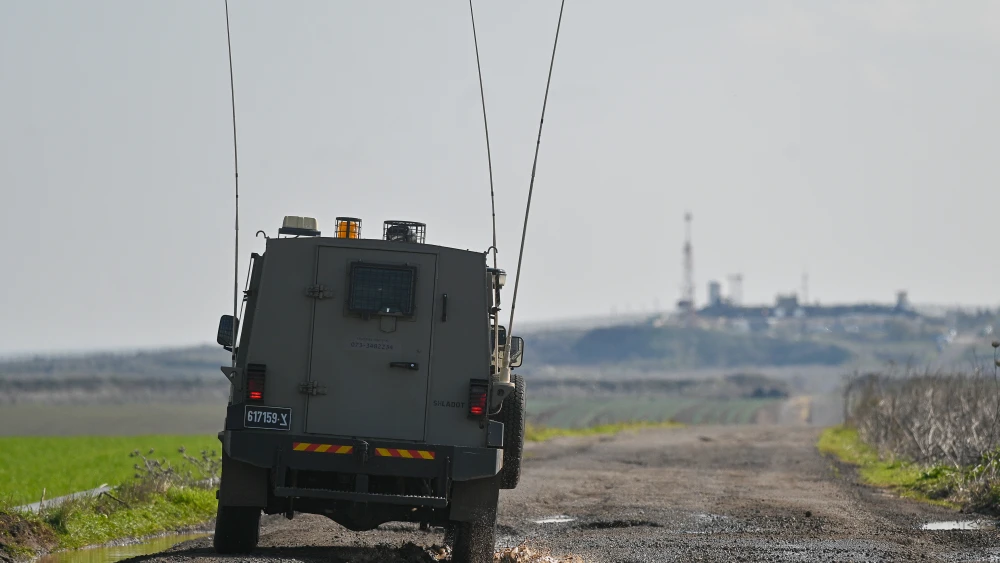
Early on Wednesday, the Syrian Arab Army reported that the Israel Defense Forces fired a number of surface-to-surface missiles from the Golan Heights at military positions in Syria’s Quneitra region. There were no reports of injuries, but damage reports surfaced following the attack, which reportedly occurred at around 12:30 a.m. The incident looks like the latest reminder of Hezbollah’s ongoing program to entrench itself in southern Syria and prepare attacks against Israel from there.
A video that was recently obtained by an Israeli security watchdog provides a rare glimpse into that same program.
Earlier this month, the Alma Research and Education Center published a report on the video, which was recorded in 2017 by a Sunni Syrian opposition group named Jaysh al-Ababil after capturing a Hezbollah operative who commanded a terror cell.
In the video, the Syrian captive—Marwan Awad Al Jaber—goes into extraordinary detail in describing Hezbollah’s activities in southern Syria.
“The video recording is a rare and live testimony, shedding additional light on the activities of Hezbollah’s Golan File Unit against Israel from southern Syria,” said the report, referring to the name of the Iranian-backed organization’s ongoing attempts to recruit operatives in southern Syria and assign them missions to spy on Israel and prepare cross-border attacks.
“Even now, Hezbollah’s Golan File Unit gathers intelligence and waits for an operational opportunity to generate terrorist activity against Israel under Hezbollah’s order,” the report cautioned.
Tal Beeri, head of Alma’s Research Department, told JNS that southern Syria is crowded with multiple attempts by the radical Shi’ite axis to entrench itself—efforts that include the Golan File Unit and Iran’s own efforts to set up a terrorist infrastructure in the Syrian Golan.
For many of the recruits, he said, particularly Sunni Syrians who have no ideological attachments to Hezbollah or Iran, “money is a central motivation. They earn hundreds of dollars per month doing this—far more than average incomes in the area.”
The Syrian rebel force that captured the Hezbollah operative is no longer in control of the area, following the summer 2018 recapture of southern Syria by forces associated with the Bashar Assad Syrian regime and backed by Iranian proxies.
Al-Jaber and his cell were both captured by the rebel group, and in his recorded testimony, he spoke of his Lebanese Shi’ite commanders.
“The advantage of recruiting local residents is that they are part of the territory,” said Beeri. “They were born and grew up in this area. This is a unit made up of locals.”
Central missions included gathering intelligence on Israel Defense Forces’ activity across the border and preparing minefields, as well as anti-tank missile ambushes, rocket launchers, mortar launchers, cross-border infiltration plots and attempted kidnappings.
“They are working all of the time, and they are deployed across southern Syria,” said Beeri. “We have exposed 30 such sites where Golan File cells are active. Every operative has his own ‘area manager,’ who in turn works with their own manager. Above that is a Hezbollah member. These cells can launch an attack at any time. They are planning attacks around the clock.”
‘Under the surface, constant activity is taking place’
In 2019, the IDF exposed the head of the Golan File Unit, naming him as senior Lebanese Hezbollah operative Ali Mussa Abbas Daqduq.
Daqduq had gained rich military experience in Iraq, where he was previously sent to set up attack cells against the U.S. military there.
While the extent of Israel’s activity against this threat is not fully known, Beeri assessed that when reports of local Syrians killed by UAV or sniper fire surface, it’s safe to assume that they formed a “clear and present danger and were about to conduct an attack on Israel.”
In any future escalation, he warned, they will be activated.
“The quiet in this area is deceptive. Under the surface, constant activity is taking place. This is a region that can go from zero to 100 in a second,” said Beeri.
The fate of Al Jaber remains unknown to this day.
Jaysh al-Ababil—once a dominant force in south Syria—was affiliated with the Free Syrian Army, a former nemesis of the Shi’ite Iran-led axis.
“For them, it was a big honor to thwart Hezbollah activities,” said Beeri.
“It sheds light on activity that has been going on in southern Syria since 2014,” he added. “We don’t recall another instance of a live testimony like this from the Golan File.”