


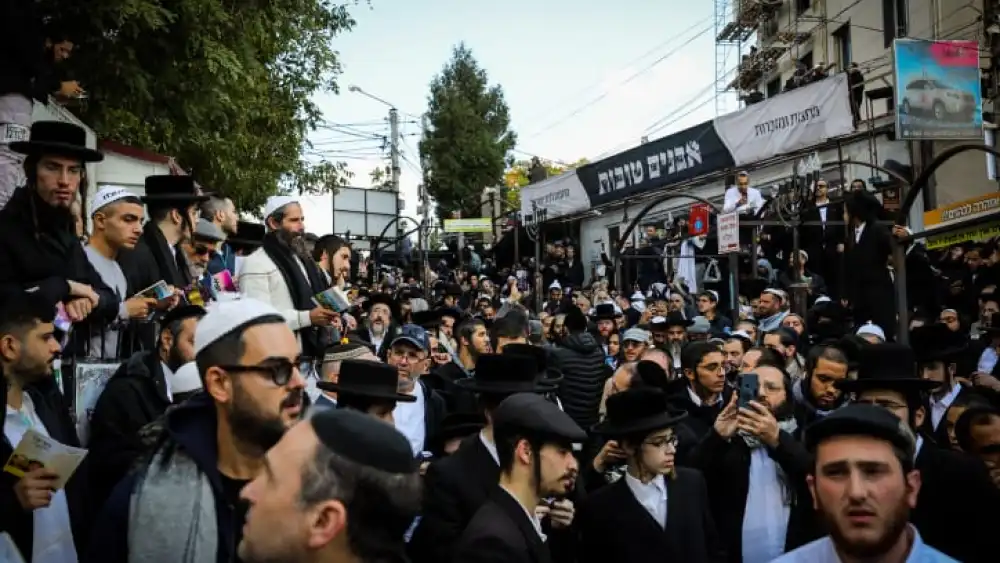
The gravesite complex of Rabbi Nachman of Breslov in Uman, Ukraine, is set for a major renovation project valued at over $2 million, the Breslov Union in Uman, which manages the site, announced on Sunday.
Work is scheduled to begin in the winter of 2026 on the 2,154 square yard complex, which has suffered from overcrowding and disruptions for decades.
Tens of thousands of worshippers customarily visit the site during Rosh Hashana. With annual upkeep that exceeds $800,000 and Rosh Hashana preparations that cost more than $350,000, the Breslov Union is preparing to launch a large fundraising campaign, according to Yeshiva World News.
Renovation plans include several major enhancements: a new women’s section that will provide a comfortable space for female visitors; creative solutions to allow kohanim (descendants of Jewish priests) to stay within the complex without concerns regarding ritual impurity; a designated dance hall so as not to disturb those in prayer; three separate prayer halls—one for Ashkenazi worshippers, a second for Sephardic worshippers and a third to be used as needed; new facilities offering light refreshments; and, for the first time, separate restrooms for women.
“Our goal is to enable every Jew to visit, focus on prayer without disturbance, and fulfill Rabbi Nachman’s teachings with peace of mind. We coordinated with relevant authorities and carefully ensured no harm would come to the other holy graves in the area,” Ynet News quoted a Breslav Union representative as saying.
“For many years we witnessed hardships and limitations faced by worshippers. This renovation is nothing short of a revolution,” said a veteran Breslav disciple, according to Ynet.
Uman, located some 125 miles south of Kyiv, has become in recent years a popular destination of pilgrimage for tens of thousands of observant Jews, who make the journey to pray at the tomb of the 18th-century luminary and founder of the Breslov Chassidic movement.
In July, the Ukrainian government announced the recognition of the tomb as a national heritage site, a decision that is expected to lead to increased security at the site for the safety of Jewish worshippers.
It followed a recent tightening of Ukrainian-Israeli relations, which have seen tensions mount since February 2022, when Russia invaded Ukraine.
Israeli Foreign Minister Gideon Sa’ar thanked the Ukrainian government for recognizing the site in Uman, during a joint press conference in Kyiv with his Ukrainian counterpart Andrii Sybiha in his recent visit to the European nation.
“Both Ukraine and Israel are going through difficult times, but our countries are strong, and the friendship between us is steadfast. We will continue to deepen it and support one another,” said Sa’ar.
In 2024, some 35,000 pilgrims flocked to Uman, Ukraine, despite official warnings urging travelers not to do so due to the ongoing Russia-Ukraine war, alongside other security concerns.
Speaking to pilgrims in Uman, AP quoted Nachman Shitrit, an 18-year-old Israeli from Haifa, who said, “The war here didn’t scare me from traveling to Ukraine; there’s also war where I came from.”



