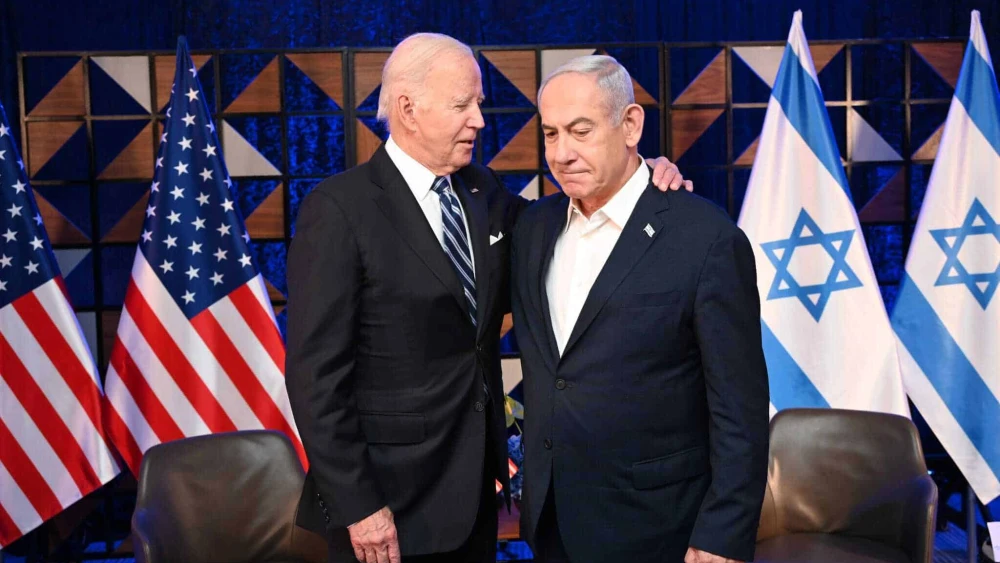
During his call on Sunday with U.S. President Joe Biden, Israeli Prime Minister Benjamin Netanyahu criticized the U.S. administration’s move to sanction four residents of Judea and Samaria over purported “settler violence,” Axios reported.
Netanyahu’s protest signaled his belief that the sanctions, allowing the imposition of penalties on Israeli officials directly or indirectly involved in vaguely defined “settler violence,” could have implications for the entire country, including the political and defense establishments, according to the report.
During the call, Netanyahu expressed displeasure that Biden had issued the executive order given the decrease in the number of attacks against Palestinians in Judea and Samaria. Data has shown that Israeli violence in Judea and Samaria has been dropping for some time; Israel’s former foreign minister Eli Cohen last month called reports of growing “settler violence” a “blood libel” and “a lie disconnected from reality.”
Netanyahu stressed to Biden that his government had taken serious steps to tackle the violence, including issuing several administrative detention orders against Israelis. The premier also noted that Israel’s Strategic Affairs Minister Ron Dermer has been tasked with preparing a list of requests for clarification from Washington about the executive order and its possible ramifications.
Last week, Netanyahu told visiting Secretary of State Antony Blinken that the executive order was “inappropriate” and “highly problematic,” Axios reported. In December, the top American diplomat had announced U.S. visa restrictions on Jews living beyond the Green Line, though those sanctioned were not named.
Biden’s executive order allows for sanctions on “persons undermining peace, security and stability in the West Bank,” citing “high levels of extremist settler violence, forced displacement of people and villages and property destruction.”
Adopting what it calls a “holistic approach” to the Middle East regional crisis, the White House named four sabras, or native-born Israelis, as targets for sanctions: David Chai Chasdai of Givat Ronen; Yinon Levi of Meitarim Farm; Einan Tanjil of Kiryat Ekron; and Shalom Zicherman of Mitzpe Yair.
In response, Netanyahu said that “the overwhelming majority of residents in Judea and Samaria are law-abiding citizens, many of whom are currently fighting—as conscripts and reservists—to defend Israel.”
His government “acts against all Israelis who break the law, everywhere. Exceptional measures are unnecessary,” added the premier.
On Monday, London followed Washington’s lead by announcing sanctions on four “Israeli settlers who have violently attacked Palestinians in the occupied West Bank.”
“Today’s sanctions place restrictions on those involved in some of the most egregious abuses of human rights,” said British Foreign Secretary David Cameron. “We should be clear about what is happening here. Extremist Israeli settlers are threatening Palestinians, often at gunpoint, and forcing them off land that is rightfully theirs. This behavior is illegal and unacceptable.”
Israeli National Security Minister Itamar Ben-Gvir and Finance Minister Bezalel Smotrich both slammed the U.K. announcement.
“The decree in question reveals a serious moral confusion,” said Ben-Gvir’s office, noting that “we have not heard of a decree issued by the British against thousands of Gaza residents who took part in the [Oct. 7] massacre, rape and looting of Jews.”
“We will not shy away from supporting these dedicated settlers, whose only sin is their refusal to submit to terrorism,” the statement added.
Smotrich told journalists at a faction meeting of his Religious Zionism Party that the British sanctions are part of a “combined American, European and Arab move” to end the war against Hamas in Gaza and force Jerusalem to agree to the establishment of a Palestinian state.