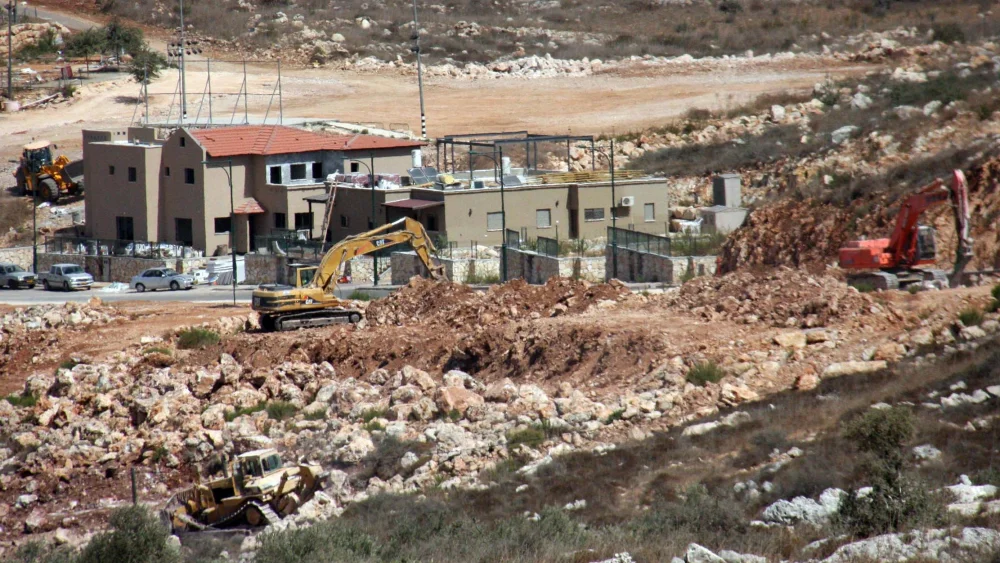
Australia on Wednesday morning imposed sanctions on four Israeli organizations and three individuals whom Australian Foreign Minister Penny Wong alleged are engaged in “illegal settlement expansion and human rights abuses against Palestinians” in Judea and Samaria.
The rationale behind the sanctions is to prevent actions that would extinguish the possibility of a two-state solution, the minister said in a statement.
The penalties on Australian citizens for violating the sanctions are up to 10 years’ imprisonment and a fine of up to A$910,000 (about $612,000), or three times the value of the relevant transaction. Australian businesses can be fined up to A$3.64 million (about $2.45 million), or three times the value of the relevant transaction.
The sanctions mark the first time Australia has targeted an Israeli construction firm, according to the statement.
It further read that “these measures [are taken] in coordination with international partners” and that “Together, we will continue to assess further action.”
The three individuals designated under Australia’s Autonomous Sanctions Regulations 2011 are Daniella Weiss, Itamar Yehuda Levi and Eliav Libi.
The four blacklisted organizations are Amana, the Nachala Movement, Hashomer Yosh and Eyal Hari Yehuda Company Ltd.
Weiss is a preeminent figure in the Israeli settlement movement. She is the former mayor of Kedumim in Samaria and is the founder of Nachala, a group that advocates the annexation of Judea and Samaria and the Gaza Strip.
Levi is the owner of the Eyal Hari Yehuda firm and is sanctioned by various countries. The Biden administration placed sanctions on him in 2024, which were revoked the following year by U.S. President Donald Trump.
Libi, co-owner of a construction company, helped fund the Farms Association aimed at formalizing Israeli agricultural farms in Judea and Samaria, according to Ynet. He is also sanctioned by the United Kingdom, New Zealand and Canada.
The individuals named in the Australian decision join seven other Israelis who were blacklisted by Australia in July 2024.
Australia’s Labor government had “imposed Magnitsky-style targeted financial sanctions and travel bans on seven Israeli individuals, and targeted financial sanctions on one entity, for involvement in settler violence against Palestinians,” said Wong at the time.
Wong added that her government “has been firm and consistent that Israeli settlements in the Occupied Palestinian Territories are illegal under international law and a significant obstacle to peace.”
Israel to push countermeasures against Britain
On Tuesday, Israeli Foreign Minister Gideon Sa’ar vowed countermeasures in response to additional sanctions announced by Britain’s Labour government, calling them “a hostile act targeting private, law-abiding companies.”
“Israel will not bow to external pressure or change its policies as a result,” Sa’ar wrote. He stated that Jerusalem would consider new ways to strengthen Jewish communities in Judea and Samaria and act to protect those involved in developing and building Israel, in accordance with government decisions.
“The Jewish people have the right to live in their historic homeland. The Jewish people’s historical rights in Judea and Samaria date back thousands of years and were recognized, inter alia, in the Balfour Declaration and the British Mandate,” he said.
Decisions would be announced “in due course,” he added.
Israel views with the utmost gravity the additional sanctions announced today by the British Labour government.
— Gideon Sa'ar | גדעון סער (@gidonsaar) November 17, 2026
This is a hostile act targeting private, law-abiding companies.
The Jewish people have the right to live in their historic homeland. The Jewish people’s historical…
On Tuesday, the United Kingdom imposed sanctions on eight Israeli construction and property development companies operating in Judea and Samaria, as well as on Tzav 9, an activist group accused of obstructing humanitarian aid deliveries to Gaza. The measures include asset freezes and director disqualifications.
British Foreign Secretary Ed Miliband said the measures were intended to help preserve a future two-state solution.
London said it aimed to disrupt financing for construction in Judea and Samaria, particularly ahead of tender deadlines associated with the E1 development project near Ma’ale Adumim. It maintains that construction there would undermine the territorial viability of a future Palestinian state.