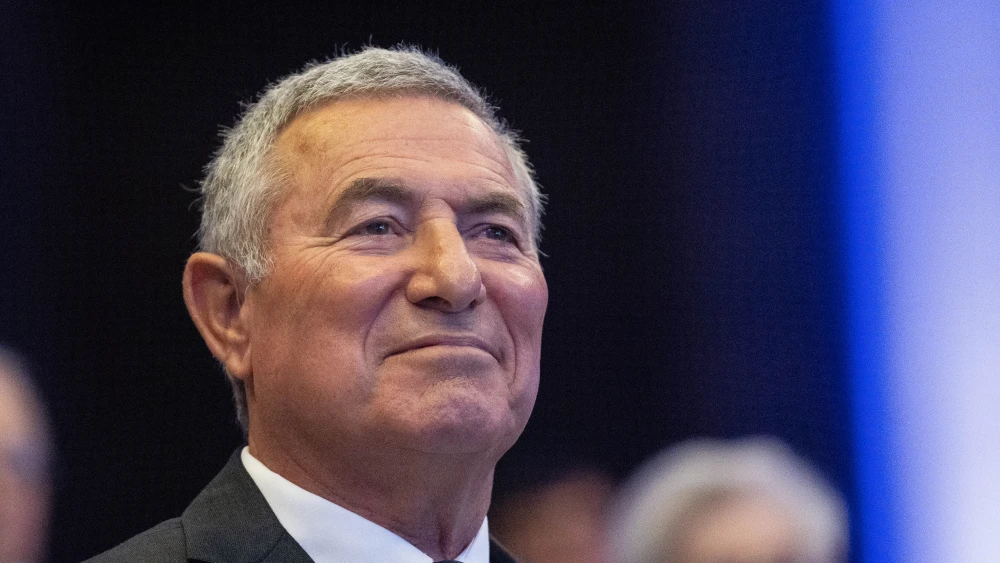
Sitting with his wife Didi in the lobby of the Waldorf Astoria Beverly Hills, Doron Almog refers to his son Eran, who died at 23 in 2007, as “the greatest teacher of my life.”
“He taught me more than anyone else—what is love, what is commitment,” Almog said.
The chairman of the Jewish Agency for Israel executive and his wife sat down with JNS in mid-February to discuss the new documentary “From Oct. 6 to Oct. 7,” which he said is about both his life and his family’s.
“Our tragedies,” he said, gesturing to Didi, and the “tragedies of the Jewish people.”
The film, which premiered in mid-February at an Israeli film festival at the Fine Arts Theatre in Beverly Hills, addresses the time period between the 1973 Yom Kippur War, when Almog was in his 20s, to the Hamas-led attacks on Oct. 7.
To Almog, the most poignant part of the film is when he is depicted teaching Eran, who was autistic, how to swim.
Someone at a gym told Almog that his son is “retarded” and shouldn’t be in the pool, Almog told JNS. It wasn’t the only time that he heard such comments about his son, who died from Castleman’s Disease, a rare disorder that involves enlarged lymph nodes, according to the Mayo Clinic.
Almog told JNS that he and his wife knew something was wrong soon after Eran was born, shortly after the Yom Kippur War.
The doctor who delivered the baby, who served with Almog in Entebbe, noticed that Eran had a “funny-looking face.” The baby didn’t react to movement, like clapping or snapping fingers, in front of his eyes and didn’t even blink, leading to initial speculation that he was deaf, Almog told JNS.
After several months of tests, a psychologist diagnosed Eran with autism and other developmental problems. The baby was “unable to do anything by himself” or to talk, and Almog had to divine what Eran wanted based on his “smiling” or nervous eyes, he told JNS.
He and his wife created a rehabilitation village in southern Israel, ADI Negev-Nahalat Eran, in their son’s honor, to integrate people with disabilities into the community. “The vision of building that village was integration and tikkun olam, loving the severely disabled,” Almog told JNS.
He and his wife learned that “these children were enveloped by walls of shame,” he said. “Parents didn’t want to speak about them.”
He told JNS that Eran helped ready him for his Jewish Agency role.
“He’s the one to be stigmatized and stereotyped—like Jews for 2,000 years in our beloved country,” he said.
Almog told JNS that he thinks of his son and others who are the weakest members of society, whether disabled, hostages or poor, before making decisions.
“He changed my life. He made me, for sure, more sensitive, a better human being,” Almog told JNS. “I miss him, and I thank him.”

‘Three journeys’
Almog told JNS that the film tells the “three journeys” of his life.
The first involves his brother Eran, who fought for the State of Israel and after whom he named his son.
He and his brother served during the Yom Kippur War, when the Jewish state was surprised as it was on Oct. 7, he told JNS. His mother was the first to tell him that his brother had been killed in battle.
Almog, a former major general in the Israeli military, did his own research and learned that his brother was left behind on the battlefield after being shot from a Syrian tank.
To this day, he feels guilty that he was not there for his brother. “He will continue shouting for assistance until my last day, my last minute on Earth,” Almog told JNS. “My military service became an oath to my bleeding brother. We never leave a wounded soldier behind.”
Raising and caring for his son was the second “journey,” and the third has been his role as Jewish Agency chair, since 2022.
Almog spoke with JNS shortly after he had visited Sydney and seen the site where terrorists killed 15 people after targeting a Chanukah celebration at Bondi Beach.
“We are living right now in a period where antisemitism is so high, the highest since the Second World War,” he said. “After the Yom Kippur War, antisemitism was also high, but not as high as it is now.”
“Now it’s another record of antisemitism,” he said.
His vision, in his role at the Jewish Agency, is that the world’s only Jewish state is a place for all Jews.
The agency aims to “strengthen the connection” with Jews outside of Israel, help Jews make aliyah and help Israel remain resilient despite the tragedies it has endured, Almog said.
The agency tends to go where Jews are suffering, according to Almog.
He said it was the first on the ground to evacuate Jews from Ukraine after Russia attacked, and it has helped evacuate tens of thousands from Ukraine and Russia.
It has also dispatched emissaries, including those whose relatives were hostages, worldwide to talk about the Jewish state’s tragedies on and after Oct. 7.
Two members of Almog’s family were killed in Kibbutz Kfar Aza during Oct. 7.
“The crisis is still very deep. Many unable to return back to their kibbutzim, to their communities,” he told JNS. “Many kibbutzim—no one’s returned yet.”
“It will take time,” he said. “We need to heal the wounds.”
The agency supports families impacted by Oct. 7 and is working to expand kibbutzim, including 1,000 new houses along the Gaza envelope, according to Almog.
“The Jewish Agency is the good heart of the Jewish people,” he told JNS. “Jews from all over the world in the wake of Oct. 7 decided to raise more money to come to volunteer, to come to support the State of Israel in this crisis.”