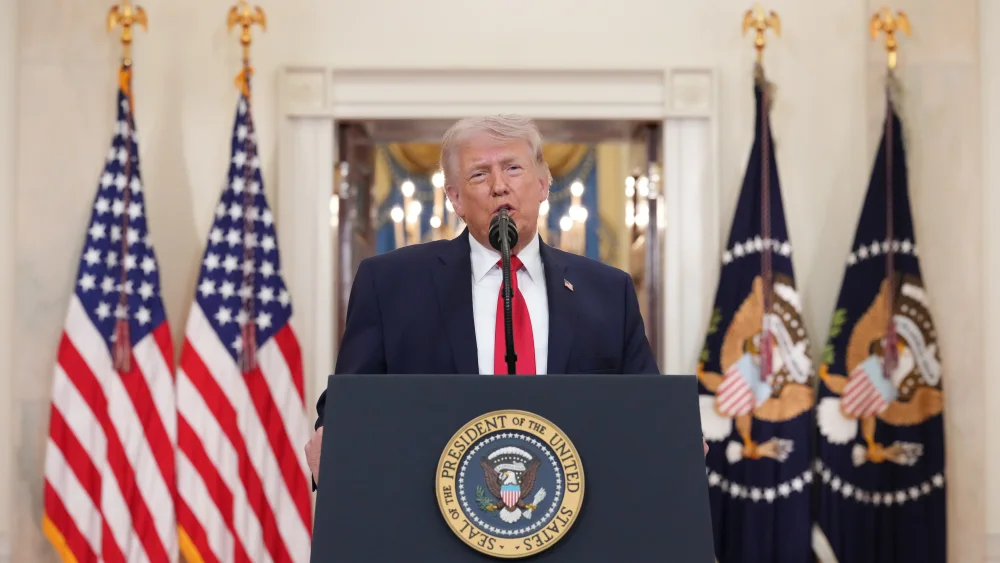
U.S. President Donald Trump warned on Friday that U.S. forces have not yet “started destroying what’s left in Iran,” vowing more attacks on critical infrastructure following airstrikes that destroyed the country’s tallest bridge.
In a post on Truth Social, Trump wrote, “Bridges next, then Electric Power Plants! New Regime leadership knows what has to be done, and has to be done, FAST!”
Trump on Thursday again urged Iran to “make a deal before it is too late,” after the strike on a major bridge connecting Tehran to the nearby city of Karaj.
“The biggest bridge in Iran comes tumbling down, never to be used again—much more to follow,” Trump wrote on Truth Social, sharing footage of the attack.
“It is time for Iran to make a deal before it is too late, and there is nothing left of what still could become a great country!” the president added.
Trump:
— Clash Report (@clashreport) April 2, 2026
The biggest bridge in Iran comes tumbling down, never to be used again — Much more to follow!
IT IS TIME FOR IRAN TO MAKE A DEAL BEFORE IT IS TOO LATE, AND THERE IS NOTHING LEFT OF WHAT STILL COULD BECOME A GREAT COUNTRY! pic.twitter.com/yHV3enL4Em
The B1 bridge, part of a central transit route between the western part of the Iranian capital and Karaj, is considered the tallest bridge in the Middle East, with a height of at least 446 feet.
In response, Iranian state media said that bridges across the region had become “legitimate targets” for the Islamic Republic. Outlets linked to the Islamic Revolutionary Guard Corps specifically mentioned the Arik Bridge on Route 87 in Israel, linking the Lower Galilee to the Golan Heights.
On Wednesday, Trump said that the U.S.-Israel military campaign against Iran could conclude within two to three weeks as the “core strategic objectives” are near completion.
“Never in the history of warfare has an enemy suffered such clear and devastating large-scale losses in a matter of weeks. Our enemies are losing and America, as it has been for five years under my presidency, is winning and now winning bigger than ever before,” Trump said in an address to the nation from the White House.
“We are going to hit them extremely hard over the next two to three weeks; we’re going to bring them back to the Stone Age, where they belong,” he vowed.
The president stressed that his administration did not seek regime change in Iran, but that has already transpired after its original leaders were killed.
He threatened that if an agreement is not reached, “we are going to hit each and every one of their electric generating plants very hard and probably simultaneously. We have not hit their oil, even though that’s the easiest target of all, because it would not give them even a small chance of survival or rebuilding. But we could hit it, and it would be gone, and there’s not a thing they can do about it.”