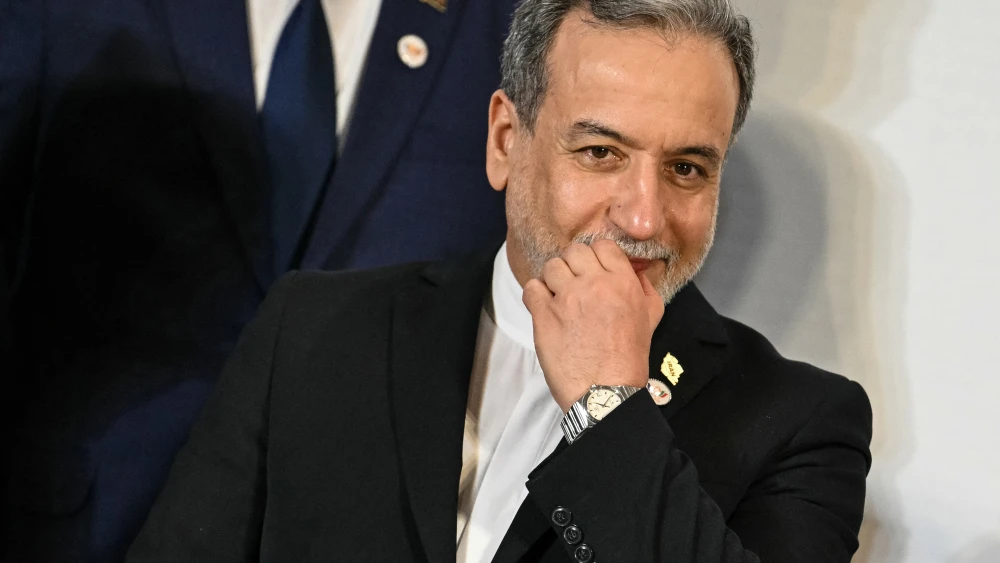
Iranian Foreign Minister Abbas Araghchi said on Tuesday that the memorandum of understanding Tehran signed with the United States necessitates a cessation of Israeli military operations in Lebanon.
“The end of the war in Lebanon is an inseparable part of complete end of the war,” Araghchi was quoted as saying by state media. “Without the withdrawal of Israeli forces from the territories they occupied during this war, the war has not fully come to an end.”
He warned that any Israel Defense Forces operations in Lebanon would be considered by Tehran as a violation of the deal with Washington.
In phone calls Monday with Lebanese President Joseph Aoun and Parliament Speaker Nabih Berri, who is aligned with Iranian-backed Hezbollah, Araghchi emphasized the need for a “complete cessation” of Israeli attacks across the region.
Aoun and Berri “expressed appreciation for the inclusion of provisions related to ending the war against Lebanon in the text of the memorandum,” reported the Tasnim News Agency, a semi-official outlet associated with the Islamic Revolutionary Guard Corps.
Hezbollah on Monday night fired “numerous rockets” toward IDF soldiers in Southern Lebanon, in violation of a separate ceasefire with Beirut.
The Israeli Air Force intercepted the projectiles and no air-raid sirens were activated in Israeli territory “in accordance with protocol,” the military stated.
Earlier on Monday, Hezbollah launched an anti-tank missile and mortar shells at troops operating in Southern Lebanon, according to the IDF. No injuries were reported in the attacks.
IDF soldiers on Monday also “identified a number of terrorists traveling in vehicles who approached IDF soldiers,” posing a direct threat to the troops. The IAF “carried out precise strikes on all of the threats,” it said.
The military vowed to “continue to operate to remove any immediate threat” emanating from Lebanon.
Jerusalem’s policy is for the IDF to remain in security zones across Lebanon, Syria and Gaza “indefinitely” to protect Israeli border communities, Israeli Defense Minister Israel Katz said earlier on Monday, after Tehran sought to tie the U.S.-Iran MoU to Hezbollah.
Katz said that Israeli Prime Minister Benjamin Netanyahu and he were “leading a clear policy” under which the military presence would be maintained in Southern Lebanon.
The defense minister said the zones would be “cleared of local residents” and that “all terrorist infrastructure, above and below ground” would be dismantled. He added that this would include the destruction of houses in border villages that had been used as terror outposts.