


“I think social media pulls people apart. And I think AI brings [people] closer,” Arab-Israeli vlogger Nas Daily told JNS last week. “Social media shows you what you want to see. AI tells you the truth.”
Nuseir Yassin, known professionally as Nas Daily, was among the speakers at EDUNATION Jerusalem, billed as Israel’s first international education conference, held Nov. 9-10 at the International Convention Center in the capital.
Organized by the Jerusalem Municipality with support from the Israeli Foreign Ministry, the two-day gathering brought together educators, academics, policymakers, technology experts and content creators from around the world to discuss the future of education.
Nas, who also appeared as a TEDxJerusalem speaker, was born and raised in the Arab town of Arraba in northern Israel. A Harvard University graduate, he left his job as a software developer in 2016 to travel the world, documenting his experiences through one-minute videos published daily for 1,000 consecutive days.
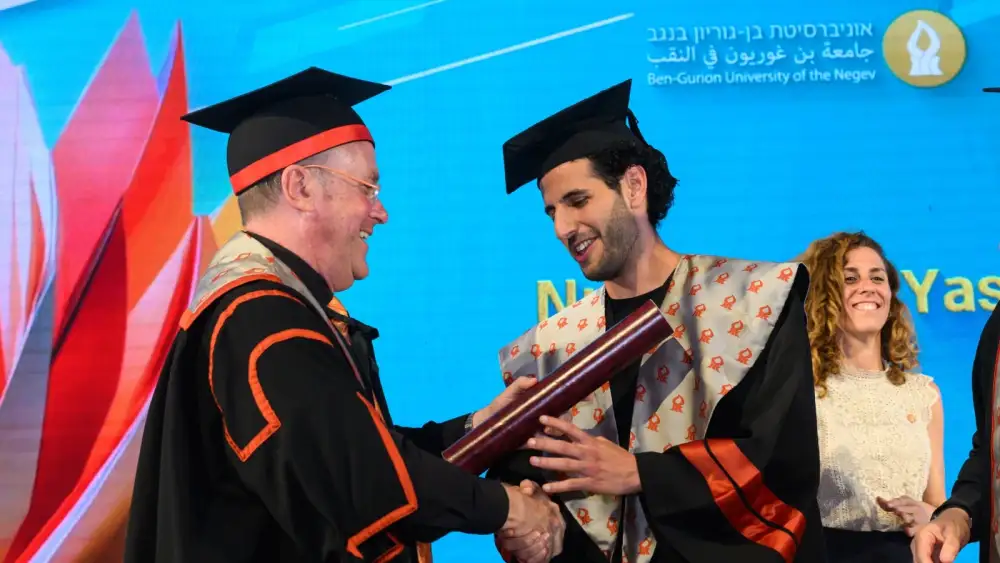
His project evolved into Nas Company, encompassing ventures in media, education and technology. In 2025, he received an honorary doctorate from Ben-Gurion University of the Negev in recognition of his work to promote Israeli-Palestinian coexistence.
Nas, who has amassed an estimated 68 million followers across social media platforms, maintained that AI could help overcome divisions.
“The reason I’m excited for the next 10 years is that AI will reduce polarization. We [will] have a shared version of the truth,” he said.
He argued that social media algorithms reinforce content based on user engagement, regardless of its accuracy, while AI has the potential to challenge misinformation.
“AI will actually say you’re wrong,” he told JNS.
Preparing students for an uncertain future
Nas’s prediction comes as educators debate whether AI and emerging technologies will promote greater understanding or deepen existing divisions.
The conference examined how education systems can prepare young people for a world increasingly shaped by technological advances, social change and security challenges.
Its program centered on two themes: EduHuman, focusing on students, teachers and communities, and EduSystem, examining the policies, infrastructure and technologies needed to address future educational challenges.
Discussions covered AI in classrooms, social media algorithms, the changing role of teachers, education during crises, identity and pluralism.
Speakers included Harvard education lecturer Noah Heller, former Israeli Education Minister Prof. Yuli Tamir and Ivo Visak, CEO of Estonia’s AI Leap Foundation, alongside education ministers and senior officials from around the world.
The program also featured an educational innovation exhibition, tours of Jerusalem’s educational initiatives and a TEDxJerusalem event titled “Growth in Uncertainty.”
Jerusalem Mayor Moshe Lion expressed hope that the gathering would become an annual tradition, saying in a municipal statement that the conference could foster “collaboration, mutual learning and growth.”
Ariela Rejwan, CEO of the Jerusalem Municipality, emphasized the lessons that could be drawn from the city’s diversity.
“We are like the microcosmos of the whole world in one city,” she told JNS.
Rejwan said students had endured five difficult years, beginning with the COVID-19 pandemic and followed by three years of war.
“So it’s like five years of really managing the city under a not really ideal situation,” she said.
She stressed the importance of recognizing students as individuals rather than focusing exclusively on academic achievements.
“We do not forget that inside all of this, there’s the individual,” Rejwan said.
‘Students who don’t feel safe will struggle to learn’
David Schapira, the California Department of Education’s chief deputy superintendent of public instruction and chief of staff, told JNS that following the COVID-19 pandemic, the state had implemented a program called Community Schools.
The initiative, he said, is “which is not so much about school as it is about community. And as it is about making sure that children are having their needs met where they are.”
The California Community Schools Partnership Program integrates academics, health and social services, youth development and family engagement.
Schapira said California was also exploring the integration of AI and technology in education.
“We’re talking a lot in California about education and technology, not just technology as a tool, but the way that technology is changing our society and our workforce,” he said.
Addressing division and polarization, Schapira told JNS, “We have so much more in common than the things that make us different.”
He also acknowledged failures to protect Jewish students.
“In many cases, we have found that the school did not do enough to protect the Jewish students on their campuses. And we have required them to implement corrective actions to ensure that the students on that campus are safe and feel safe,” he said.
Schapira compared the difficulties faced by Jewish students who feel unsafe to those experienced by children who are hungry or lack access to adequate health care.
“Students who don’t feel safe will struggle to learn,” he said.
California has faced mounting criticism over antisemitism in its schools, including complaints, lawsuits and investigations into alleged discrimination.
Udo Michallik, secretary-general of the Kultusministerkonferenz (KMK), the body coordinating Germany’s 16 state education, science and cultural ministers, also expressed concern.
“Antisemitism is growing and is developing like a virus. It’s developing different kinds of antisemitism,” he told JNS.
“Education is a foundation of combating antisemitism,” he added.
Fighting antisemitism beyond the classroom
While educators worldwide grapple with rising antisemitism, social media creators are developing their own approaches to combating prejudice outside the classroom.
Nas stressed the importance of normalization in his content.
“Maybe I just like to be contrarian,” he said, referring to his willingness to embrace terminology associated with Israeli identity and Zionism.
“Whatever word that people are scared of is my favorite word.”
“Normalization is my favorite sport. Zionism is my favorite word,” he added.
Aija Mayrock, a bestselling author and content creator, also uses her platform to challenge misconceptions about Jewish identity.
Her “Jews Around the World” series explores Jewish communities across the globe, highlighting communities that many viewers may not know exist.
Explaining her approach to reaching audiences unfamiliar with Jewish life, Mayrock told JNS, “You have to think: why do people that know nothing about this issue or my people care?”
She emphasized the importance of finding shared human experiences across cultures and religions, describing how creators can develop “very interesting storytelling that reaches people outside the echo chamber.”
Nas also described his Arab-Israeli identity through the metaphor of “burning the ships,” explaining that he views integration and coexistence as a commitment rather than a temporary arrangement.
“Like when you burn a ship, there’s no going back. There’s only a way forward. I think a lot of Arab-Israelis kind of had a ship—it’s not burned, so you want to integrate, but if it doesn’t work, you can always go back and become a Palestinian.”
“I’m just going to burn the ship. There’s only one way forward,” he said, emphasizing the need for Jewish and Arab Israelis to find a way to live together.


