
In every major conflict, the battle over memory begins almost as quickly as the battle itself. Facts remain the same, but the starting point of the story gradually shifts. Events are reordered, context is selectively applied, and responsibility is redistributed. What begins as an argument about history eventually becomes an argument about morality.
Since the Hamas massacre of Oct. 7, 2023, this process has unfolded with remarkable speed. The deadliest mass murder of Jews since the Holocaust initially shocked the world. Civilians were slaughtered in their homes, families were executed, children were murdered, and hundreds of hostages were dragged into Gaza. The brutality was documented by the perpetrators themselves. Yet as months passed, the defining event that triggered the current phase of the conflict increasingly receded from public discussion. In many political and media conversations, the narrative came to begin not with the massacre itself, but with Israel’s military response.
This shift is more significant than it appears. When the beginning of a story changes, so does its moral architecture. The focus moves from the perpetrators of violence to the conduct of those responding to it. The central question is no longer what happened on Oct. 7, but whether Israel’s reaction was proportionate, acceptable or justified. Legitimate debates about military strategy and civilian casualties become detached from the event that made those debates inevitable in the first place.
The consequences extend beyond the Israeli-Palestinian conflict. They shape how contemporary antisemitism is understood. Across parts of academia, activism and public discourse, antisemitic hostility is increasingly discussed as though it were primarily a reaction to Israeli policy. Such arguments overlook a historical reality that long predates the modern State of Israel.
Antisemitism survived kingdoms, empires, republics and revolutions. It flourished when Jews were stateless and when they possessed a state. Its forms evolved, but its underlying logic remained remarkably resilient.
None of this renders criticism of Israeli policy illegitimate. Democracies require criticism. The distinction lies elsewhere. A line is crossed when the right of Jewish self-determination is treated as uniquely suspect, when standards applied to Israel are not applied elsewhere, or when violence against Jews is routinely explained through context while violence committed in their defense is stripped of context altogether. At that point, political disagreement begins to intersect with a much older and darker tradition.
What is often overlooked is that this same pattern of selective moral framing has appeared in another struggle far removed from Gaza: the Iranian fight for freedom.
For many Iranians, the phenomenon is painfully familiar.
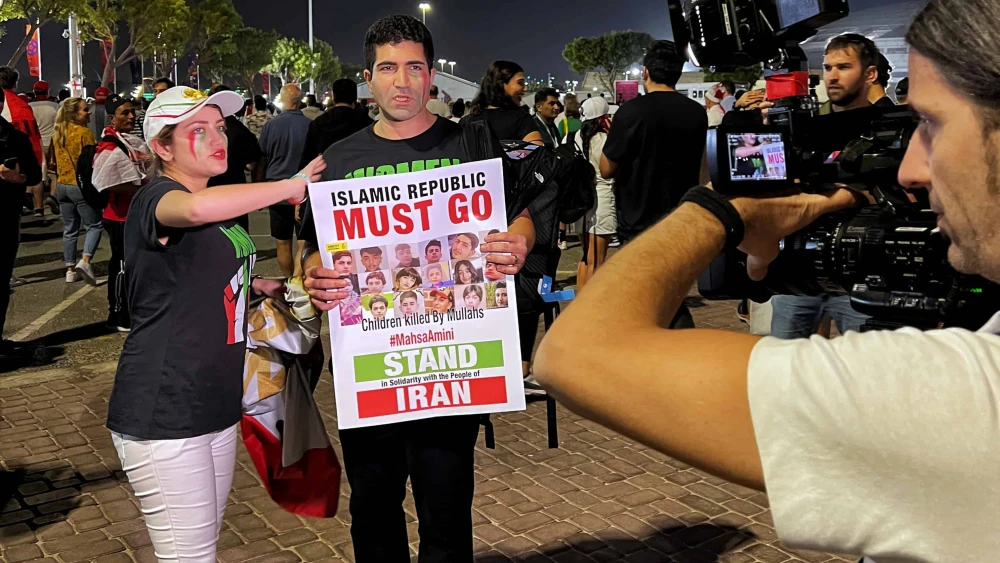
Over the past decade, millions of citizens have repeatedly challenged the Islamic Republic through nationwide uprisings—from the protests of 2017 and 2019 to the “Woman, Life, Freedom” movement that captured international attention in 2022. Their demands have been neither revolutionary nor extremist. They have asked for accountable government, individual liberty, national sovereignty and an end to clerical authoritarianism. The response of the state has been imprisonment, torture, executions and systematic repression.
Yet the Iranian democratic movement has often encountered a peculiar hesitation abroad. Support has frequently been filtered through ideological considerations unrelated to the aspirations of the protesters themselves. Rather than focusing on the victims of state violence, debates often shift toward the political identity of the opposition, the symbolism present at diaspora rallies or whether segments of the movement fit comfortably within prevailing activist frameworks. The result is a subtle but consequential inversion: the character of the victims receives greater scrutiny than the conduct of their oppressors.
The connection between these two cases is not political but methodological. In both instances, reality is filtered through ideological expectations. In both instances, solidarity becomes conditional. In both instances, foundational facts are displaced by secondary arguments. Oct. 7 is pushed to the margins of discussions about antisemitism. The brutality of the Islamic Republic is pushed to the margins of discussions about Iran. The victims remain visible, but only after passing through an increasingly complex set of political qualifications.
This pattern is particularly dangerous because it obscures a deeper reality. The Islamic Republic is not merely another authoritarian state. It is one of the principal sponsors of the very forces that have destabilized the Middle East for decades. The regime that imprisons Iranian women, executes dissidents and crushes democratic aspirations at home is also a patron of militant movements that reject coexistence, pluralism and peace. The ideological ecosystem that fuels regional extremism abroad is inseparable from the machinery of repression that operates inside Iran.
Seen from this perspective, the struggle against antisemitism and the struggle for a free Iran are not entirely separate questions. Both involve a broader contest between democratic societies and movements that reject liberal pluralism. Both reveal how easily moral clarity can be sacrificed when events are viewed through ideological lenses. And both demonstrate the dangers of confusing explanation with justification.
Historical integrity requires something remarkably simple: honesty about where a story begins.
Oct. 7 cannot be detached from any serious discussion of contemporary antisemitism. Nor can the conduct of the Islamic Republic be separated from any honest assessment of the Iranian freedom movement. When those realities are removed from the frame, analysis gradually gives way to narrative management, accountability becomes selective, and victims are transformed into subjects of suspicion.
The health of democratic discourse depends on resisting that temptation. It requires the willingness to confront terrorism without qualification, oppose antisemitism without excuses, and support democratic movements without ideological litmus tests. Above all, it requires the intellectual discipline to begin with reality rather than with the conclusions we hope reality will support.
The first casualty of ideological politics is often truth. The second is solidarity with those who need it most.