
The fear is palpable. Every week brings new horrors. Every conversation is dominated by one topic. British Jews are struggling to come to terms with what is happening on our streets, outside our synagogues and in the public discourse.
One thing we are not, however, is surprised. We have all watched as events have unfolded across recent years to bring us to this position, even if most of us never believed it would become this serious.
The massive surge in antisemitism in Britain has, in the past few weeks, exploded onto the streets with a violence and intensity I didn’t think was possible in this country.
The terror attack on a synagogue in Manchester last fall, which claimed two lives on Yom Kippur, was a heartbreaking moment for British Jews. But to me, this past month has felt more threatening as attacks have become more random, frequent and widespread.
I have been surrounded by elements of such hatred for years. As a reporter and editor for a decade at the Jewish Chronicle, I charted the ebb and flow of antisemitism. Back in 2008 and 2009, during and after the Israel Defense Forces’ “Operation Cast Lead” against Hamas in Gaza, a clear spike in antisemitic incidents occurred. After a while, the numbers dropped, and we moved on. The same thing happened in May 2021, after an 11-day round of fighting between Hamas terrorists and Israel, though that was directly felt among the college-age crowd. It was a precursor of things to come.
But Oct. 7 and its aftermath changed everything—statistically and in our daily lives.
The Community Security Trust, a nonprofit that works to keep Jews safe through physical security measures, as well as advocacy and government liaison, recorded 931 antisemitic incidents in 2009. Fast-forward to 2023, and that number hit more than 4,000. The British Jewish community is thought to currently number only around 300,000 people.
The past five weeks have seen a dramatic escalation. The arson attacks on the Hatzola volunteer ambulance service shocked all, Jews and non-Jewish allies alike. Waking to images of ambulances gutted by fire was devastating.
Ambulances, which represent the very symbol of caring, helping and a desire to preserve life, were charred to their shells. Almost everyone here has called Hatzola to help in a medical emergency; it is deeply embedded in British Jewish life. The doctors and paramedics are friends, neighbors and colleagues. When I was struck desperately ill with COVID four years ago, it was the flashing blue lights and siren of one of these ambulances under which I was rushed to the emergency room.
From that arson, the descent into further shock and fear has deepened. Attempted fire-bombings of synagogues have, miraculously, failed to wreak serious damage or cause injury.
This week has brought with it the stabbing of two Jewish men in Golders Green, the absolute heart of the British Jewish community, as the attacker strolled past a bus stop. A common, daily activity—waiting for a bus—turned into an attempt at murder. Thanks to CCTV camera footage, the scene streamed across social media by lunchtime.
I doubt there is a Jew in Britain today who does not wonder and fear what will be next. Or worse, who will be next?
While we are accustomed to heavy security around synagogues and communal buildings, and especially the often dramatic-looking measures at schools, until recently, kosher shops and restaurants have traded amid relative calm.
But now? The Community Security Trust is employing private security guards to patrol the streets around hubs of Jewish life—meaning a brief dash for Shabbat food or a coffee with a friend comes accompanied by burly, high-visibility, vest-wearing guards. It is a new daily reminder of lurking threats under which we live.
My only point of comparison is from a visit to Paris in the period after the mass shooting at the Charlie Hebdo magazine offices in January 2015. A visit to a synagogue there saw us met at the gates by two soldiers from the French Army, carrying semi-automatic weapons. Britain remains, thankfully, some way from that outcome. But aside from discussing plans to leave the country and a swelling in aliyah enquiries, we have become understandably fixated on the responses by authorities.
A week ago, British Prime Minister Keir Starmer put on his best compassionate face and visited the Kenton synagogue in northwest London, which was the target of an attempted arson. In terms of firm action, however, he continues to wring his hands.
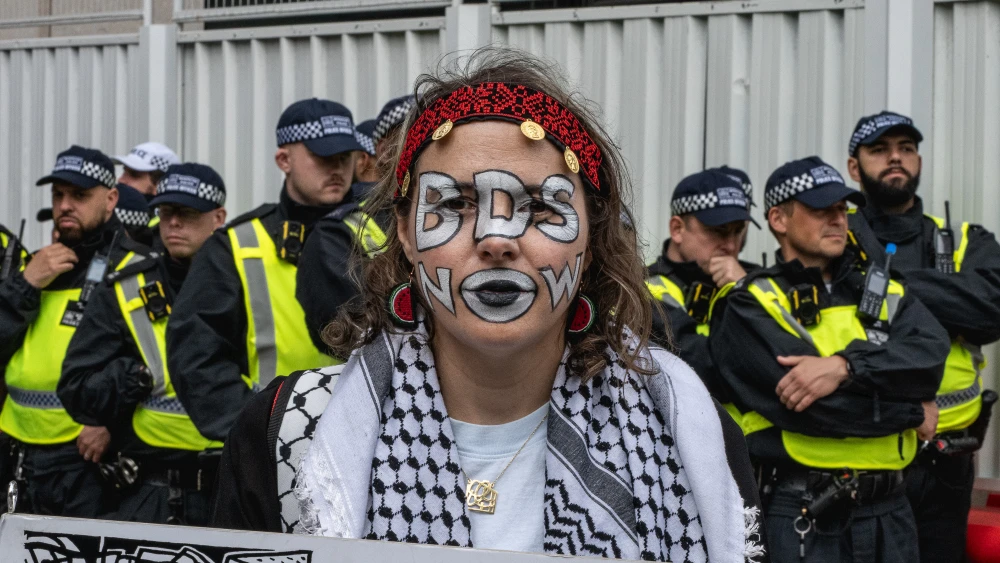
His government has done little to quash the mass anti-Israel marches that have overrun central London since 2023—so many of which have spilled over into outright Jew-hatred—or the “Free Palestine,” “Globalize the intifada,”
“Stop Killing Babies” and even more aggressive chants that have spurred so much of this current spate of attacks.
While he talks of “doing everything in our power to keep British Jews safe,” his government has yet to ban Iran’s Islamic Revolutionary Guards Corps (IRGC) as a terror group. The years-overdue legislation is unlikely to be brought in until May.
Communal anger with the Labour Party has been long-standing. But there is growing disgust with those on the fringes as well. Zack Polanski, the Jewish but self-proclaimed “certainly not a Zionist” leader of the Green Party, has regularly raised the community’s ire, not least last week when he was filmed questioning whether Jews felt “a perception of unsafety or whether it’s actual unsafety.”
Where does this all end, aside from more British Jews hurt or dead in the streets? The statistics, as well as the anecdotes, show that in the past, spikes in antisemitic activity were just that. Violence in the Middle East meant a rise in verbal, online and occasionally physical attacks here. We are well past that. The needle has moved too far. The rapid rise since Oct. 7 cannot and will not be reversed quickly or easily.
Culturally, politically and socially, the damage has been done. Tough legislation to deal with domestic and foreign-backed threats to the community is urgently needed, though it is too slowly forthcoming. A national conversation must be had on why Jews are the only minority against whom racism can be directed without the perpetrators being tackled in a meaningful way.
And in a further blow to so many of us, too many relationships with non-Jewish friends and colleagues have been trashed by the silence that has met our pain. We are not a people who forget, let alone during a time of need.
Ultimately, does this mean that Britain is no longer safe for Jews? It would break my heart to answer affirmatively. Still, the mountain of evidence piling up is leading many to reach their own conclusions. They are making their departure plans and packing their bags. For Britain and its Jewish community, it’s an outcome that is already a tragedy.