
Israel’s Central Elections Committee voted on Sept. 23 to bar all Arab parties from the Oct. 27 elections: the Joint List made up of the Hadash, Ta’al and Balad factions, and Mansour Abbas’s Ra’am. The decision still has to go to the Supreme Court, which is expected to overturn it because the legal threshold for disqualifying a party is very high. The court will also rule on the disqualification of some individual candidates, and there the outcome may be different.
About one-fifth of Israel’s population is Arab, but Arab citizens make up only around a sixth of the electorate, largely because most Arab residents of eastern Jerusalem are not citizens and cannot vote in Knesset elections. In the last election, a large share of Israeli-Arab votes went to Hadash-Ta’al and Balad, parties that reject Israel’s existence as the nation-state of the Jewish people. The question I keep asking is why Israel’s Arab citizens have this kind of representation.
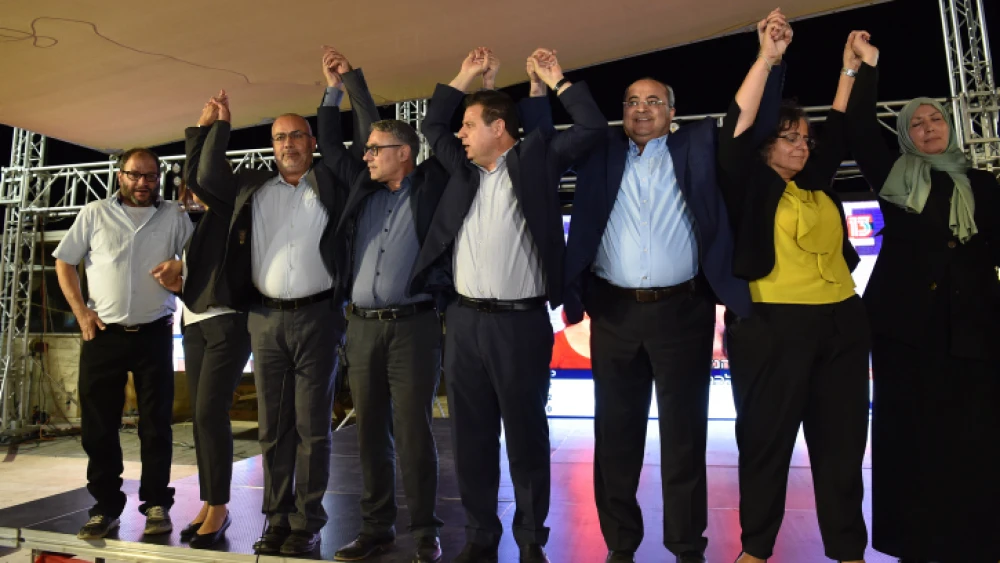
Let’s look at who is running: The Joint List is headed by Yousef Jabareen of Hadash, followed by Ahmad Tibi of Ta’al and Sami Abu Shehadeh of Balad.
Balad has long demanded that Israel become “a state of all its citizens,” instead of a Jewish state. In plain language, that means the end of Israel as we know it.
Abu Shehadeh is the target of one disqualification request. On Oct. 8, 2023, he published an article in Arabic calling the Hamas attack on Israel a historic event in military, political and strategic terms. He suggested that others could learn from how Hamas surprised Israel. Families were still waiting to hear whether their loved ones were still alive.
Today, Shehadeh says he was only analyzing the political consequences of the attack and would not have written it had he known the scale of the atrocities. But by then, all of Israel knew the scale of the slaughter and the kidnappings, with images broadcast around the world. Even if Abu Shehadeh was genuinely unaware of this, should a man so detached from reality be writing laws for the country?
Ahmad Tibi was an adviser to Yasser Arafat before entering the Knesset. Over almost three decades as a Knesset member, he has been above all a spokesman for the Palestinian Authority. Is this why he sits in the Knesset? Isn’t he supposed to represent the Arab citizens of Tayibe, Sakhnin and Rahat?
This is what bothers me most: Arab towns in Israel are living through a crime wave that takes hundreds of lives every year, and their residents’ daily concerns deserve far more attention from the people they elect. Yet their representatives spend most of their energy on Gaza, Judea and Samaria. Yoseph Haddad, a Christian Arab who grew up in Nazareth, put it well when he accused the Arab parties of looking to Ramallah instead of Nazareth and to Gaza instead of Rahat.
Ra’am’s case is different, but its record is not entirely clean. Its leader, Mansour Abbas, took his party into the Bennett-Lapid government in 2021, the first time that an independent Arab party joined a governing coalition. He also said openly that Israel was born a Jewish state and will stay one. This year, he added former Yesh Atid Knesset member Yoav Segalovitz, a former senior police official, as Ra’am’s first Jewish candidate.
Still, Ra’am grew out of the Southern Branch of the Islamic Movement; supports a Palestinian state; and remains a sectarian party that bargains with the state more than it identifies with it.
There is another side to the Arab community in Israel from which we rarely hear. These are the young men and women who serve in the IDF, work in every hospital in the country, and are pharmacists, engineers and business owners. On Oct. 7, some of them lost their lives. Many others made it clear which side they are on. But today, very few of them sit in the Knesset as members of Zionist parties.
Some are stepping forward anyway.
Yoseph Haddad is one of them. He was badly wounded as a Golani soldier in the Second Lebanon War and has since become one of Israel’s most effective advocates abroad. In August, he joined Ofer Winter’s People of Israel party as its number two candidate, saying he wants to be the next public diplomacy minister and the first Arab member of the security cabinet. Whatever one thinks of Winter, Haddad’s move is exactly what we need: an Arab citizen seeking power to strengthen the state, not weaken it.
He should not be alone. Mohammad Kabiya, a Bedouin Muslim who served in an Israeli Air Force search-and-rescue unit and remains an IDF reservist, has become one of Israel’s most outspoken defenders and a strong voice for Bedouin integration. Jonathan Elkhoury, a Christian whose family fled Lebanon for Israel in 2001 after his father’s South Lebanon Army unit collapsed, has spent years defending Israel on American campuses and encouraging Christians and Muslims to serve the state. People like them belong in realistic slots on the major party lists, and others should follow their example.
The party lists for this election are already registered, so here is my challenge to both Israel’s Arab citizens and to the Zionist parties: Next time, put forward candidates who talk about crime in Umm al-Fahm and jobs in Nazareth, and stand proudly under the Israeli flag. I am certain many Arab voters are waiting for exactly that.