Newsletter
Newsletter Support JNS

Senior Hamas delegation in Moscow for talks with Russian foreign minister

Hamas: “The Russian Foreign Ministry has requested that this visit last a few days. The purpose is to discuss the future of bilateral relations in order to aid the Palestinian cause.”

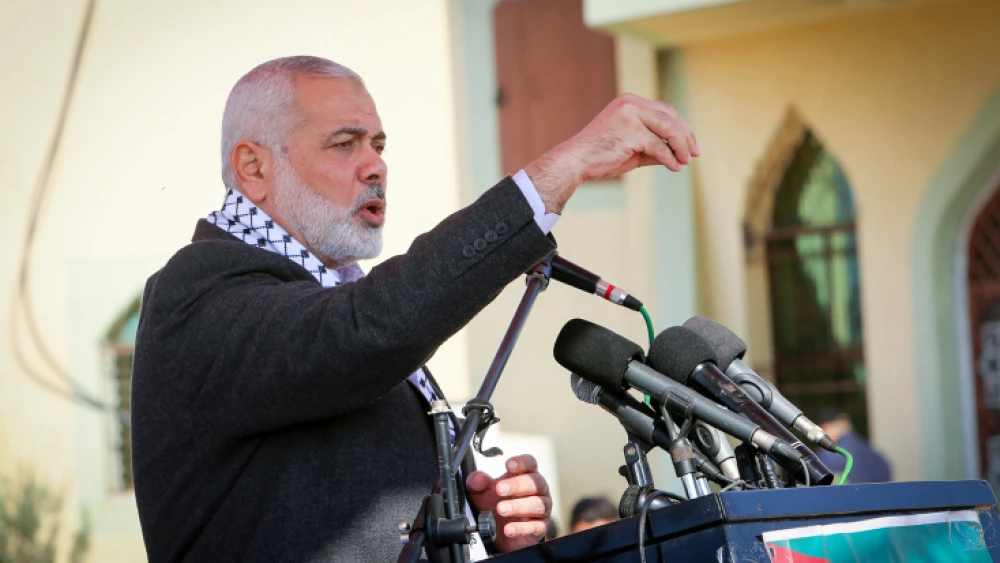
Hamas chief Ismail Haniyeh attends a groundbreaking ceremony for the Rafah Medical Complex in the southern Gaza Strip, Nov. 23, 2019. Photo by Abed Rahim Khatib/Flash90.

Hamas political bureau chairman Ismail Haniyeh arrived in Moscow on Saturday together with a senior delegation from the terror organization for talks with Russian officials.

The Hezbollah-affiliated Al-Mayadeen television channel, based in Beirut, cited a Hamas spokesperson as saying Haniyeh “has arrived in Moscow on a visit during which he wants to meet with Russian Foreign Minister Sergei Lavrov and a number of Russian leaders and officials.”

The Hamas delegation includes Saleh al-Arouri, the deputy head of Hamas’s political bureau, and who is responsible for orchestrating terrorism in the West Bank, as well as senior Hamas politburo members Moussa Abu Marzouk and Maher Salah.

“The Russian Foreign Ministry has requested that this visit last a few days. The purpose is to discuss the future of bilateral relations in order to aid the Palestinian cause,” the Hamas spokesperson added.

In May, Abu Marzouk, who is head of Hamas’s “International Relations Office,” visited Russia to discuss a number of issues.

Russia has in the past accused the West of being preoccupied with the situation in the Ukraine while ignoring Israeli actions in Gaza, using the Palestinian-Israeli conflict to distract from its war in Europe.

On September 5, the United Nations denounced as a violation of international law Hamas’s execution last week of five Palestinians in the Gaza Strip.

“We condemn the execution of five prisoners in Gaza and urge the de facto authorities in Gaza to establish a moratorium on all executions,” said Ravina Shamdasani, spokesperson for the U.N.’s human-rights commissioner, in a statement.

“Anti-Zionism can be a framework for justifying anti-Jewish hostility,” Rafaela Dancygier, of Princeton University, told the N.J. Advisory Committee to the U.S. Commission on Civil Rights.
A board member at the Orthodox synagogue told the FBI that members began attending services less frequently after Kevin Charles Pyles allegedly targeted the synagogue in separate July and August 2025 incidents.
The Senate rejected a resolution calling for the removal of U.S. forces from the war against Iran after U.S. President Donald Trump hammered Senate Republicans for approving a similar measure the day before.
“When someone uses the N-word on campus, no one thinks about free speech. No one talks about, ‘Let’s understand what they’re thinking. Let’s have a discussion,’” Rep. Randy Fine said. “But somehow when it came to Jews, everyone wanted to rediscover the idea of free speech.”
“Leadership should be responding with moral clarity, not suggesting that the act of teaching about the Holocaust has somehow ‘missed the mark,’” said Kurt Schwartz, CEO of CAMERA.
The judges said the sanctions, which the United States imposed in response to the Hague-based court’s targeting of Israel, are unlawful.
Benny Gantz, JNS editor-in-chief Jonathan S. Tobin, Gilad Erdan, Mosab Hassan Yousef, Nissim Black and leading voices in security, diplomacy, media, law and Jewish communal affairs headline the summit’s third day in Jerusalem.