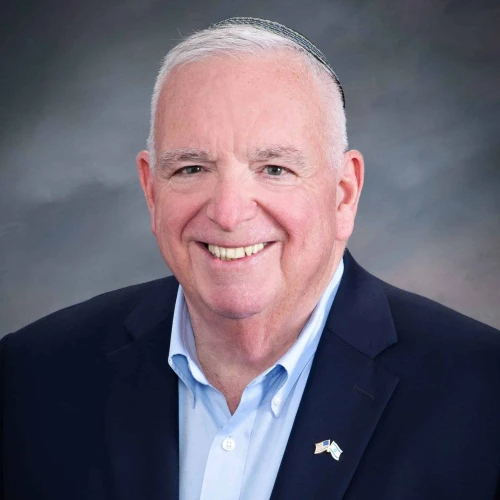
A 5,000-man strong Palestinian police force is expected to deploy to the Gaza Strip within 60 days, Ali Shaath, chief commissioner of the U.S.-backed National Committee for the Administration of Gaza (NCAG), announced on Thursday, as he addressed the Board of Peace.
The “professional civilian police” will be created “under one authority, one law and one weapon,” Shaath said in his remarks in Washington.
The police force, which reportedly already has 2,000 applicants, will fall under the auspices of the NCAG and train in Egypt. It will be responsible for disarming all armed groups in Gaza, including Hamas, Palestinian Islamic Jihad and other terrorist organizations.
Shaath, a former deputy minister in the Palestinian Authority, closely echoed remarks by P.A. chief Mahmoud Abbas, who has long insisted that arms in Gaza, Judea and Samaria be brought under Ramallah’s control under his principle of “one authority, one law, one gun.”
Israel, however, opposes any role for the P.A. in Gaza, due to Ramallah’s incessant support for terror against the Jewish state.
Shaath, who was seated in front of Israeli Foreign Minister Gideon Sa’ar during the Board of Peace meeting, wore a pin on his lapel with the flag of the Palestine Liberation Organization, long headed by Yasser Arafat, Abbas’s protégé.
“Thank you, President [Donald] Trump, for your leadership, for your continued efforts,” Shaath opened his remarks during the summit.
“A new governing authority is now in place for Gaza—with a clear mandate and a clear commitment to establishing development and stability,” Shaath declared, noting that his committee was operating in “extremely difficult conditions” following the two-year-long Gaza war.
‘This is a problem of peace,’ not money
Gaza High Representative Nickolay Mladenov, who spoke after Shaath, told the gathering that the police force will “allow us to ensure that all factions in Gaza are dismantled and all weapons are put under the control of one civilian authority.
“We now have a fully agreed framework,” Mladenov announced while publicly thanking Qatar, Egypt and Turkey “for their excellent support.”
He concluded by saying that “there is no other option except the full demilitarization and decommissioning of all weapons in Gaza for reconstruction to begin, and for people to have a new way of life.”
Yakir Gabay, an Israeli businessman who sits on the Gaza Executive Board, laid out plans to rebuild the Strip “for the next generations.”
In addition to initial temporary housing, the reconstruction plan seeks to develop infrastructure and permanent housing, including “modern schools and hospitals, manufacturing and agriculture, roads and trains, water and energy plants, logistic hubs, telecom, tech and data centers, sports and leisure facilities, seaports and an airport,” Gabay said.
Marc Jeffrey Rowan, an American billionaire who sits on the Executive Board alongside Gabay, said reconstruction would start in the Strip’s southernmost city of Rafah, where 100,000 homes would be built for 500,000 people, in addition to $5 billion in infrastructure projects.
“Over time, 400,000 homes for the entirety of the population with more than $40 billion of infrastructure” will be built under the plan, he said.
“This is not a problem of money or collateral; this is a problem of peace,” he said, noting that Gaza’s coastline alone is worth $50 billion. “It just needs to be unlocked and financed,” Rowan added.
Speaking earlier at the summit, U.S. President Donald Trump said he believes Hamas will lay down its weapons under his plan, warning the terror organization will be “very harshly met” if they refuse to disarm.
In his remarks, Trump claimed that the Islamist terrorists told him that contrary to popular belief, “they don’t want to die.”
He also gave Hamas credit for returning the body of Israel Police Master Sgt. Ran Gvili, the last remaining hostage taken from Israel during the Hamas-led terrorist attacks on Oct. 7, 2023, whose remains were recovered by the Israeli military in late January.
The president stated that all countries that joined the Board of Peace, including the United States, had been “very generous with money.”
He said that Washington would be contributing $10 billion to the Board of Peace. Kazakhstan, Azerbaijan, UAE, Morocco, Bahrain, Qatar, Saudi Arabia, Uzbekistan and Kuwait pledged $7 billion for Gaza.
In addition to funding, some countries are also pledging personnel to help preserve the ceasefire, he said.
Indonesia, Morocco, Albania, Kosovo and Kazakhstan “all committed troops and police to stabilize Gaza,” according to the president, who noted that other nations like Egypt and Jordan, are also providing “substantial help” to create a “trustworthy” Gaza police force.