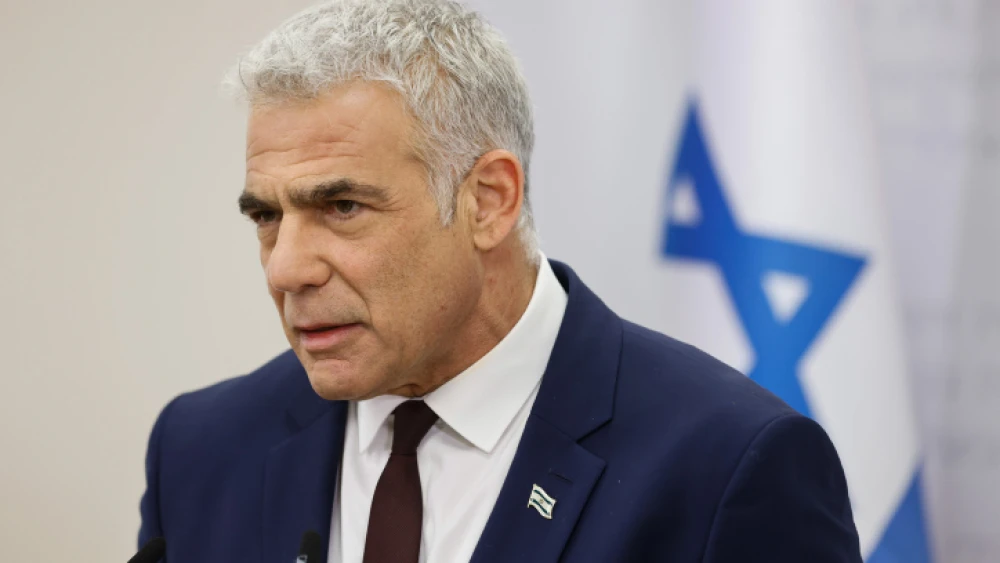
Israeli Foreign Minister Yair Lapid said on Monday that Israel would do “whatever we think is necessary” to ensure Iran does not become a nuclear threshold state.
Speaking at the Conference of Presidents of Major American Jewish Organizations in Jerusalem, Lapid questioned the Biden administration’s promise that it would seek a “longer and stronger” nuclear deal with Iran.
The current Israeli government has done a “good job” at restoring Israel as a bipartisan issue in American politics, said Lapid, and Israel is “working very well with this administration on many issues: the Abraham Accords, the economy, Syria, a lot of security issues.”
He acknowledged that Israel and the United States disagree on the 2015 Iran nuclear deal, known as the Joint Comprehensive Plan of Action (JCPOA), but said, “We disagree in a manner that helps us (A) work with them on the results of the disagreement, and (B) on other issues.”
A potential agreement would be “a weaker deal even if it is the same deal,” he said.
However, compared to the talks that led up to the JCPOA, he added, this time around Israel maintains a “dialogue with the American administration.”
One of the issues being discussed pertains to Iran’s Islamic Revolutionary Guards Corps, which Iran is requesting be delisted as a terror organization as part of the deal.
“We are talking to [the Americans] about this,” said Lapid. “I think everybody in his right mind should talk to the administration about this and say, ‘this is just wrong. Don’t do that.’”
“And besides,” he said, “we’ve maintained publicly our ability to say ‘you signed the agreement. We didn’t sign it.’ It doesn’t oblige us.”
Israeli Prime Minister Naftali Bennett told the same conference on Sunday that “Israel will not accept Iran as a nuclear threshold state.”