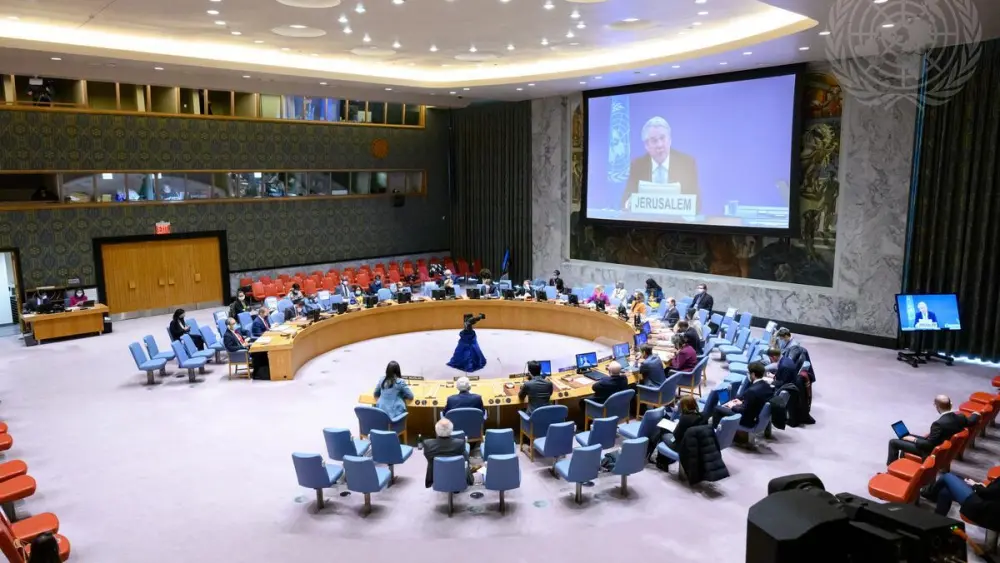
The United Nations Security Council was poised to vote on a resolution on the Israel-Hamas war as early as Monday, according to reports, even as negotiations over the language of the text continue.
The latest draft resolution obtained by Reuters calls for “an urgent and sustainable cessation of hostilities to allow safe and unhindered humanitarian access.”
The draft demands that aid be allowed to enter the Gaza Strip via land, sea and air, with its delivery monitored by the United Nations.
Agence France Presse reported on Monday that the text also calls for the “immediate and unconditional release of all hostages” and condemns “all indiscriminate attacks against civilians,” without explicitly mentioning Hamas.
It also reiterates backing for a two-state solution and “stresses the importance of unifying the Gaza Strip with the West Bank under the Palestinian Authority.”
Reuters reported that final negotiations over the resolution are ongoing primarily between the United States, which maintains veto power in the council, and the United Arab Emirates, which drafted the text.
“We have engaged constructively and transparently throughout the entire process in an effort to unite around a product that will pass,” an anonymous U.S. official was quoted as saying. “The UAE knows exactly what can pass and what cannot—it is up to them if they want to get this done.”
The United States is reportedly seeking to tone down the language calling for a ceasefire.
A Security Council resolution requires nine or more votes in favor to pass, and no vetoes by the United States, France, Britain, China or Russia.
Earlier this month, Washington vetoed a resolution demanding an immediate truce between Israel and the Palestinian terrorists in Gaza.
“I greatly appreciate the correct stance that the U.S. has taken in the U.N. Security Council,” said Israeli Prime Minister Benjamin Netanyahu after the vote.
“The other countries need to understand that, on the one hand, it is impossible to support the elimination of Hamas while on the other hand calling for a halt to the war, which will prevent the elimination of Hamas,” he added.
“Therefore, Israel will continue our just war to eliminate Hamas and achieve the other goals of the war that we have set,” said the premier.
U.S. Deputy Ambassador Robert Wood criticized the council after the vote as the resolution did not condemn Hamas’s Oct. 7 massacre of 1,200 people in Israel or the kidnapping of some 240 hostages by the terror group. It also did not acknowledge Israel’s right to self-defense.
Wood said the resolution was “divorced from reality” and would have “only plant[ed] the seeds for the next war.”
Thirteen members of 15-strong UNSC voted in favor of the resolution, while Britain abstained.
The Security Council had convened the emergency meeting to hear from Secretary-General Antonio Guterres, who had invoked Article 99 of the U.N. Charter, which allows the head of the international body to bring to the council’s attention issues that he perceives as a threat to international security.
Gaza is at “a breaking point,” Guterres said, adding that Hamas’s Oct. 7 slaughter “can never justify the collective punishment of the Palestinian people.”
In late October, Guterres told the Security Council that “it is important to also recognize the attacks by Hamas did not happen in a vacuum,” adding that “the Palestinian people have been subjected to 56 years of suffocating occupation.”
Israel’s government sharply criticized Guterres, with a Prime Minister’s Office spokesman telling the press, “I don’t think any U.N. secretary-general in history has gone so far to secure the survival of a terrorist organization.”
On Tuesday, the U.N. General Assembly passed a resolution calling for an immediate ceasefire in the war.
Out of the 193 members of the world body, 153 voted in favor of the measure, which is not legally binding. The United States joined Israel and eight other countries in opposing the resolution. There were 23 abstentions.
Also voting against the resolution were Austria, Czechia, Guatemala, Liberia, Micronesia, Nauru, Papua New Guinea and Paraguay.
The resolution made no mention of Hamas or the Oct. 7 massacre that triggered the war.