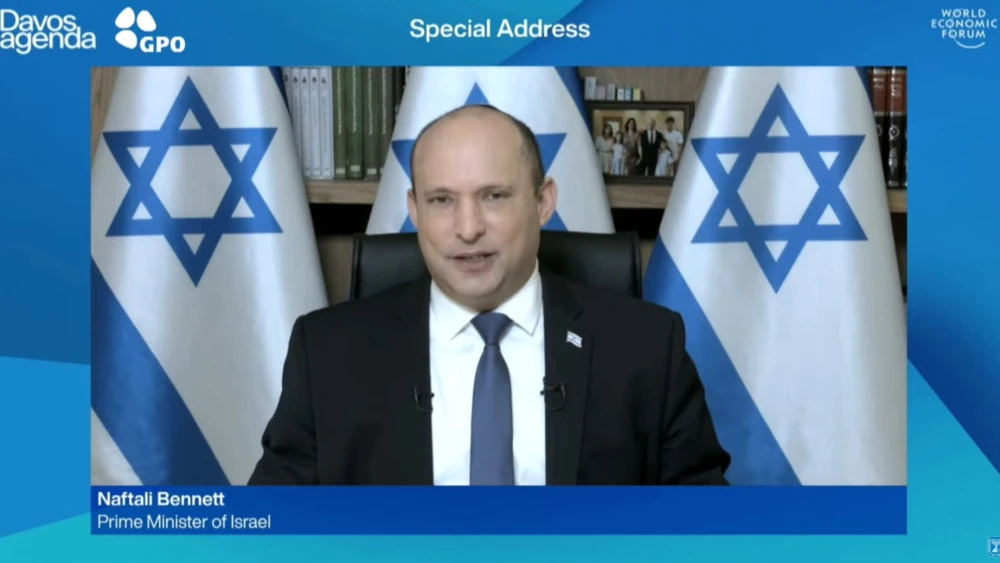
Israeli Prime Minister Naftali Bennett addressed the 2022 Davos World Economic Forum virtually on Tuesday, where he urged the international community to avoid financially supporting the Iranian regime.
“Iran is an octopus of terror and instability. Their head is in Tehran, and they send their arms all across the Middle East and get involved in Lebanon with Hezbollah in Iraq, in Syria, in Yemen with the Houthis,” Bennett told world leaders.
“The last thing you want to do with this sort of octopus is pour tens of billions of dollars into this apparatus. Because what will you get? You’ll get terror on steroids. Right? Everything we’ve seen will be doubled and tripled because they’ll be much stronger,” he said.
Noting his own extensive business background, Bennett said that “I’m a businessman. I came to age as a businessman in high-tech, etc. I would say that investing in Iran is not a sound investment, whether there’s a deal or not a deal.”
Bennett’s comment came as Iran and the P5+1 world powers (the United States, the United Kingdom, France, Russia, China and Germany) are engaged in talks to renew the 2015 Iran nuclear deal. Iran is looking for the United States to drop all of its sanctions enacted by the Trump administration after it pulled out of the deal in May 2018.
The Israeli leader also discussed the coronavirus and dealing with the Omicron strain, the Abraham Accords and the situation in the Middle East.
“My approach is to build bridges, build bridges in the region. And I think we’ve been doing that for the past few years,” said Bennett.
“We have a common foe in the region, and that’s Iran,” he continued. “We need reasonable-minded countries, that want to fight extreme Islam, collaborating. And I think more and more regional partners are coming to see Israel as an anchor of stability in a very tumultuous region, and not only in the security sense but also in economy.”