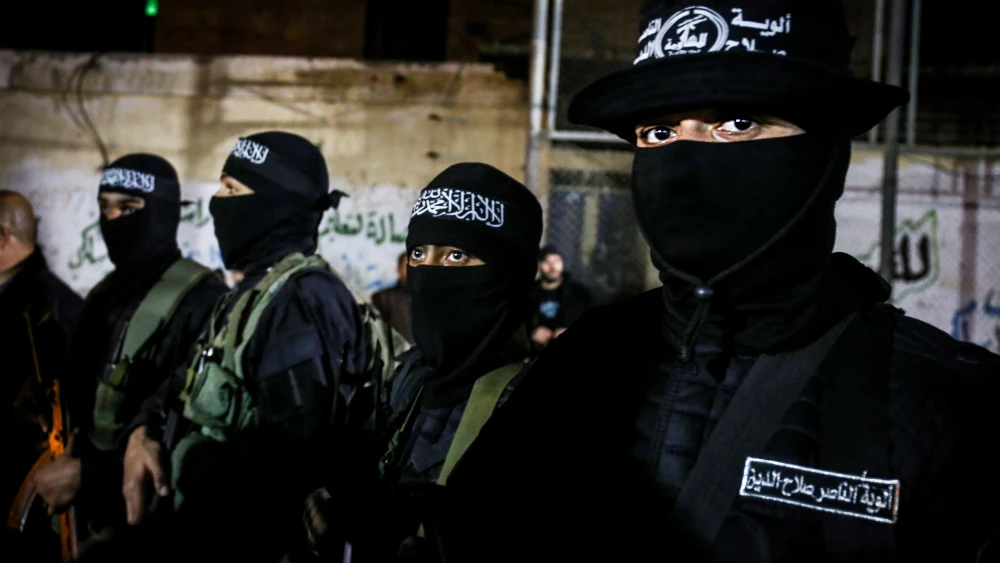

Three years after the Hamas-led Oct. 7, 2023, onslaught on Israel, Palestinian Islamic Jihad (PIJ), the second-largest terrorist organization in the Gaza Strip, is making one thing clear: It has no intention of abandoning its armed struggle against Israel.
On the contrary, the Iran-backed terrorist organization is reaffirming its commitment to jihad (holy war), armed resistance and the destruction of what it calls the “Zionist project.”
That message should be taken seriously by anyone hoping that the Gaza war can end with the disarmament of Hamas, PIJ and the other armed groups.
In statements marking the third anniversary of the Oct. 7 attack and the 39th anniversary of PIJ’s founding, the organization’s leaders did not speak about surrendering their weapons, dismantling their military infrastructure or transferring control of Gaza to a new Palestinian government.
Instead, they said they would keep fighting.
PIJ Secretary-General Ziad al-Nakhala declared that his organization would remain committed to “the path of jihad and resistance,” which would continue “by all possible means” as long as the “Zionist project” remains on supposedly Palestinian land. He also declared that the “unity of the resistance forces in Palestine and in the region” would remain in place.
Al-Nakhala went further, describing the Oct. 7 attack, which he called the “Battle of Al-Aqsa Flood,” as a “natural response” to what he described as Israeli aggression. He portrayed the conflict as a battle between one nation and one enemy—the “Zionist project and its allies.”
“The Battle of Al-Aqsa Flood came as a natural response to this ongoing aggression, and it was a natural extension of our people’s struggle and resistance against the Zionist project that uprooted us from our country, Palestine,” he said.
In other words, three years after Oct. 7, the Palestinian jihadis and their patrons in Tehran have not repudiated the attack. They have not apologized for the massacre of Israeli civilians. They have not apologized for bringing death and destruction on their own people.
Instead, they continue to celebrate Oct. 7 as part of a purportedly legitimate historical struggle.
PIJ’s anniversary statement was explicit: The organization said it would continue, alongside other “resistance forces,” on the path of jihad until it achieved what it calls its rights and had “liberated” its land. It described Israel as a “criminal Zionist entity.” Needless to say, PIJ, Hamas and the other terrorist groups in the Gaza Strip do not recognize Israel’s right to exist.
This is exactly the issue that must not be obscured by diplomatic language about ceasefires, peace plans and reconstruction. The question is not whether Hamas or the other Islamist terrorist groups will agree to a temporary pause in fighting. The real question is whether these organizations are prepared to abandon their weapons and their ideology of armed struggle.
The latest statements from the Islamist terrorists provide a clear answer: No.
PIJ proudly announced that more than 2,000 of its fighters had been killed in Gaza, dozens more in Judea and Samaria and more than 80 on the Lebanese front. According to the organization, its fighters fought alongside Hamas’s Izz ad-Din al-Qassam Brigades and other Palestinian factions.
This boast is particularly important because PIJ is not operating in isolation. The organization openly identifies itself as part of a wider regional “resistance” camp that includes Hamas, Hezbollah in Lebanon, the Houthis in Yemen and Iran.
The message is clear: The Iranian regime and its terror proxies in the Middle East have always seen the war against Israel as part of a broader regional confrontation. This premise should concern not only Israel but also the United States and other Western countries.
The PIJ statements also demonstrate the continuing influence of Iran. Given the history of Iranian funding, weapons and training for Hamas and PIJ, the continuing relationship between Tehran and these groups remains an important factor in evaluating their ability and willingness to abandon armed struggle.
U.S. Treasury Department assessments have for years documented Iranian state sponsorship of Hamas amounting to hundreds of millions of dollars. The Treasury Department has also identified Iranian funding, weapons and training for PIJ through the Islamic Revolutionary Guard Corps.
In its “2026 National Terrorist Financing Risk Assessment,” the Treasury Department reported: “Hamas continues to rely on global fundraising efforts, donations, hundreds of millions of dollars in state sponsorship from Iran, and abuse of sham charitable entities for revenue.”
Statements by the leaders of the Iranian regime and their terror proxies repeatedly refer to the United States as an ally of Israel and accuse the U.S. of complicity in Israel’s actions. The rhetoric of the Islamists does not portray the conflict as a narrowly Palestinian-Israeli dispute. It portrays Israel and its allies as a single enemy camp.
This distinction matters.
Those who believe that the conflict will end simply by persuading Hamas and PIJ to accept a new political arrangement in Gaza should listen carefully to what the terrorist groups themselves are saying.
Defeating Islamist terrorism cannot be treated as a short-term diplomatic exercise. No peace plan or diplomatic initiative will succeed so long as the Iran-backed terrorist organizations retain the ability to launch another Oct. 7 massacre.
Three years after Oct. 7, the international community should stop asking only what Israel intends to do next. It should ask what Hamas, PIJ and their Iranian patron intend to do next. The answer is already available. They keep reminding us: They intend to continue their jihad until the elimination of Israel.
Originally published by the Gatestone Institute and the Jerusalem Center for Security and Foreign Affairs.