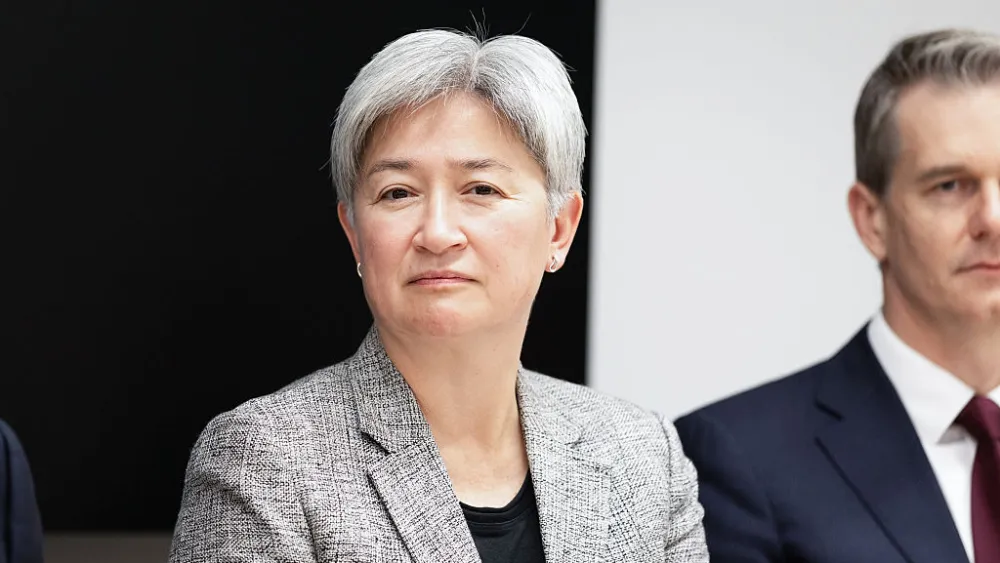

Australian Foreign Minister Penny Wong is back to condemning Israel, joining her counterparts from Canada, Italy and the United Kingdom in declaring that 150,000 tents and other essential supplies are being prevented from entering the Gaza Strip.
With winter storms flooding temporary shelters, the humanitarian need is undeniable. But before assigning blame, shouldn’t Wong establish precisely why those supplies have not entered?
Israel’s embassy in Canberra stated that more than 820 requests covering tens of thousands of trucks carrying winter supplies have been approved, but many shipments remain undelivered by the responsible organizations.
According to the United Nations, more than 150,000 tents remain outside Gaza, including approximately 117,000 in Egypt. It identifies Israeli restrictions, alongside logistical and funding difficulties, as contributing factors. Israel disputes its responsibility, saying more than 93,000 tents and 8,600 trucks carrying winter supplies have already entered Gaza.
How many of those 150,000 tents have been approved? How many remain restricted or await collection? These are questions Wong should be asking before issuing another condemnation.
Perhaps she has been following Formula One champion Lewis Hamilton’s visit to Egypt’s Rafah crossing. Hamilton drew attention to the walls separating Israel from Gaza. Yet Egypt has constructed substantial border fortifications, citing smuggling and security concerns.
Why does Egypt’s role escape comparable scrutiny?
If security barriers are sometimes legitimate, surely Israel, which endured two violent intifadas; suicide bombings on buses and in cafes, nightclubs and shopping centers; and the massacres of Oct. 7, 2023, is entitled to explain why it regards such barriers as an essential defense against terrorism.
The humanitarian consequences of Israel’s barrier are open to scrutiny, but its security rationale cannot simply be erased to suit a narrative.
Understanding history matters. So does understanding the statistics used to condemn Israel.
From Nov. 2-8, the United Nations reported that 262 trucks carrying humanitarian supplies for its agencies and partners, with 228 offloaded on the Israeli side of the Kerem Shalom crossing.
Meanwhile, the Next Century Foundation, citing the Palestinian Gaza Crossings and Borders Authority, recorded 1,149 trucks entering Gaza between Oct. 30 and Nov. 5: 808 commercial and 305 humanitarian—along with 36 fuel tankers.
The periods overlap but are not identical, and the figures measure different things. U.N. humanitarian logistics figures do not necessarily include commercial shipments or private deliveries.
She is entitled to criticize Israel. But criticism must be grounded in accurate evidence and applied consistently.
But why doesn’t Wong explain these distinctions? How much aid is reaching civilians, what remains undistributed, and how much, if any, has been diverted by Hamas? If Wong demands accountability from Israel, surely the same standard should apply to the Palestinian leadership Australia has recognized.
Indeed, which conditions attached to Australia’s recognition of “Palestine” has the Palestinian Authority actually fulfilled?
Australia recognized Palestinian statehood in September 2025, citing commitments to elections, governance reform, education reform and excluding Hamas from government.
Yet Palestinian elections scheduled for November 2026 have been postponed again. Mahmoud Abbas, now 91, elected president of the Palestinian Authority in 2005, remains in office more than two decades into what was originally a four-year term. Meanwhile, Israel held another Knesset election in October. Jewish and Arab Israelis alike exercised their democratic rights.
On Oct. 28, Australian Sen. James Paterson asked whether Australia would withdraw recognition if the Palestinian Authority continued failing to honor its commitments.
Wong’s answer? “No. We have recognized the state of Palestine.”
Officials clarified that further diplomatic steps were conditioned on reform, but recognition itself would not be reversed. Recognition was granted; elections were postponed; the consequences appear limited.
Wong insists that a two-state solution is the only path to peace. Yet Hamas’s founding charter called for Israel’s destruction, while its revised 2017 political document still refused to recognize Israel’s legitimacy. How does Wong propose lasting peace while Hamas remains armed and rejects Israel’s existence?
Questions about her judgment also extend to her own statements.
In September, she told the United Nations that 15,000 Palestinian children had been displaced by settler violence in Judea and Samaria during the first six months of 2026. Yet a U.N. figure cited in subsequent reporting was approximately 1,000 children displaced by settler violence during that period.
Before the Senate, Wong acknowledged the timeframe error, yet the published speech had not been visibly corrected.
The suffering of displaced children is real. But accuracy matters, particularly when a foreign minister presents a statistic without its correct timeframe or context.
A foreign minister’s words carry authority, and with that authority must come accountability. Verification is Wong’s responsibility before she speaks, not someone else’s burden afterwards, especially because misleading claims fuel hostility towards Israel and Jewish Australians when antisemitism is already a serious concern. Accountability begins with the person making the accusation, not the person forced to disprove it.
And if humanitarian concern guides Wong’s diplomacy, how consistently is it reflected in Australia’s priorities?
While Gaza dominates political discussion, Christian communities in Nigeria and the Democratic Republic of Congo face killings, abductions and attacks by armed extremist groups. Christians in Sudan also suffer persecution amid civil war. Muslims and other communities have likewise suffered atrocities.
Wong has condemned violence in Sudan. But why does the persecution of African Christians receive comparatively little prominence?
Where are the celebrity delegations, international campaigns and repeated demands for accountability? A Christian child murdered in Nigeria deserves the same concern as a Palestinian or Israeli child.
The provocative expression, “no Jews, no news,” comes to mind.
Wong is entitled to criticize Israel. But criticism must be grounded in accurate evidence and applied consistently. Otherwise, it risks crossing into antisemitism, particularly where it involves the double standards identified in the International Holocaust Remembrance Alliance (IHRA)’s working definition of antisemitism.
So, Wong should explain which Palestinian Authority reforms have been delivered, how Hamas will be disarmed, and why factual errors in official speeches are not promptly corrected.
A two-state solution requires accountable government, mutual recognition and credible security guarantees. Without these prerequisites, it becomes little more than a two-state delusion and perhaps the greatest diplomatic hoax of the 21st century.
Penny Wong demands accountability from Israel. Australians are entitled to demand precisely the same from their foreign minister.