Newsletter
Newsletter Support JNS

Jonathan S. Tobin is editor-in-chief of the Jewish News Syndicate, a senior contributor for The Federalist, a columnist for Newsweek and a contributor to many other publications. He covers the American political scene, foreign policy, the U.S.-Israel relationship, Middle East diplomacy, the Jewish world and the arts. He hosts the JNS “Think Twice” podcast, both the weekly video program and the “Jonathan Tobin Daily” program, which are available on all major audio platforms and YouTube. Previously, he was executive editor, then senior online editor and chief political blogger, for Commentary magazine. Before that, he was editor-in-chief of The Jewish Exponent in Philadelphia and editor of the Connecticut Jewish Ledger. He has won more than 60 awards for commentary, art criticism and other writing. He appears regularly on television, commenting on politics and foreign policy. Born in New York City, he studied history at Columbia University.

If there was any doubt about the need for Congress to pass the Israel Anti-Boycott Act, it was erased yesterday.
Was this proof that Israel has become yet one more issue on which Republicans and Democrats disagree?
Jews and Poles spent most of the first half of the 20th century at each other’s throats. Must they continue on the same destructive path as we head further into the 21st century?
Last Saturday was International Holocaust Remembrance Day. The problem is that so many of the mournful and resolute speeches and statements uttered by international leaders on Jan. 27 are so laden with hypocrisy that it is debatable whether we’d be better off without giving so many of those in Europe or at the United Nations who are actually uninterested in applying the lessons of the Holocaust an opportunity to parade their virtue.
The Pew Research Center’s latest poll about American attitudes towards Israel set off alarms—and not without reason. The survey showed the partisan gap with respect to Israel to be widening.
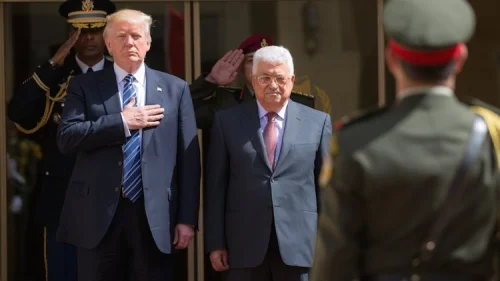
Reactions to Trump’s latest Middle East comments from liberal Americans as well as Europeans illustrated a dangerous trend. Rather than focus on Abbas’s foolish decision to burn his bridges with the U.S. and his rejection of peace, those damning Trump’s comments about being “disrespected” were essentially telling the Palestinians to ignore the American demands.
It is possible for Americans and Israelis to care about the treatment of immigrants without also insisting on amnesty for those who break laws that are neither unreasonable nor unfair. But that is a truth liberal ideologues choose not to comprehend.
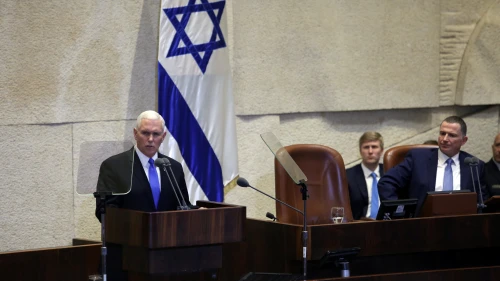
Most Israelis may have been thrilled with Vice President Mike Pence’s visit to Israel, but some Jewish liberals were decidedly nonplussed by his eloquent speech to the Knesset. While the left’s lack of enthusiasm for anything coming out of the Trump administration is to be expected, the attempt to denigrate Pence’s stance as somehow damaging the bipartisan pro-Israel consensus is more than a little disingenuous.
For those who can’t listen to anything coming out of this administration without re-interpreting it through the lens of the resistance, Pence’s moving comments about the ties between America and Israel may seem like a creepy conservative plot against liberal values. But if that’s how you heard it, the problem isn’t in Pence’s rhetoric, but in a rejection of a belief that the overwhelming majority of Americans still rightly view as a consensus issue.
Some in the so-called peace camp prefer to blame Palestinian misbehavior on President Donald Trump rather than own up to the truth about Palestinian Authority President Mahmoud Abbas.
Far from hurting the BDS movement, Israel’s new “blacklist” of boycott leaders banned from entering the country allows these enemies of the Jewish state to play martyrs and garner undeserved sympathy. Contrary to the fears of Israeli lawmakers, the real threat posed by BDS is to Jews in the Diaspora, not those in Israel, writes JNS Editor in Chief Jonathan S. Tobin.
You don’t have to be supporter of President Donald Trump to understand that he is right to demand that if the Palestinians want U.S. money they must, at the very least, come back to the negotiating table and cease funding and fomenting terror. It isn’t so much a case of “America First” to demand that recipients of U.S. largesse cooperate with U.S. policy, as it is one of common sense, writes JNS Editor in Chief Jonathan S. Tobin.