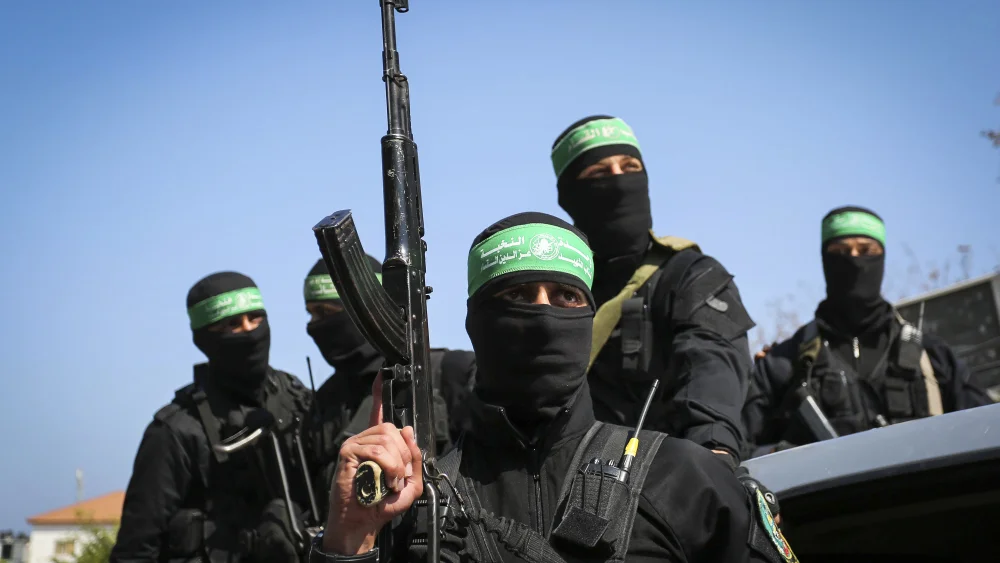
With the Jan. 19 ceasefire set to expire this Saturday, March 1, Hamas has taken a number of steps to prepare for the possibility of a return to fighting with Israel in the Gaza Strip.
The terrorist group has appointed new commanders, identified strategic spots to place its personnel and started repairing its tunnel network, according to Arab officials in contact with the group, The Wall Street Journal reported on Wednesday.
Hamas terrorists have also reworked unexploded ordnance into improvised explosive devices, scanned for Israeli listening devices and assigned terrorists to check for spies, according to the report.
It has also provided instructional leaflets to new recruits on how to fight a guerrilla war.
“Izz al-Din Haddad, Hamas’s military head in northern Gaza, met earlier this month with lieutenants to lay out how a renewed Israeli attack might unfold, warning that Israel would first move to retake a strategic corridor dividing the strip, the Arab officials said,” the Journal reported.
The preparations come as Israel and the United States are pushing Hamas to extend the current truce in Gaza and release more hostages before entering phase two negotiations.
Phase one of the deal temporarily stalled on Sunday when Israeli Prime Minister Benjamin Netanyahu announced he was pausing the release of Palestinian prisoners “in light of Hamas’s repeated violations [of the ceasefire], including the ceremonies that humiliate our hostages and the cynical exploitation of our hostages for propaganda purposes.”
The two sides reached an agreement on Tuesday night for the release of some 600 Palestinian prisoners in exchange for the remains of four Israelis.
Negotiations on the second phase of the ceasefire were to start in early February, but Israel delayed them, with American backing. The United States says it’s committed to reaching a truce but needs more time.
Hamas and Israel’s positions regarding stage two are far apart, with the terrorist group refusing to abandon the Strip and Israel demanding that it do so.
Israeli Brig. Gen (res.) Amir Avivi, head of the Israel Defense And Security Forum (IDSF), a group of more than 35,000 reserve officers focused on national security issues, told the Journal: “The government, the army, the U.S. administration, everyone is aligned with the idea that Hamas can’t stay and the Gaza Strip needs to be cleaned of weapons.”
Hamas is split internally, according to the report. Hard-liners want to remain a terrorist force while others accept the group will have to give up ruling Gaza, at least openly, if foreign funds are to flow toward reconstruction.
“The debate has become so intense that Hamas’s leadership based in Doha has considered breaking with the group’s cadres in Gaza,” the Journal reported, citing Arab intelligence officials and a Hamas official.
Although Hamas has been badly degraded by the year-long war with Israel, the Journal reported that it is reasserting control over civilian matters, with its forces controlling the delivery of humanitarian aid.
Israel says Hamas is taking those supplies for its members, selling whatever is left over to Gaza’s civilians at sky-high prices.