


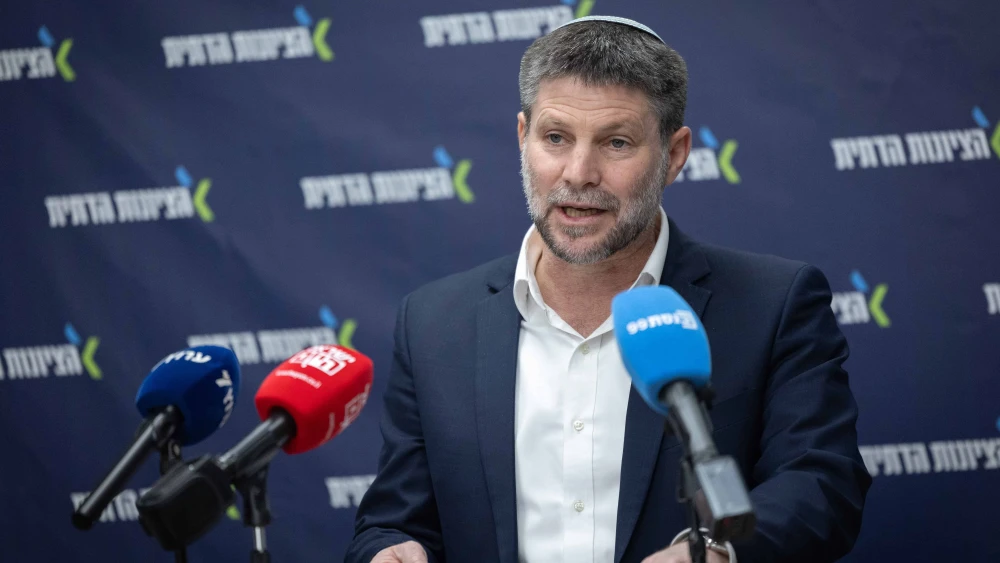
The Israel Defense Forces will “likely” need to intensify military operations in Southern Lebanon, Israeli Finance Minister Bezalel Smotrich told JNS on Monday.
“We are enforcing in Lebanon, without compromise, against any Hezbollah armament and any violation of the ceasefire,” Smotrich stated, speaking at a Knesset meeting of his Religious Zionism Party.
“It is likely that we will soon need to return and operate there to preserve the gains achieved against Hezbollah,” he continued.
“We will not allow Hezbollah to remain,” the minister vowed. “Residents of the north deserve to live in complete security in their communities,” with the Israel Defense Forces holding strategic positions beyond the border, he added.
“There will no longer be a situation in which towns are the front line and the IDF is behind them. The IDF will be the front protecting the communities, and the communities will be behind it.
“We will continue to strike Hezbollah and defeat it,” continued Smotrich, adding, “We will not repeat the mistakes of the past 20 years.”
The IDF overnight Monday carried out strikes against Hezbollah terrorist infrastructure across Southern Lebanon, the military said.
The targets included a compound used by Hezbollah’s Radwan Force to train operatives for attacks against Israeli civilians and soldiers. Trainees there conducted shooting drills and received instruction in the use of various weapons, according to the IDF.
Military structures and a launch site used by the Iranian-backed terror group to facilitate attacks on Israeli forces and the state were also hit, the army said.
The targets “constitute a violation of the understandings between Israel and Lebanon and a threat to the State of Israel,” the IDF said, adding that it “will continue to operate to remove any threat.”
Israeli forces recently dismantled a Hezbollah tunnel in the Houla area of Southern Lebanon, the military said on Sunday. IDF troops had located and neutralized the tunnel during the war, but had now fully dismantled it to prevent any future exploitation.
IDF soldiers also recently dismantled a Hezbollah weapons storage facility in Ayta ash-Shab.
Lebanese Prime Minister Nawaf Salam told Qatar’s Al Araby Television Network on Saturday that Beirut is seeking to disarm all groups in the country’s south, including Hezbollah, by the end of the year.
The terror group had “accepted the ceasefire agreement, which restricts weapons to the hands of state forces,” Salam told the channel. “We are committed to restricting weapons south of the Litani [River] by the end of the year, and in the remaining areas during the next year.”
Days earlier, Jerusalem and Beirut dispatched officials to talks in Lebanon as “a first attempt to create a basis for economic relations and cooperation,” the Israeli Prime Minister’s Office announced.
The Israeli representative, Uri Resnick, senior director for foreign policy at Jerusalem’s National Security Council, met in Naqoura with “relevant Lebanese civilian representatives” as well as Morgan Ortagus, the deputy U.S. special envoy to the Middle East.
The meeting came after the Israel Defense Forces warned on Dec. 2 that Hezbollah was rapidly rebuilding its capabilities despite ongoing airstrikes since a truce deal last year.
The ceasefire went into effect on Nov. 27, 2024, after more than a year of war that culminated in an intense two-month IDF campaign that decimated the Iranian proxy’s leadership. The agreement was finalized by the Israeli and Lebanese governments with the involvement of five mediating countries, including the United States.



