Israel on Wednesday launched its “Beresheet 2” project, the country’s second lunar mission. Israeli President Reuven Rivlin hosted the ceremony, which was joined online by schoolchildren, students and volunteers from six space centers around the country. Science and Technology Minister Izhar Shay, SpaceIL founder Kfir Damri and CEO Shimon Sarid, as well as Israel Aerospace Industries (IAI) CEO Boaz Levy, also participated in the event.
“Beresheet 2,” a joint initiative of SpaceIL, IAE and the Israel Space Agency at the Science and Technology Ministry, aims to launch three spacecraft—one orbiter and two landers—to the moon in approximately four years. Alongside its scientific missions and role in advancing international cooperation, an additional aim of the project is to “inspire the next generation of engineers, innovators and dreamers,” according to an official statement.
“We are setting out on a new path, familiar but different, at the end of which we hope to land three spacecraft safely on the moon. This project will extend the boundaries of human knowledge with groundbreaking scientific experiments, helping us to understand better the universe in which we live,” said Rivlin.

“Just a year-and-a-half ago, we were here together, when Israel held its breath and looked to the stars. We anxiously watched the ‘Beresheet’ spacecraft on its historic journey to the moon. We watched its long journey, were in wonder at the researchers and were filled with pride at the Israeli daring and ability that flourished right here and at the groundbreaking work of Space IL. We were disappointed and realized that we had to start once again from the beginning. Today, we are setting out on a new path, familiar but different, at the end of which we hope to land three spacecraft safely on the moon,” he added.
Israel’s first lunar probe, “Beresheet,” named after the first word and the first book of the Torah (meaning “in the beginning”), lifted off from Cape Canaveral on Feb. 21, but crash-landed on the lunar surface on April 11, 2019, at the end of its 6.5 million-kilometer (approximately 4 million-mile) journey.
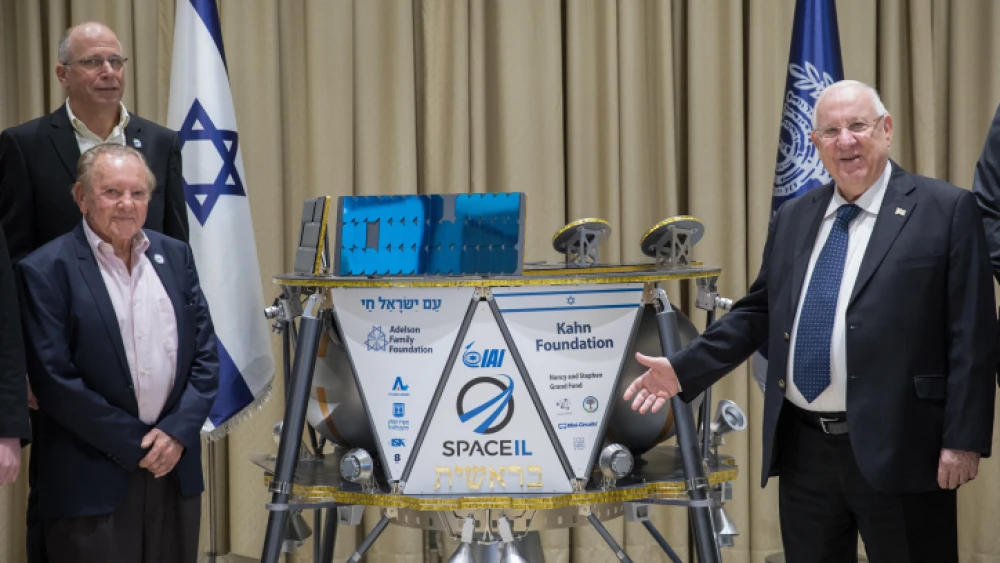
Science and Technology Minister Shay called the project “groundbreaking and inspiring,” and said that “the Ministry of Science and Technology and the Israeli Space Agency are proud to be partners in the second chapter of the mission.”
“We are pleased to announce that in conversations with the Israel Space Agency, seven countries from five continents have expressed an interest in participating in the project and that in conversations with the United Arab Emirates, the subject has been raised several times,” he said. “I have no doubt that ‘Beresheet’ will once again spark our imagination, redefining the boundaries of the possible and securing Israel’s status as a powerhouse of innovation.”