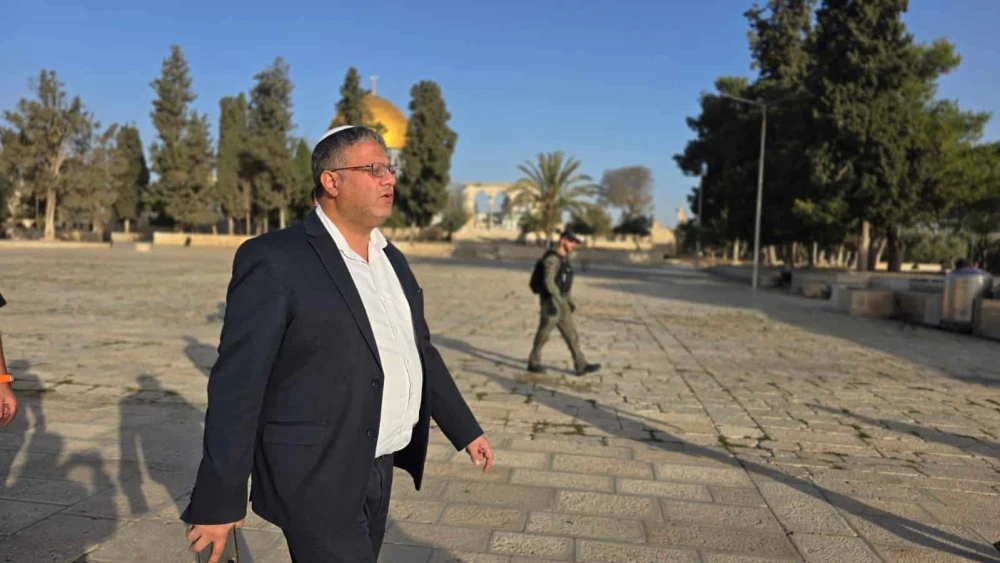
Israeli National Security Minister Itamar Ben-Gvir visited the Temple Mount in Jerusalem on Thursday morning to pray for Israel’s soldiers and the hostages in Gaza.
“This morning, I ascended to the site of our Holy Temple to pray for the safety of our soldiers, the swift return of all the hostages, and absolute victory, with God’s help,” the Otzma Yehudit Party leader tweeted.
עליתי הבוקר למקום מקדשנו, לתפילה לשלום חיילנו, להחזרת כל החטופים במהרה ולניצחון המוחלט בעזרת השם. pic.twitter.com/uSBQCk64aZ
— איתמר בן גביר (@itamarbengvir) December 26, 2024
The visit prompted the Prime Minister’s Office to clarify that “the status quo on the Temple Mount has not changed.”
Ben-Gvir last visited the Temple Mount in August, saying his policy was to allow Jewish prayer at Judaism’s holiest site.
“We are here on Tisha B’Av, at the Temple Mount, to commemorate the destruction of the Holy Temple. As I said—our policy is to allow prayer [here],” he said.
Fellow Otzma Yehudit Party member and Development of the Periphery, the Negev and the Galilee Minister Yitzhak Wasserlauf joined Ben-Gvir in August, along with hundreds of other Jewish worshippers. Dozens of pilgrims prostrated themselves in prayer, in violation of the status quo that forbids Jews from praying on the Temple Mount.
Foreign Affairs and Defense Committee member Amit Halevi of the Likud Party also visited the site on Tisha B’Av.
In June, Ben-Gvir said he intended to allow all Jews to openly pray at Judaism’s holiest site, changing the status quo that has existed there since 1967.
The status quo against Jewish prayer at the Temple Mount was never ratified in legislation. There have been various references to it over the years by all branches of government, but not in a way that grants it an independent legal status.
The Temple Mount is the holiest site in Judaism. It was historically home to the two Jewish Temples of antiquity—the first, known as Solomon’s Temple, was built in 957 BCE and destroyed by invading Babylonians in 586 BCE. The second, following the return of Jews from Babylonian exile, endured from 515 BCE until the Roman conquest of Jerusalem in 70 C.E.