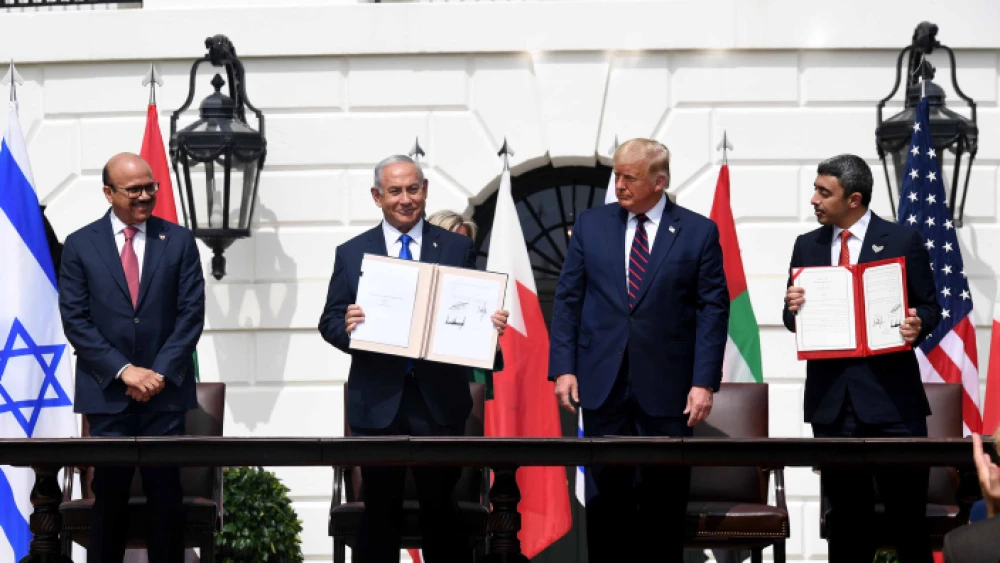
The Abraham Accords were one of the few foreign policy initiatives of the Donald Trump White House with broad bipartisan support.
On the second anniversary of the signing of Israeli normalization agreements with Bahrain and the United Arab Emirates, a number of congressional Democrats tell JNS they want to keep it that way.
“We’ve got to tie in what happened with the Accords and say that’s not enough. It’s a great first step. But we’ve got to bring this thing home,” Rep. David Trone (D-Md.), an Abraham Accords Congressional Caucus co-founder, told JNS.
“We have the same goals. We just want to go home, see our family, get our kids educated and live a safe life. Let’s get the politics out of it and see the commonalities that we all have from country to country. And that’s what’s going to build peace at the ground level. And that’s where it can be done, versus just the politicians getting lost,” the lawmaker continued.
Trone and Rep. Brad Schneider (D-Ill.) both point to recent bipartisan, bicameral support for the DEFEND Act, which aims to facilitate the development of a U.S.-led regional air defense alliance with Israel and a number of Arab states.
“I think the most important piece right now for [the Abraham Accords Congressional Caucus] is what’s happening with the DEFEND Act. We drove this. It’s in the NDAA (National Defense Authorization Act). It went through the House with 329 votes—very bipartisan. It needs to get through the Senate,” said Trone. “We can’t just sit here in the face of what we’re looking at with Iran.”
Trone said the caucus is balancing its efforts between strengthening the existing relationship between Israel and its new partners in the region and expanding the so-called circle of peace by facilitating additional normalization agreements.
“You hit the nail on the head with ‘balance.’ We’ve got to keep making it better, getting more connectivity between the existing countries. But expansion—maybe Saudi Arabia—that’s something we need to be working hard on. The more folks we can bring into it, the better off we’re going to be in dealing with the threat that’s out there with Iran,” said Trone.
Schneider said he and Republican members of the caucus are organizing an Abraham Accords congressional delegation to partner countries, likely to visit the region in February.
“We want to bring members of Congress to see for themselves, on the ground, the fruits of what is a historic agreement. To be able to go to Israel, to Bahrain, the UAE, Morocco and meet people who are benefiting from these accords, talk to those who are realizing those benefits and making sure that they last in the future—I think that’s something that would be good for all of my colleagues to experience,” Schneider told JNS.
One caucus member said he didn’t have to travel outside of his home district to see the benefit of the accords, one of which has been a burgeoning personal friendship.
“Through the Abraham Accords, I had the opportunity to meet with my favorite ambassador, Yousef Al Otaiba, who is an extraordinary public servant. And the UAE, which is an owner of the New York City Football Club, actually built a soccer field in the South Bronx, in the poorest congressional district in America,” Rep. Ritchie Torres (D-NY) said of the UAE ambassador to the U.S.
“Who would have thought that a peace agreement in the Middle East would lead to the creation of a soccer field in the South Bronx. It sends a powerful message that the Abraham Accords are creating friendships among the people we would least expect in the places we would least expect. It’s a beautiful thing to watch,” he said.