IDF Unit 8200, Israel’s signals intelligence agency, stopped listening to Hamas’s handheld radios a year ago, deciding it was a “waste of effort.” It was one of a series of failures that led to the shocking success of the terrorist group’s Oct. 7 invasion, The New York Times reported on Sunday.
Monitoring that network might have helped Ronen Bar, the director of the Israel Security Agency, or Shin Bet, realize at 3 a.m. on Oct. 7, a few hours before the attack, that the unusual activity he was seeing on the Gaza border wasn’t just another Hamas “military” exercise, the Times noted.
Israel’s military also placed its confidence in “The Barrier,” the nearly 40-mile-long concrete wall that plunges underground to prevent tunneling. It included a high-tech surveillance system that relies on cameras, sensors and remote-controlled machine guns.
“Senior Israeli military officials believed that the combination of remote surveillance and machine-gun systems with the formidable wall would make it almost impossible to infiltrate Israel, and thus reduce the need for a large number of soldiers to be stationed at the bases,” the newspaper reported.
Hamas’s attack put paid to the idea that concrete and technology could be relied on. The terrorists blew up cellular antennas and remote shooting systems along the fence with explosives precisely dropped from drones.
“In a conversation with military investigators two weeks after the attack, soldiers who survived the assault testified that the Hamas training was so precise that they damaged a row of cameras and communication systems so that ‘all our screens turned off in almost the exact same second,’” the Times reported.
There simply were not enough IDF soldiers to fill the gaps once the technology was destroyed and the security barrier breached. Hamas terrorists poured through.
“We started receiving messages that there was a raid on every reporting line,” one soldier at the Gaza Division base told an Israeli news site. “The forces did not have time to come and stop it. There were swarms of terrorists, something psychotic, and we were simply told that our only choice was to take our feet and flee for our lives.”
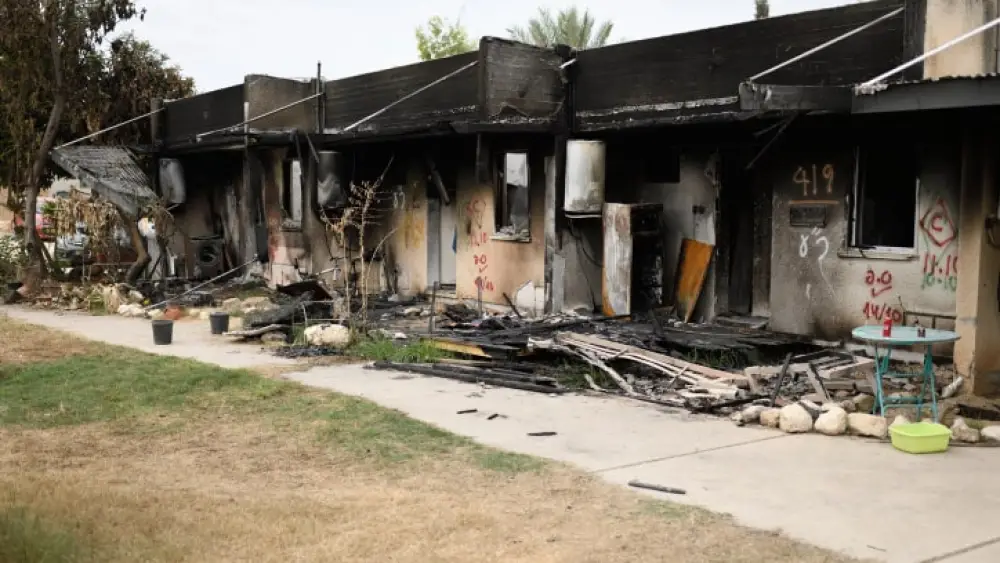
The Hamas rampage across western Negev communities went on for hours, with the IDF response shockingly slow, (Something that has still not been explained). Israel lost more than 1,400 dead, including women, children and the elderly. Parents were tortured in front of their children. Women, living and dead, were raped. Some 5,300 were wounded and more than 230 taken captive.
After the fighting, IDF soldiers found hand-held radios on the bodies of some of the Hamas terrorists, “the same radios that Israeli intelligence officials had decided a year ago were no longer worth monitoring,” the Times reported.
Underlying Israel’s overreliance on technology and its failure to comprehensively monitor Hamas communications networks was a belief that Hamas was not interested in going to war.
This concept, (or “konceptzia” in Hebrew), which the Times dates from May 2021 was an official assessment by IDF intelligence and the National Security Council that Hamas wouldn’t attack for fear of bringing on a crushing Israeli response.
Ironically, this konceptzia failed almost 50 years to the day after another konceptzia, one that led to the IDF’s most devastating intelligence failure—the Yom Kippur War, which began on Oct. 6, 1973.
The intelligence assessment then was that Egypt would not attack Israel until it had sufficiently built up its military forces. Israel lost 2,600 lives in that war, mostly soldiers.