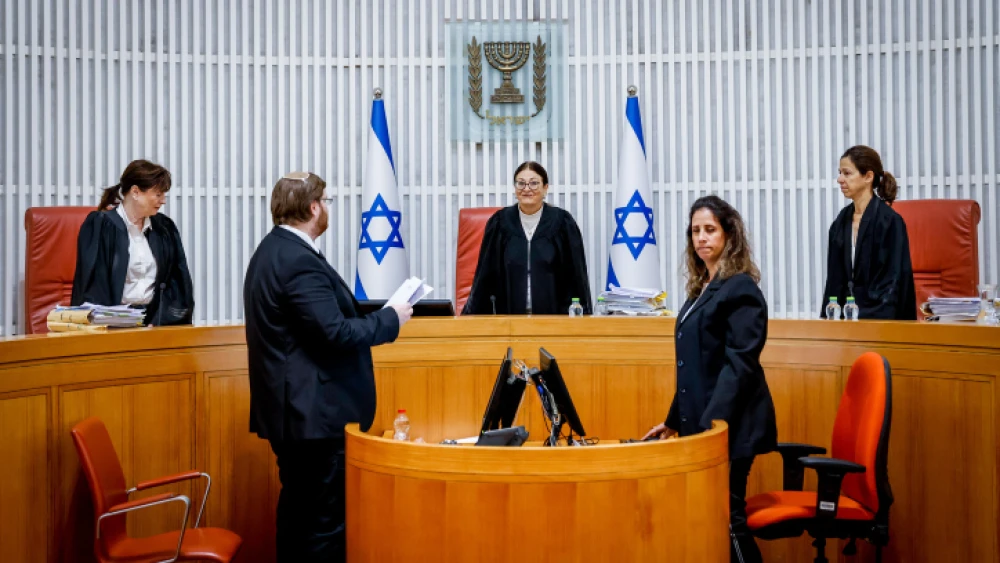
The Supreme Court of Israel, sitting as the High Court of Justice, on Sunday issued a temporary injunction against the “recusal law” passed by the Knesset a few months ago.
The court set a hearing for Sept. 28 in which the government will need to argue why the law should take effect immediately and not after the next Knesset is sworn in. An expanded panel of 11 judges will hold the hearing after a three-judge bench heard the petitions against the law last Thursday.
The government will have until Sept. 14 to submit arguments while the petitioners have until Sept. 20 to submit their arguments.
The amendment to Israel’s Basic Law: The Government limits the circumstances under which a sitting premier can be removed from office. Passed in March, it stipulates that only the Cabinet, and not the court or the attorney general, has the authority to declare a sitting prime minister unfit to serve, and then only in cases of physical or mental incapacity.
The amendment’s explanatory notes state that declaring a prime minister unfit while he is physically and mentally able to fulfill his duties annuls the election results and the democratic process.
The petitions against the law were filed by the Movement for Quality Government in Israel, an NGO heavily involved in the anti-judicial reform movement, and opposition party Israel Beiteinu.
Supreme Court President Esther Hayut and Justices Uzi Vogelman and Yitzhak Amit heard the arguments at Thursday’s session, which lasted about five hours.
The High Court has never overturned a Basic Law.
The “recusal law” is part of a government initiative to reform the judicial system.
Other bills advancing through the Knesset would alter the way judges are appointed and removed, give the Knesset the ability to override certain High Court rulings and change the way legal advisers are appointed to government ministries. On July 24, the Knesset passed the “reasonableness law” restricting the way judges can cite the reasonableness standard when overturning laws and government decisions.