Newsletter
Newsletter Support JNS

MK Bennett: No guarantee of support for Likud in event of new elections in Israel

Railing against the Israeli prime minister’s handling of the coronavirus crisis, the head of the right-wing Yamina Party called the current government “one of the worst” in the country’s history.

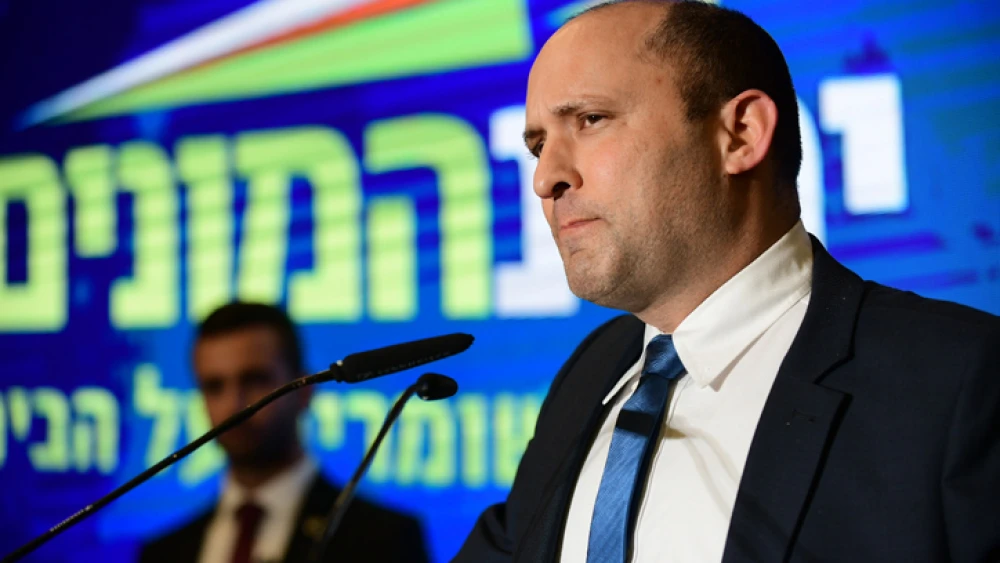
Former Israeli Defense Minister Naftali Bennett attends the launch of the Yamina Party campaign, on Feb. 12, 2020. Photo by Tomer Neuberg/Flash90.

Former Defense Minister and current Knesset member Naftali Bennett told Israel’s Channel 13 on Monday night that there was “absolutely” no guarantee that he would join a Likud-led government in the event of a new round of elections.

Bennett heads the right-wing Yamina Party, which did not join the current coalition due to a dispute over portfolios.

Netanyahu “abjectly failed in dealing with the coronavirus and 1 million [unemployed] Israelis are paying the price,” said Bennett. “For four months, there was no plan in place. This is one of the worst governments in the history of the State of Israel.”

He also stated that although he opposes sending the public to the polls for an election in the middle of the current crisis, if the number of new coronavirus patients reaches 10 to 20 per day, “we should get rid of this government.”

Talk of what would amount to a fourth round of Knesset elections since April of last year has heightened recently, due primarily to a disagreement between Netanyahu and Defense Minister Benny Gantz over the time period of the national budget. Netanyahu wants it to be a one-year budget; Gantz, who heads the Blue and White Party that is in a national unity coalition with Netanyahu’s Likud, wants the budget to be for two years.

According to the coalition agreement, if the budget is not passed by Aug. 25, the Knesset will disband automatically and new elections will be called.

“Anti-Zionism can be a framework for justifying anti-Jewish hostility,” Rafaela Dancygier, of Princeton University, told the N.J. Advisory Committee to the U.S. Commission on Civil Rights.
A board member at the Orthodox synagogue told the FBI that members began attending services less frequently after Kevin Charles Pyles allegedly targeted the synagogue in separate July and August 2025 incidents.
The Senate rejected a resolution calling for the removal of U.S. forces from the war against Iran after U.S. President Donald Trump hammered Senate Republicans for approving a similar measure the day before.
“When someone uses the N-word on campus, no one thinks about free speech. No one talks about, ‘Let’s understand what they’re thinking. Let’s have a discussion,’” Rep. Randy Fine said. “But somehow when it came to Jews, everyone wanted to rediscover the idea of free speech.”
“Leadership should be responding with moral clarity, not suggesting that the act of teaching about the Holocaust has somehow ‘missed the mark,’” said Kurt Schwartz, CEO of CAMERA.
The judges said the sanctions, which the United States imposed in response to the Hague-based court’s targeting of Israel, are unlawful.
Benny Gantz, JNS editor-in-chief Jonathan S. Tobin, Gilad Erdan, Mosab Hassan Yousef, Nissim Black and leading voices in security, diplomacy, media, law and Jewish communal affairs headline the summit’s third day in Jerusalem.