


Tal Scherzer, a 23-year-old from Arad, west of the Dead Sea, recently served in Gaza as a convoy driver in the 101st “Cobra” Battalion of the IDF Paratroopers Brigade. Scherzer says nothing prepared him for the unexpected love he found in the heart of the destruction.
For the past three months, he has been raising a dog he rescued from the ruins, driven by a belief in giving new chances to humans and animals alike.
“At the start of the war, we were stationed on the outskirts of Gaza, providing logistical support. One evening, while resupplying a platoon inside the Strip, the logistics officer suddenly started shouting, ‘Where’s Chiquita? Where’s Chiquita?’ I went up to him and asked what he was talking about,” Scherzer recalls.
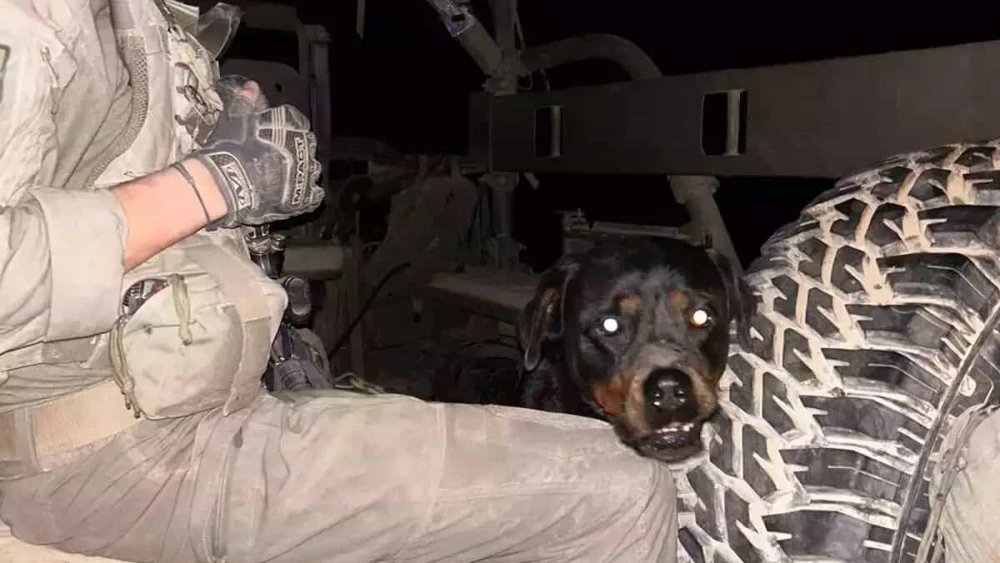
“He told me about this amazing dog, a rottweiler, who had been following the troops for a few days. They had been feeding her, but it was time to move on. I couldn’t stop thinking about her after that.”
After seeing pictures of Chiquita, Scherzer says it was love at first sight.
“At one point, I went to my officer and said, ‘I don’t know if you’ll like this, but there’s a dog here—and I have to take her.’ My officer thought I was joking, but he went along with it. To his credit, he’s the kind of person who believes in giving everyone a chance.”
The rescue mission
That same evening, Scherzer returned to the unit and asked about the dog.
“The people in the area showed her to me, and she was amazing. There are many dogs in Gaza, and I wish we could save them all. But there was something in her eyes that told a different story. The only food I had with me was canned tuna, so I gave it to her. She ate it and stayed put.
“I tried to get her into my Humvee and wondered how she’d react if I tried to pick her up. In the end, I asked if anyone had some dog food. A soldier from the Oketz Unit [the IDF’s canine special forces unit] said he had some Bonzo dog food. I got a few cans, and as soon as she smelled it, she started following me. I got into the Humvee, and she placed her front paws on it but couldn’t climb in.”
Scherzer and his comrades had to leave the area.
“People started rushing me, but I said I wouldn’t drive until that dog came with us. I asked a friend to grab her and hold her in the back of the vehicle. He was hesitant because rottweilers are considered a dangerous breed. But I wholeheartedly believed that everyone deserves a second chance, no matter where they come from, whether human or animal,” Scherzer explains.
Eventually, he brought Chiquita to Israel, to a kibbutz near the border.
“As soon as we arrived, she jumped off the Humvee and started walking around. Then it hit me—maybe I’d made a mistake. She was still a dog from Gaza, possibly unvaccinated, and now she was roaming freely in the kibbutz. When we woke up the next morning, she was sitting right outside our quarters.”
Realizing she was friendly and loyal, Tal began considering how to care for her until his release from reserve duty.
“We gave her more tuna, and a friend from the area suggested a local kennel. We called them and asked if they could take her for a few weeks. They were shocked that she was a rottweiler from Gaza, but we convinced them. She stayed there for eight months.”
The war dragged on, and Scherzer says he constantly worried about Chiquita’s well-being at the kennel.
“I didn’t know how she was adjusting or when I’d be able to take her. Meanwhile, I paid for her vaccinations. According to the law, I had to have her spayed, and she was kept in isolation for 10 days away from other dogs. Finally, in September, when I was discharged from reserve duty, I went to pick her up.”
Chiquita has been living with Tal for four months now, and their bond continues to grow.
“At first, it took her a day or two to recognize me, but since then, she hasn’t left my side,” he says. “You can tell she’s grateful. She follows me everywhere, cries and gets excited when I come home.
“One of the things I’ve learned from her is that she could have become a monster, given that she had to hunt to survive in Gaza’s ruins, but she chose not to. She’s sweet, doesn’t make a mess, and is just a pure soul.”
Originally published by Israel Hayom.


