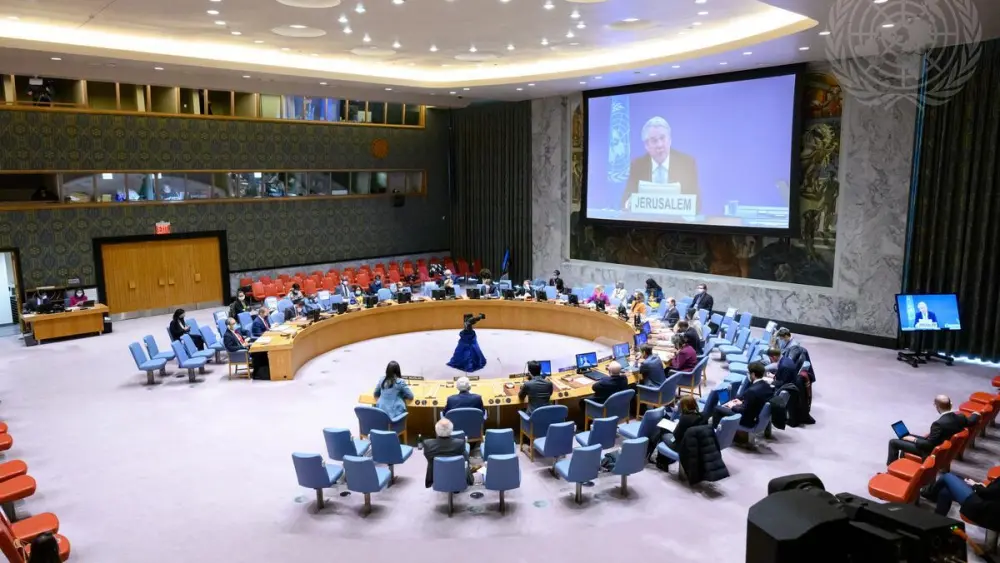
A United Nations Security Council resolution on the Israel-Hamas war was delayed on Wednesday for the third straight day, after the United States requested more time for negotiations.
Upon exiting a reportedly tense 75-minute closed-door meeting, Vanessa Frazier, the Maltese ambassador to the United Nations, could only tell JNS the vote was set for “tomorrow.”
“We believe today giving a little bit of space for additional diplomacy could yield positive results. And we are going to be optimistic and try and do that,” UAE U.N. envoy Lana Nusseibeh told reporters following Wednesday’s closed consultations. “If by tomorrow those results have not been yielded, then we will assess as a council to proceed apace to vote on the resolution.”
Nusseibeh wouldn’t go into specifics of internal discussions, saying a resolution needed to have “impact” and be “implementable on the ground.”
She indicated, though, that separate discussions being held by Israel, Hamas, Qatar and Egypt on a potential pause in hostilities in exchange for the release of Gazan-held hostages was not impacting the council’s work or part of its debates.
Diplomats indicated the major sticking point now with regard to the resolution was whether the United Nations should take over from Israel responsibility for the inspection of shipments of food, fuel and other aid entering Gaza.
The resolution’s supporters claim that giving U.N. agencies the ability to bypass Israeli inspections would speed up aid delivery. The United States has supported such measures in the past, including through a 2014 Security Council resolution which authorized Turkish aid convoys into Syria without the approval of Damascus.
Israel’s Coordinator of Government Activities in the Territories (COGAT), the Defense Ministry body charged with overseeing Palestinian civilian affairs, last week charged the United Nations with holding up distribution of aid in Gaza.
“We have expanded our capabilities to conduct inspections for the aid delivered into Gaza. Kerem Shalom [crossing between Israel and Gaza] is to be opened, so the number of inspections will double. But the aid keeps waiting at the entrance of Rafah,” it tweeted on Dec. 12. “The U.N. must do better—the aid is there, and the people need it,” it added.
However, Nusseibeh was insistent the United Nations was fit to oversee the delivery of aid into Gaza, calling the global body “one of the most trusted brand names globally.”
Both the Israeli Foreign Ministry and the country’s U.N. mission declined to comment on the exact nature of the objections they have lodged with Washington over the issue, and what might lead in Jerusalem’s eyes to a satisfactory result.
A vote on the UAE resolution was tentatively scheduled for Thursday morning. Should the United States use its veto, a separate council resolution which passed on Nov. 15 with a U.S. abstention is still in effect.
That resolution calls for urgent and extended “humanitarian pauses” and for humanitarian corridors to be established throughout the Gaza Strip. Guterres sent a letter this week to the Security Council outlining possible options for implementing the resolution, including an increased U.N. presence in Gaza, a civilian observer mission or an unarmed military observer mission, all of which would require Israeli cooperation to some extent.
Stephane Dujarric, spokesman for the U.N. chief, told JNS on Wednesday that Guterres has not yet heard back from the council on its preferred course of action.
Earlier in the week, Guterres viewed a 45-minute compilation of video footage from Hamas’s Oct. 7 massacre, a good deal of which was filmed by the terrorists themselves. The footage showed “humanity at its worst,” he said.
Israel’s U.N. Ambassador Gilad Erdan said that he was now waiting to see if Guterres’ language on the conflict would change. Asked to respond to Erdan’s comments, Dujarric said he wasn’t “interested in entering into a polemic with the ambassador. But I think the secretary-general’s language has been very direct and very clear, using very simple and very understandable words.”
Guterres has been heavily criticized by Israel for some of his remarks regarding the war, and has sought to clarify them on more than one occasion.