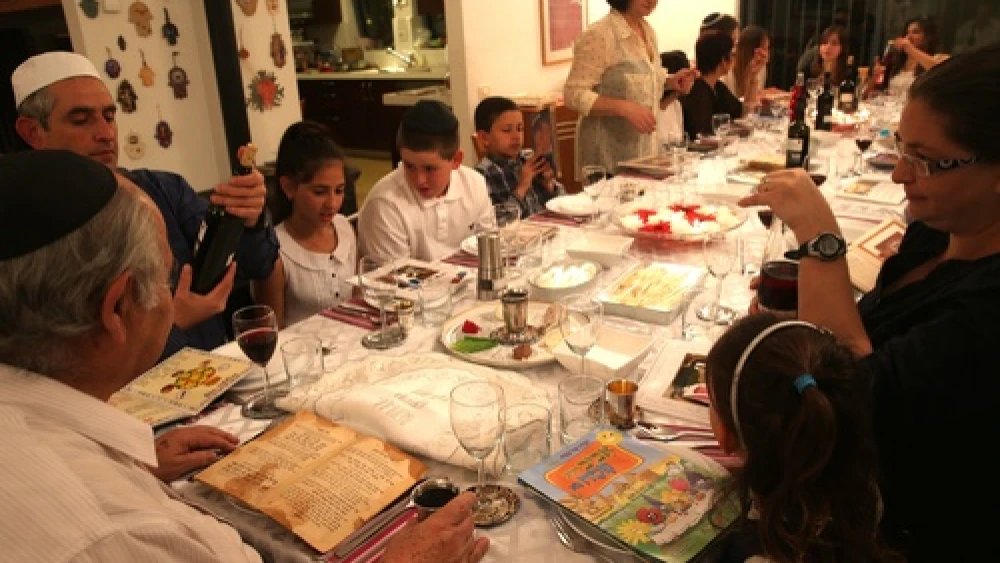
According to a Jewish People Policy Institute survey of 3,000 respondents, 97 percent of Israelis Jews say they either host or participate in a Passover Seder, compared to the 2013 Pew Study’s finding of 70 percent of American Jews who participated in the Seder the prior year.
In Israel, only one Seder is held on the first night of the holiday.
The survey confirms that similar to the Rosh Hashanah (New Year’s) dinner, the Passover Seder is one of the only practices of Jews in Israel that is almost equally observed across the spectrum of Jewish sectors, including 93 percent of “totally secular” Jews.
As such, JPPI’s senior fellow and sociologist Dr. Shlomo Fischer commented: “The Passover Seder of Israelis has remained a highly traditional Jewish ritual.”
JPPI, founded by the Jewish Agency, is a nonprofit think tank that, according to its website, hopes “to ensure the thriving of the Jewish People and the Jewish civilization by engaging in professional strategic thinking and planning on issues of primary concern to world Jewry.”
Their newest study seeks to better understand what “participation” in Jewish rituals, such as reading the Haggadah, means for different Jews. The Institute found that 64 percent of Israeli Jews read “the entire Haggadah, including the part that is read after the meal,” making Passover one of the most common practices of both Israeli and non-Israeli Jews.
A majority of Jews from all seven sectors of Jewish Israeli society (except “totally secular,” 22 percent of whom read the entire Haggadah and 71 percent of whom read parts of the Haggadah) reported that they read the entire Haggadah.
While the “totally secular” group is the outlier in the study, it is the largest sector of Israeli society, making up 31 percent of Israeli Jews.
JPPI also found that those who read the Haggadah in its entirety do not necessarily keep other Passover laws, such as keeping kosher for Passover; in fact, 13 percent of Hagaddah readers do not keep kosher for Passover. Conversely, 85 percent of those who keep kosher for Passover read the Haggadah in its entirety, meaning that 56 percent of Israeli Jews both read the entire Haggadah and keep kosher for Passover.
When asked why Israeli Jews uphold traditions like the Passover Seder, 25 percent responded that the “Torah says so.” Others said “that’s how my family behaved throughout the generations,” “that’s how I express my Jewish culture,” and “it makes me feel like I am taking part in history.”