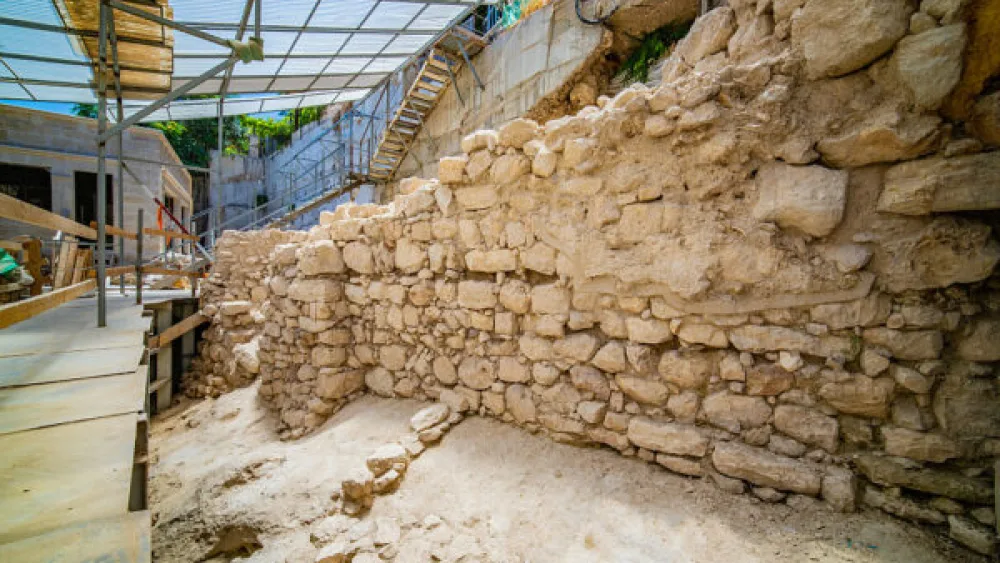
Archaeological excavations at the City of David National Park in the Old City of Jerusalem have unearthed the remains of an Iron Age city wall, constructed in the First Temple era, which was designed to protect Jerusalem against attacks from the east, the Israel Antiquities Authority reported on Tuesday.
The IAA is conducting the dig in collaboration with the City of David Foundation, as part of the park development process.
According to excavation directors Dr. Filip Vukosavović, of the Ancient Jerusalem Research Center, and Dr. Joe Uziel and Ortal Chalaf on behalf of the IAA, the unearthed city wall protected Jerusalem from “a number of attacks during the reign of the kings of Judah, until the arrival of the Babylonians, who managed to break through it and conquer the city.”
“The remains of the ruins can be seen in the archaeological excavations. However, not everything was destroyed, and parts of the walls, which stood and protected the city for decades and more, remain standing to this day,” the archaeologists said.
The newly excavated section of the wall connects two previously excavated segments on the eastern slope. In the 1960s, British archaeologist Kathleen Kenyon uncovered a section of the wall at the northern part of the slope and dated it to the days of the Kingdom of Judah.
About a decade later, archaeologist Yigal Shiloh dug out a long section of the wall in excavations at the southern part of the slope. Over the years, doubts have been raised about whether these stone edifices were remains of the First Temple-era city wall. However, the new section appears to prove that the remains were all parts of the wall that once defended ancient Jerusalem.
Reconstruction of the sections unearthed in early 20th-century excavations has allowed researchers to trace nearly 30 meters (98 feet) of the surviving wall to a height of 2.5 meters (eight feet) and a width of up to five meters (16.4 feet).
In 2 Kings, 25:10, the Bible describes the Babylonian conquest of the city thus: “The whole Babylonian army under the commander of the imperial guard broke down the walls around Jerusalem.”
But it appears that the eastern part of the wall withstood the Babylonian attack, possibly due to the precipitous nature of the eastern slope of the City of David, which slopes towards the Kidron Valley at an angle of more than 30 degrees.
Evidence of the Babylonian destruction can be seen in a building that stood next to the wall, which contained rows of storage jars that were smashed when the building burned and collapsed. The jars’ handles were stamped with rosettes, symbols associated with the Kingdom of Judah. Also discovered was a Babylonian stone seal bearing the symbols of two Babylonian gods, Marduk and Nabu. Nearby, archaeologists found a bulla (a stamp seal impression made in clay) that was inscribed with the Judaean name “Tsafan.”
The latest finds from the ongoing excavation are scheduled to be presented in October at the IAA’s conference, “New Studies in the Archaeology of Jerusalem and its Region.”
This article first appeared in Israel Hayom.