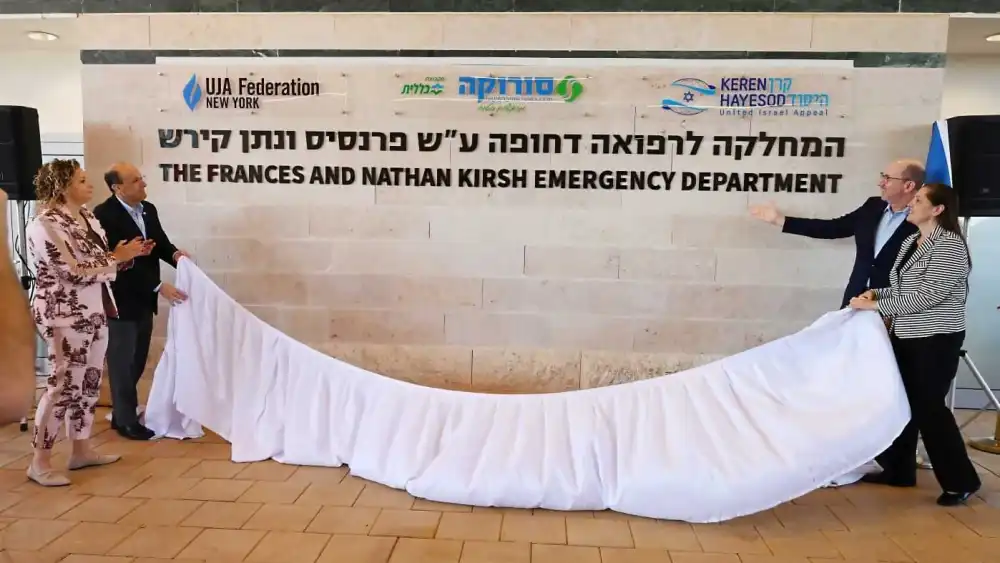
Soroka Medical Center in Beersheva inaugurated its newly expanded emergency department on Tuesday, increasing its capacity by approximately 50% following an Iranian missile strike that damaged the hospital last June.
The new department, named for philanthropists Frances and Nathan Kirsh, adds 2,000 square meters (more than 21,000 square feet), 40 treatment stations and two trauma bays, significantly increasing the department’s ability to respond to routine medical needs and large-scale emergencies, the hospital said.
Soroka, the main medical center serving Israel’s Negev region, treated 674 civilians in its emergency department on Oct. 7, 2023 after the Hamas-led terror attacks. In June 2025, an Iranian missile struck the hospital, causing “extensive damage” and disrupting operations, according to the medical center.
“The emergency department is where life-saving decisions are made, where just a few minutes can change the course of a person’s life,” said professor Shlomi Kodesh, director general of Clalit-Soroka University Medical Center, during the inauguration ceremony. “Its importance has already been demonstrated in reality and has been felt by both our patients and our medical teams.”
Maj. Gen. (res.) Yohanan Locker, chairman of Clalit’s board of directors, called the expansion a “milestone in the development of Soroka and part of our broader commitment to ensuring that it continues to lead and serve the population entrusted to its care.”
Soroka is part of Clalit Health Services, Israel’s largest health organization.
Yair Avital, a resident of Kibbutz Be’eri and commander of its local civilian security team, was seriously wounded on Oct. 7 and treated in Soroka’s emergency department.
“After what I had experienced, I encountered kind eyes, enormous hearts and genuine patience,” Avital said during the inauguration ceremony. “I witnessed capabilities I had never seen in any other system in the country, all through the extraordinary cooperation and shared understanding among the medical teams.”
“They do everything they can for every single patient, even under impossible conditions,” he said.
“At the heart of everything we do is a simple principle,” said professor Dan Schwarzfuchs, deputy director of Clalit-Soroka and head of its emergency medicine department. “Treating every person as a human being, first and foremost.”
The expansion was made possible through support from several organizations, including Kirsh Philanthropies, the UJA-Federation of New York and the municipality of Be’er Sheva.