


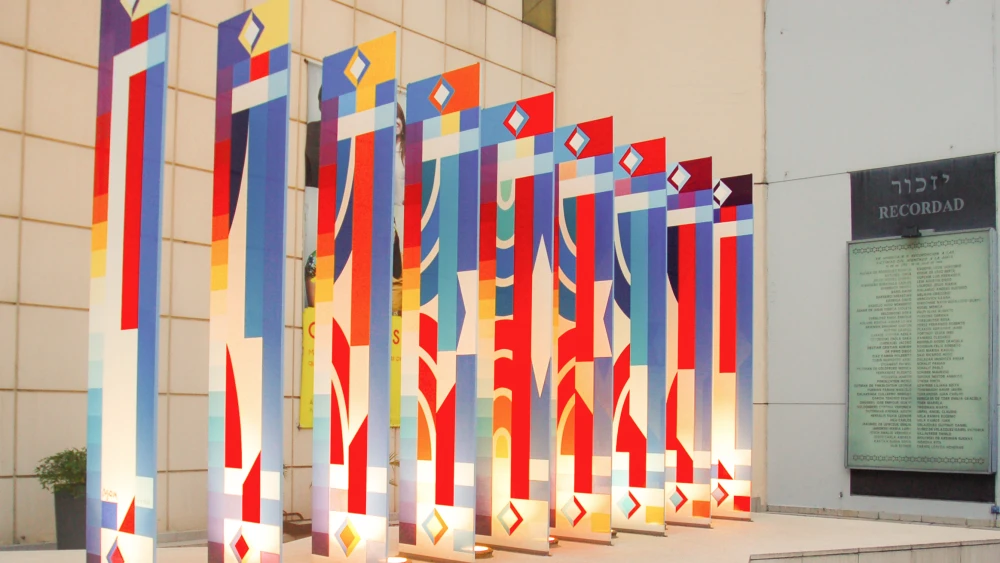
Israeli and Lebanese representatives huddled with U.S. officials at the State Department on Wednesday evening, hammering out a joint statement on a plan of action to rid southern Lebanon of Hezbollah’s control. Across the street, victims of the terror group’s 1994 bombing of a Buenos Aires Jewish community center were memorialized.
“In the 32 years since the bombing, Argentina has transformed from a beacon where terrorism once reigned supreme to a beacon of Jewish life,” Yehuda Kaploun, a rabbi and the State Department’s special envoy to monitor and combat antisemitism, told attendees at the U.S. Institute of Peace.
The department co-hosted the event with the House Committee on Foreign Affairs, Argentina’s embassy in Washington and the Argentine Israelite Mutual Association, or AMIA, which was bombed on July 18, 1994.
Terrorists rigged a van with explosives and drove it into the building, killing 85 people and hurting more than 300—the deadliest terror attack in the country’s history.
A series of suspected cover-ups preceded a 2006 decision by prosecutors to accuse Hezbollah of carrying out the attack at the direction of its benefactor, the Iranian government. An Argentine court ruled in 2024 that this was the case and characterized Iran as a terror state.
Two years before the AMIA bombing, the Israeli embassy in Buenos Aires was bombed in an attack thought to be linked to Hezbollah and Iran as well. That blast killed 29 people and hurt 242.
“Today, AMIA stands not only as a site where horror once occurred but as a living testament to the strength and vitality of the Jewish community in Argentina,” Kaploun told attendees.
He noted that the country has the sixth largest Jewish population in the world.
Gregory LoGerfo, State Department coordinator for counterterrorism, also spoke at the event, as did Reed Rubenstein, the department’s leading legal officer.
Alejandro Oxenford, Argentina’s ambassador to the United States, represented his country. Daniel Pomerantz, executive director of AMIA and a survivor of the 1994 attack, also spoke.
“More than three decades later, their absence is still a wound in the life of my country, not a closed chapter of history but an open question we are still bound to answer,” Oxenford said, of the victims. “We remember them today one by one, because memory is the first form of justice.”
The conclusion that Hezbollah carried out the bombing at Iran’s direction is “a condition of the truth,” Oxenford said. “After 30 years of silence, evasion and cover-up, the truth itself is a form of justice.”
“The truth is not enough, and Argentina has stopped pretending that it is,” Oxenford said.
Recent Argentinian legislation provides for trials in absentia, and 10 people accused of planning the bombing have since been ordered to stand trial, even as they remain at large, the envoy said.
Earlier in the day, the Argentine embassy unveiled an artwork that states, “What is not remembered dies, and what is remembered never dies.” Oxenford asked attendees to take “instruction” from it.
“This is not a ceremony of mourning alone. It is an act of resistance against forgetting, and forgetting in matters like these is never neutral,” he said. “It is the final accomplice.”



