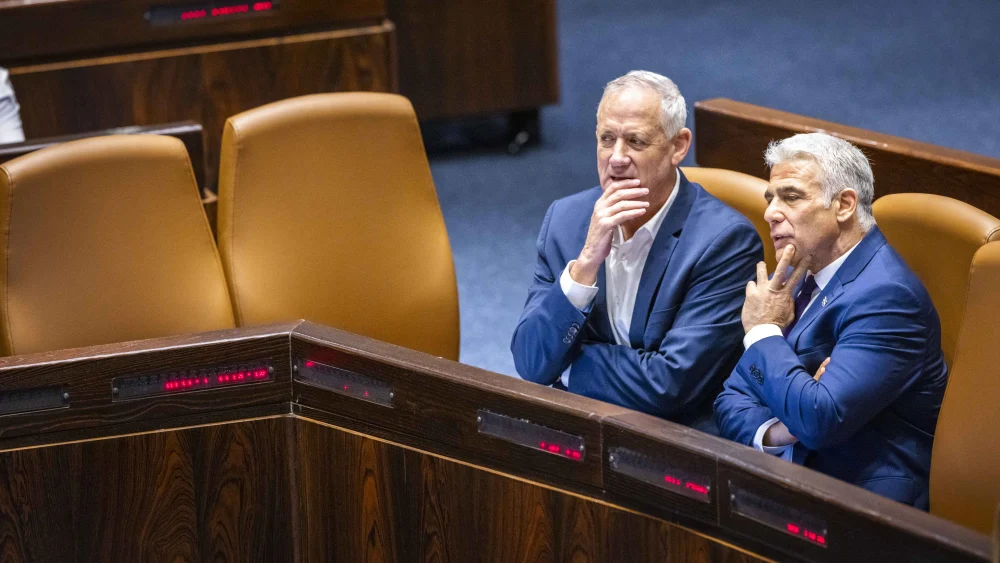

With the new government in office, the Israeli opposition faces the urgent question of what to do now, especially because Prime Minister Benjamin Netanyahu’s latest coalition is a troubling one.
It contains elements of the religious right that are determined to make radical changes in Israeli society, and while a great many support these changes, they are nonetheless radical, and opposed by a roughly equal number of Israelis.
Unfortunately, the opposition is divided and disorganized, with a multitude of parties spanning the center-right to the far-left. They agree on little beyond a strong distaste for Netanyahu.
In the face of a radical government, a vibrant opposition is more important than ever, if only for the health of Israeli democracy. So, are there issues around which the opposition parties could unite? Is there a viable manifesto they could present to the Israeli people in the next election?
I believe there is, and it can be summed up in a simple Hebrew slogan: Shivyon, Hiloniut, Shalom—Equality, Secularism, Peace.
Shivyon (Equality)
Much has been made of Israel’s success as the “Start-Up Nation,” which is understandable. But this macroeconomic miracle conceals a microeconomic crisis. Only a small part of the population—roughly 10% according to recent reports—works in the tech sector, and for the other 90%, things are not going well. Economic inequality is severe, the housing market impossible, the cost of living intolerable and real wages have been mostly flat for years. More and more Israelis are finding it difficult to make ends meet.
The opposition, then, should advocate moving Israel away from a neoliberal free market economy to a communitarian social market economy. This does not mean giving up on capitalism or restoration of the old socialism. It means, among other things, moving the tax burden off the working and middle classes onto the wealthy, preserving and expanding the welfare state, taking measures to curb the cost of living, regulating the real estate sector to create more affordable housing and undertaking infrastructure projects to connect Israel’s periphery to the center of the country.
Hiloniut (Secularism)
The relationship between religion and state in Israel has reached its nadir. Faced with a government dependent on radical religious parties, the divide between the religious and secular communities appears all but unbridgeable.
To counter this, the opposition must become the flag bearer for secular Israel. It should advocate an Israeli laïcité that does not reject or demonize religion but which firmly insists on ending religious coercion.
This involves shifting the economic, social and military burden off the secular majority via a complete moratorium on government stipends to Haredi yeshiva students; equality of military or national service; putting an end to discrimination against non-Orthodox Jewish denominations (which would also greatly strengthen relations with the Diaspora); and legalizing civil marriage and divorce.
More than anything else, however, the opposition must change the language of the debate. Rather than simply being “anti-religious,” it should put forward a positive message that it seeks to defend the right of all Israelis—including the Orthodox—to be as Jewish as they wish to be and forge their own Jewish identity. This is secularism raised to a universal principle, rather than the ideology of an arrogant minority.
Shalom (Peace)
Peace with the Palestinians is, at best, a long way off, and no opposition will see any electoral success without acknowledging this reality. However, some measures can be taken to advance the cause of peace.
In particular, while Netanyahu deserves immense credit for forging the Abraham Accords, his coalition partners could well endanger them. Despite the enthusiasm of the Arab governments involved, the Accords are unpopular on the Arab street and, unless carefully managed, could be destroyed.
The opposition should work to make sure that they are not destroyed. Besides expanding the Accords, it should oppose provocative or reckless moves that could weaken them, such as Itamar Ben-Gvir’s recent visit to the Temple Mount or annexation of parts or all of Judea and Samaria.
A winning manifesto
All of these policies are relatively popular and certainly achievable. They are also consensus issues that could bring the opposition parties together and expand their electoral support. The first step towards this would be for the parties to sign on to such a manifesto, issue it publicly, and then take practical steps in the Knesset to advance its principles.
Israeli voters are famously cynical, but one of the main reasons for this is that they see no chance that their vote will result in any meaningful change. In many ways, this is the opposition’s fault. For the most part, their message has been nothing more than the demonization of Netanyahu. This is not a particularly appealing platform.
The opposition, then, must give the electorate something to vote for rather than against. If they can put hate and ego aside and adopt a collective manifesto under the slogan “Shivyon, Hiloniut, Shalom,” they just might win.
Benjamin Kerstein is a writer and editor living in Tel Aviv. Read more of his writing on Substack and his website. Follow him on Twitter @benj_kerstein.