


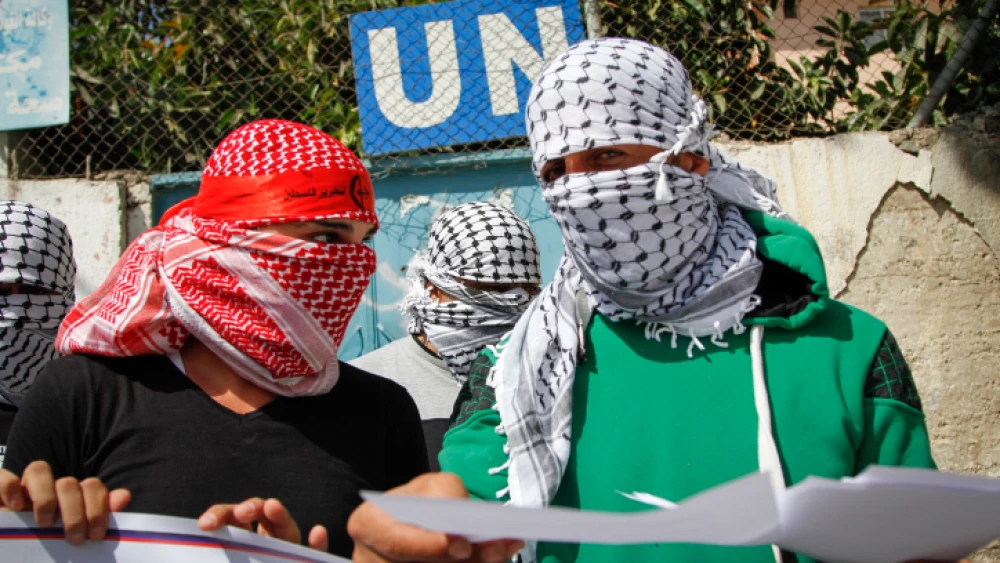
The “Palestine refugees” have been exceptionally indulged by the international community for seventy long years. This ranged from their very recognition as refugees though most of them fail to satisfy the basic criteria for such status, to the unprecedented benefit of a relief agency created exclusively for their welfare (the United Nations Relief and Works Agency for Palestine Refugees in the Near East, or UNRWA), to the unique privilege of passing on “refugee” status to future generations.
Rather than help resolve the Palestinian predicament, these unique benefits have served to confirm the permanency and growth in the “refugee” problem (what started as 600,000 is now more than 5 million).
And no organization has contributed more to this perpetuation than UNRWA, which, instead of ending direct relief within months, as stipulated by its mandate, has kept them as passive welfare recipients for decades under false humanitarian pretense, thus allowing the decades-long manipulation of their cause by successive Palestinian leaderships and the Arab regimes.
One can only hope that as UNRWA nears its 70th anniversary, the agency’s main donors, first and foremost the United States and the European Union, which bankroll nearly half of its budget, will find the necessary courage and integrity to acknowledge the urgency of deep reform and condition future contributions on UNRWA’s reversion to the original mandate: That is, its gradual transfer of responsibility for the Palestinian “refugees” to the Palestinian Authority and the host Arab governments, thus ending their eternal “refugeedom,” and facilitating their integration in their respective societies as equal and productive citizens.
This will be 70 years later than originally conceived, but better late than never.
Professor Efraim Karsh is the Director of the Begin-Sadat Center for Strategic Studies. Professor Emeritus of Middle East and Mediterranean Studies at King’s College London; Professor of Political Science at Bar-Ilan University; Principal Research Fellow (and former Director) of the Middle East Forum (Philadelphia), where he also edits the scholarly journal Middle East Quarterly; founding editor of the scholarly journal Israel Affairs, now in its twenty-fourth year, and founding general editor of a Routledge book series on Israeli History, Politics and Society, with over 60 books published. Email: efraim.karsh@kcl.ac.uk
The full report can be viewed here.


