
Following the horrific antisemitic attack against Jews in Bondi Beach on Dec. 14, our day school leadership asked me to speak as the community rabbi with students at our morning minyan. Unfortunately, this wasn’t the first time our fifth- and sixth-grade students have gathered together for a conversation like this. Challenging events in the news over the last several years have caused our school community to convene.
I tried to move quickly and deftly through what happened during the attack, the safety and security of our campus, and all that we were trying to do to offer support to the Australian Jewish community. But it was the innocent question of an astute fifth-grader who caught my attention when he earnestly asked, “Rabbi, why do people hate us?”
A combination of innocence and intensity filled the room as dozens of young faces looked at me and awaited an answer to an impossible question. I began to address the history of antisemitism and the shape-shifting nature of Jew hatred. I began to explain that anti-Zionism is just a new strand of an ancient disease.
“But why?” he interrupted.
My heart sank. Sometimes, we are faced with unanswerable questions. If this student studied the history of Jew-hatred for the rest of his academic career, he would learn stories of communities through time, varied stereotypes and legal institutionalized policies, strategies to vilify us and how our people survived. Yet none of the dissertation would result in the core answer.
I explained that people hate Jews because of who we are and what we believe. And although we’re diverse across spectrums of race, culture and religious observance, the hate always adapts and follows us. The hate emanates from an ancient darkness, and nobody can explain why. Yet we know that good and evil exist. And it’s ultimately up to us to pick goodness. Despite the challenges, it’s up to us to be the best people that we can be.
We all know the risk that if we focus too much energy on antisemitism, then we risk losing focus on Jewish living, Jewish learning and Jewish engagement. This idea has been well cemented into our zeitgeist after New York Times columnist Bret Stephens made headlines due to his State of World Jewry address in February at the 92nd Street Y in Manhattan. That topic was picked up again in a Sapir Debate in March between author Dara Horn, and historian and professor Deborah Lipstadt, most recently the U.S. special envoy to combat and monitor antisemitism. We can debate the merit of combating Jew hatred all we want, but the truth is that to some questions there are no answers … except one.
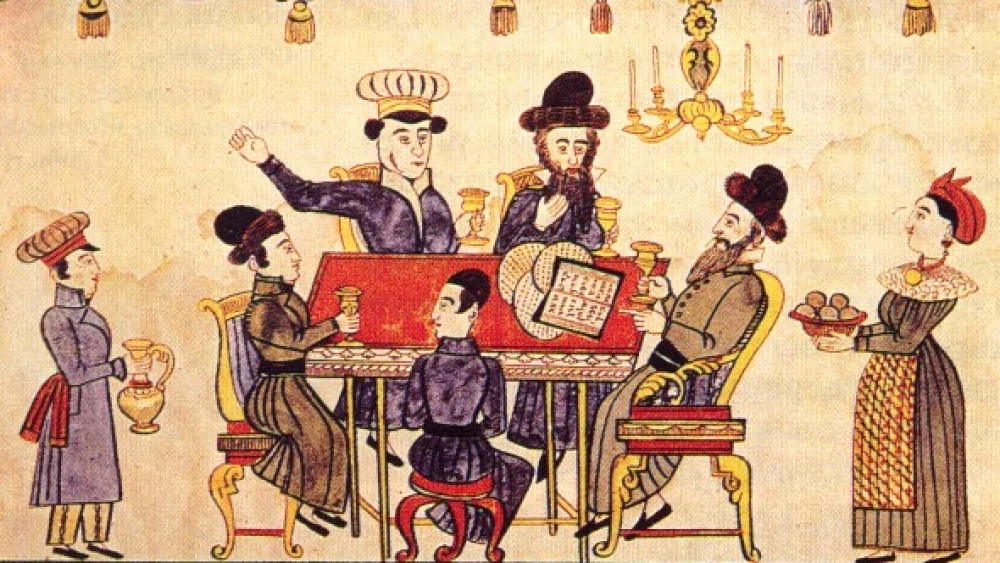
Passover is the ultimate answer. Long ago in antiquity without any certainty over what kind of liberation would arrive, Jewish families sat down in Egypt to eat together and prepare for an eternal journey toward a better life. We prepared for an uncertain future by discussing uncertainty.
Passover teaches us an important lesson. How do we combat hate? We endeavor to ask questions.
When we reached the Land of Israel, our ancestors gathered together and celebrated Passover as an act of memory. In the Middle Ages, during the Spanish Inquisition, Jews met in secret and adapted Passover to become an underground act of defiance. In 1943, while most of world Jewry was consumed by the darkness of the Shoah, the Passover seder stood as inspiration for dozens of teens to initiate the Warsaw Ghetto Uprising in 1943 against Nazi forces.
Once per year, our people gather in groups to reflect and to envision. We ask questions that have been asked many times before, yet each year brings with it the possibility for new answers and new ideas. We ask the same prompts with honor and respect, even though we know that we still might not have the answer. We do this because our people have always believed that questions are far more significant than answers.
Our Passover seder begins with a child asking “The Four Questions,” not as an audit of our children’s Jewish education, but as a means to set a tone that questions have always propelled our people forward from darkness to light, from slavery to liberation. Our Passover seder ends with a famous statement—“Next year in Jerusalem!”—that is meant to invite the first post-seder question to follow, “Is this the year?”
I’ve always thought it is significant that the sequence of the seder’s questions begins with the youngest among us. From a very early age, we are taught to question, explore and seek. Even before the child has all of their words, we invite their questions and encourage their sense of wonder.
For thousands of years, our people have posed questions about Torah, about the universe, about science, about economics, about politics, about ourselves and about God. In a world so opinionated, so polarized, so confident in its positions, what could be more powerful than an ancient exercise in inquiring from our loved ones the anxieties that lay deep within our souls?
In a world ravaged by war, economic disparity and outright bigotry, what could be more of a remedy than a formal dinner that expresses the notion that our people have engaged in a long journey that has succeeded because we learned to question ourselves and doubt the world around us? It’s the “why questions” that baffle the composite wisdom of the internet and that will propel us forward.
My question this year will certainly be, “When will mainstream America wake up and push Jew hatred back into the dark shadows of society?” Even with the depressing markers, I uphold an abiding faith in my American neighbors to choose goodness. I’m uncertain how long it will take, but on Passover, generational conversations maintain merit.
Perhaps an answer is not yet available. There are some questions to which we don’t have answers. However, that should never deter our questions.