


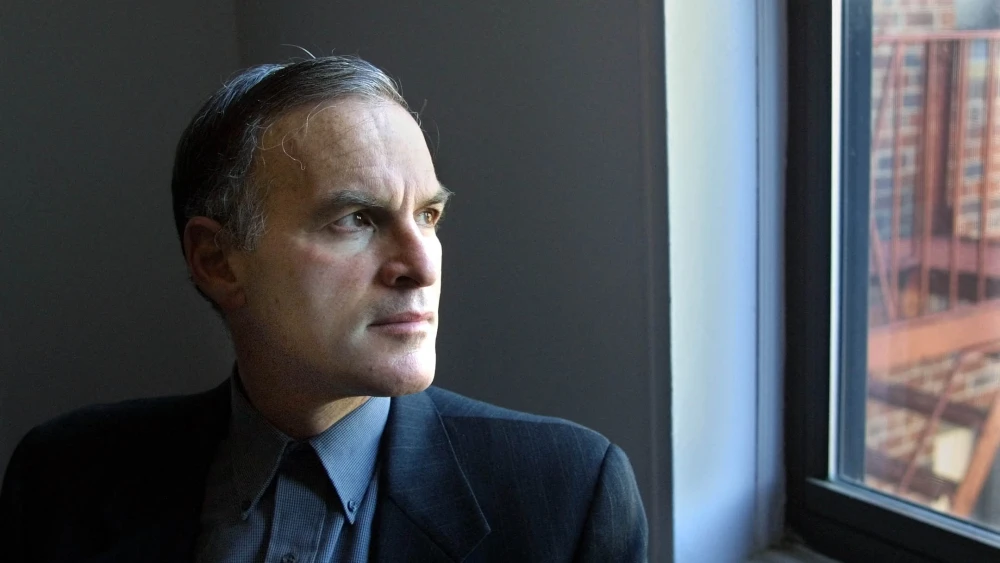

I owe Norman Finkelstein something. He was my professor at New York University in the mid-1990s, and for a young Jewish kid from Queens, N.Y., he was an electric disruption. He challenged everything I thought I knew, introduced me to Noam Chomsky and wrote the recommendation that got me into graduate school. I read his work for more than 30 years. This essay is not written in contempt. It is written in disappointment, with the same demand for consistency he spent his career imposing on others.
Norman Finkelstein built his reputation on a single devastating argument: that suffering can be exploited, historical trauma can be weaponized and moral authority can become currency. His 2000 book The Holocaust Industry accused Holocaust survivor Elie Wiesel of turning tragedy into a brand, commanding speaking fees upward of $25,000 while claiming the Holocaust was “noncommunicable.”
He accused attorney Alan Dershowitz, professor emeritus at Harvard Law School, of fraud. He accused Jewish organizations of running “an outright extortion racket.” His standards were ferocious and he insisted they apply to everyone.
It is time to hold Finkelstein to his own standard.
Today, his public identity revolves around Gaza and his identity as the son of Holocaust survivors. His mother survived Majdanek. His father survived Auschwitz. Both survived the Warsaw Ghetto. Their suffering is not incidental to his public persona. It is the credential that accompanies him into every interview, every introduction, every podcast appearance.
He has built two books totaling more than 900 pages on Gaza alone, to be sold as a matched box set modeled on Vasily Grossman and Ilya Ehrenburg’s documentation of Nazi atrocities. He promotes his new volume, Gaza’s Gravediggers, across every available platform.
The man who accused others of transforming historical suffering into moral authority now relies on his own inherited suffering as his primary credential. The man who condemned what he called an industry has built one himself. The subject matter changed. The mechanism did not.
Earlier this year, I reached out to Finkelstein directly, as a former student who had read his work for 30 years. I asked about antisemitism that predates Israel by centuries. I asked about the institutional silences that followed the Hamas-led terrorist attacks in southern Israel on Oct. 7, 2023, before any Israeli military response began. I asked about the future of Jewish life in the Diaspora.
Not one question was engaged. Instead came dismissal, sarcasm and the declaration that “those who want to know, know.”
He told me Gaza was “about as complex as an Auschwitz gas chamber.” That comparison, deployed casually in a personal letter to the son and grandson of survivors of Bergen-Belsen and Terezín, reveals something important. The man who once demanded that arguments be answered rather than dismissed now pronounces verdicts and calls it scholarship.
On Oct. 7, Finkelstein posted that it “warms every fiber of my soul” to see Gaza’s “Jewish supremacist oppressors” humbled. He invoked the Warsaw Ghetto Uprising—the very one his own parents survived—as a parallel to Hamas’s assault on a music festival and kibbutz families.
His parents were deported to Majdanek. His father survived Auschwitz. Their experience, Finkelstein has written, became the prism through which he himself came to see the world. And that son, citing their memory as his moral foundation, expressed joy at the massacre of Jews at a peace festival, in kibbutzim where residents had spent years driving Palestinian workers to and from Israeli hospitals.
In our correspondence, he confirmed that he is “the one and only person” who refused to condemn Oct. 7, explaining this by analogy to Nat Turner, implying that Hamas’s massacre of civilians, including infants and elderly Holocaust survivors, was morally equivalent to a slave rebellion against enslavers.
The framework was fixed. The verdict was pre-written. This is not the methodology he demanded of others.
Last October, Finkelstein appeared on the podcast of far-right political commentator Candace Owens for nearly three hours. It was not his first visit. Owens herself confirmed a prior appearance in that same episode. He returned anyway. No one dragged him back.
Owens has been documented by the Anti-Defamation League and the American Jewish Committee for accusing Jews of orchestrating the transatlantic slave trade, calling Israel’s supporters “satanic pedophiles,” dismissing the German Nazi experiments of SS physician Josef Mengele as “bizarre propaganda” and recycling medieval blood-libel narratives.
StopAntisemitism named her “Antisemite of the Year” for 2024. She has been condemned by conservative commentators and media personalities Ben Shapiro and Dennis Prager; the ADL; evangelical leaders; two foreign governments that denied her entry visas; a bipartisan House resolution introduced by Reps. Josh Gottheimer (D-N.J.) and Mike Lawler (R-N.Y.); and her own father-in-law, Lord Michael Farmer of the British House of Lords.
YouTube suspended and permanently demonetized her channel for antisemitic content.
This is the platform Finkelstein chose. This is the man who spent decades attacking others for the platforms they embraced. The standard became flexible the moment the audience was large enough to buy his book.
Now 72, Finkelstein has spent more than 30 years holding others to a standard of intellectual honesty that he is no longer willing to apply to himself. His parents gave him a prism: an experience of history so devastating and intimate that it shaped everything he saw afterward. For a time, that prism produced genuine illumination.
His work on Palestinian suffering was serious. His challenge to the weaponization of Holocaust memory opened a necessary conversation. But a prism held too long in one direction, by someone who has decided that anyone asking him to reconsider is a moral cretin, stops being a lens and becomes a wall.
• He built a career attacking those who monetized suffering, then monetized suffering.
• He denounced those who used Holocaust credentials as moral currency, then spent that currency freely.
• He demanded that scholars engage with opposing arguments, then refused to engage a single question from a former student who had read every word he ever published.
• He condemned ideological utility over intellectual integrity, then appeared on a platform named in a congressional resolution for antisemitism and used it to sell his book.
I will keep his books. The Fateful Triangle remains on my shelf. The scholar who introduced me to it helped shape how I think about power, history and intellectual courage. For that, I remain genuinely grateful.
If the standards Finkelstein applied to Wiesel, Dershowitz, Jewish organizations, Israel and the entire intellectual establishment mean anything at all, then they must apply equally to him.
The mirror he spent a career holding up to others has not moved.
The tragedy is not that he was wrong to hold it up. It is that he no longer recognizes the reflection staring back.


