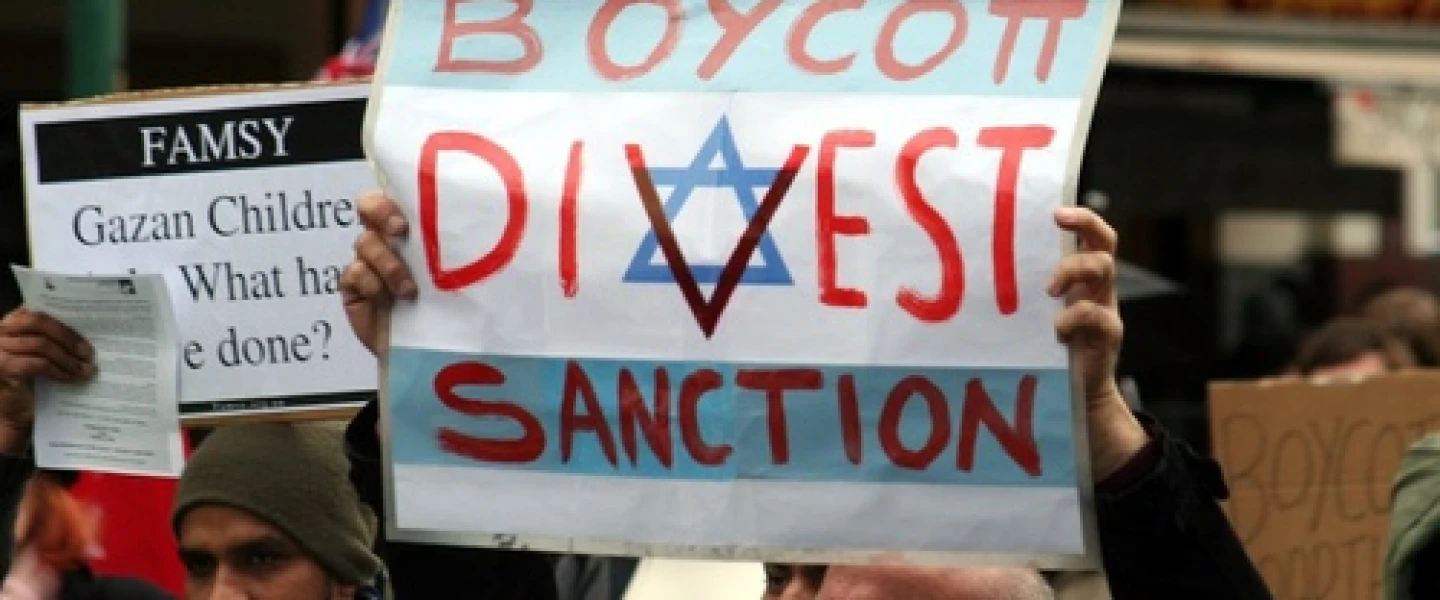

In a July 28 op-ed in The New York Times, Ben & Jerry’s co-founders Bennett Cohen and Jerry Greenfield—calling themselves “proud Jews"—wrote that though they “no longer have any operational control of the company [they] founded in 1978,” they “unequivocally support [its] decision ... to end business in the occupied territories, which a majority of the international community, including the United Nations, has deemed an illegal occupation.”
They further stated that their support of the company’s decision “is not a contradiction nor is it anti-Semitic. In fact, we believe this act can and should be seen as advancing the concepts of justice and human rights, core tenets of Judaism.”
As part of the justification for their claim, they insisted that “is not a boycott of Israel” or an endorsement of the BDS movement. “As our company began to expand internationally, Israel was one of our first overseas markets. We were then, and remain today, supporters of the State of Israel.”
The board of directors of Ben & Jerry’s has clashed with its parent company, Unilever, however, over the issue.
Onn July 19, Ben & Jerry’s issued a statement that read: “We believe it is inconsistent with our values for Ben & Jerry’s ice cream to be sold in the Occupied Palestinian Territory (OPT). We also hear and recognize the concerns shared with us by our fans and trusted partners. We have a longstanding partnership with our licensee, who manufactures Ben & Jerry’s ice cream in Israel and distributes it in the region. We have been working to change this, and so we have informed our licensee that we will not renew the license agreement when it expires at the end of next year. Although Ben & Jerry’s will no longer be sold in the OPT, we will stay in Israel through a different arrangement. We will share an update on this as soon as we’re ready.”
In response, the very board of directors that Cohen and Greenfield had put in place expressed its objection to the above statement, saying that it “does not reflect the position of the independent board, nor was it approved by the independent board. By taking a position and publishing a statement without the approval of the independent board on an issue directly related to Ben & Jerry’s social mission and brand integrity, Unilever and its CEO at Ben & Jerry’s are in violation of the spirit and the letter of the acquisition agreement.”
According to a report by NBC News, Anuradha Mittal, chairman of the independent board, said that Unilever released the statement against the wishes of the board and in violation of a legal agreement made when it bought Ben & Jerry’s in 2000.
“I am saddened by the deceit of it,” Mittal said, according to the report. “This is not about Israel. It is about the violation of the acquisition agreement that maintained the soul of the company. I can’t stop thinking that this is what happens when you have a board with all women and people of color who have been pushing to do the right thing.”
It is clear, in other words, that the decision of the board was to ban sales of its ice cream in all of Israel.
Mittal’s history of support for BDS and opposition to Israel is no secret. In a tweet about Israeli Independence Day in 2018, she wrote: “The catastrophe [of the establishment of the State of Israel] continues #Nakba70 years later #palestine bleeds Boycott Divest Sanctions #israel.”
In June of this year, she boasted on Twitter: “I signed a petition to @ABlinken demanding that he halt the $735 million in weapons to Israel!”
Cohen and Greenfield can’t claim, as they do, to be “proud Jews” and “supporters of Israel,” after placing a BDS-backing anti-Semite like Mittal at the head of their board and praising her. Real “proud Jews” and “supporters of Israel” would reverse Ben & Jerry’s decision. “Proud Jews” would never favor an anti-Semitic ban on sales to Jews in Jerusalem, home of Judaism’s holiest sites—the Temple Mount and the Western Wall—or in Judea and Samaria, where the forefathers and foremothers of the Jewish people are buried.
It is thus up to real supporters of Israel to fight this anti-Semitic decision, as some brave Ben and Jerry’s franchise-holders have done.
Farley Weiss, former president of the National Council of Young Israel, is an intellectual property attorney for the law firm of Weiss & Moy. The views expressed are the author’s, and not necessarily representative of NCYI.