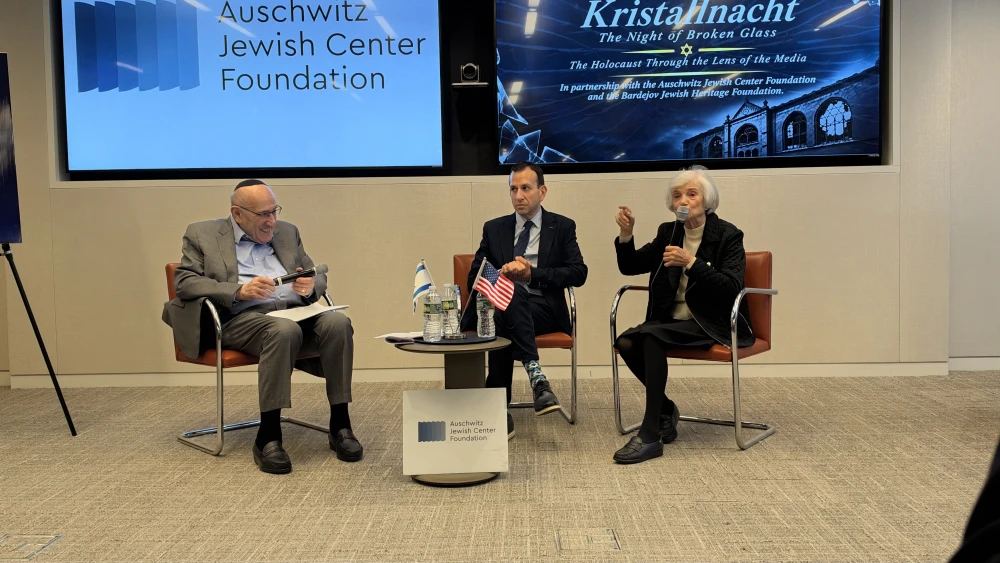
Toby Levy, a Holocaust survivor who was born in Poland in 1933, is concerned that some Jews don’t recognize the seriousness of rising antisemitism, she told JNS at the Consulate General of Israel in New York’s Kristallnacht memorial on Thursday night.
“Most of the Jews don’t get it,” she said. “When their heads are gonna be in the oven, that’s when they’re gonna get it.”
Levy spoke to JNS after the event, which the consulate hosted at the Auschwitz Jewish Center Foundation, a nonprofit on Manhattan’s Upper West Side.
The survivor said that she hopes she can change even a single mind. “If I get one person that sees my way and does something about it, it’s worth it,” she told JNS.
She was one of about 60 people who gathered for the event, which focused on the responsibilities of journalists and editors to preserve Jewish history.

Emil Fish, a Holocaust survivor who was born in Bardejov, Slovakia, told attendees that “survivors are no longer here to tell the stories.”
“It will be up to you guys, the younger generation, and the members of the media, to carry the torch and to remember the victims, to keep alive a story all of their own,” he said.
Fish told the audience about growing up in a town where Jews made up about a third of the population of 9,000. Jew-hatred was part of his childhood long before the mass deportations began.
His first memory, at age 6, is of being unable to walk on the same sidewalk as a non-Jew. “I realized that I’m a Jew, and that’s why I get beaten up,” he told attendees. He added that Jewish children, like him, had to sit in the back of the classroom in school.
New York-based journalist David Caplan, who moderated the event, asked Fish when he first remembered things getting bad for Jews. The survivor responded almost immediately.
“I don’t remember when it was good,” he said.
Fish’s family initially avoided deportation because his father, who worked in railroad manufacturing, received an exemption from Nazi authorities. Many of Fish’s extended family members were not as fortunate. His father’s parents, siblings, aunts, uncles and cousins were deported to Auschwitz in 1942. None survived, he said.
‘Common elements’ in the stories of survivors
When the Slovak government began deporting Jews again in a second wave in 1944, Fish and his immediate family went into hiding, moved between villages and reached Bratislava. Their attempts to evade capture included a nighttime encounter with a ranger, who threatened to shoot them. Fish’s father negotiated their release by offering valuable coats and money.
The Nazis arrested his family and sent him, his mother and his sister to Bergen-Belsen and his father to Buchenwald. All four reunited after the war.
“Every survivor has a unique story,” Fish told the audience. “But in my opinion, there are common elements in all of these stories of survivors.”
“In order to survive, you have to be lucky. You have to have faith in God. You have to be physically strong,” he said. “You have to have money, knowing the right people and the kindness of strangers, believe it or not, among them many who were not Jewish.”

After returning to Bardejov decades later, Fish was devastated by what remained. He had left in 1949 and returned for the first time in 2005 with his family.
“There were no Jews living here any longer and no evidence of a rich and vibrant Bardejov,” he told attendees.
Fish, who said that he had a successful career as a builder, preserved the town’s Jewish history. He established an organization to restore Jewish heritage sites, including synagogues, communal buildings and the cemetery.
The survivor told attendees that he is responsible for a memorial in the town that bears the names of 3,381 Holocaust victims from Bardejov and surrounding villages, which are engraved on 12 marble walls.
“These victims never had a proper burial,” he said. “They will always be remembered.”
Levy, the other survivor who spoke at the event, told JNS that something her father said he heard from a neighbor has remained with her years later.
“It’s your house, but it’s not your land,” the neighbor told her father.
Jews can build homes and establish lives in a country only to be told they do not belong there, she said. JNS asked if she thinks that warning is relevant to Jews today, including in the United States.
“Definitely,” she said.
Levy, who has long talked to students about the Holocaust, told attendees that she thinks that there isn’t enough Holocaust education in schools and that it isn’t being taught correctly.
“You’ve got to show who we are, where we come from, what we did accomplish,” she said. “You can’t emphasize only the bad part.”
She also expressed frustration with media coverage of Israel and what she sees as the failure of Jewish leaders to challenge false narratives.
Levy described her conversations with Jewish leaders. “I said, ‘You let it,’ allowing these lies to go too long,” she said. “They waited too long.”
She also shared another message of her father’s with the audience. “You will go to school, get educated, and you will teach the world,” he told her when she was young.
Levy said that one of her most memorable lessons came during a school visit when a student asked if she had ever wanted revenge against the Nazis.
“Yes, I have my revenge,” Levy told the student.
When the child asked what she had done, Levy said, “I have Jewish children, grandchildren and great-grandchildren.”
The student told her, “I never knew that you can have revenge without killing,” Levy told the audience.