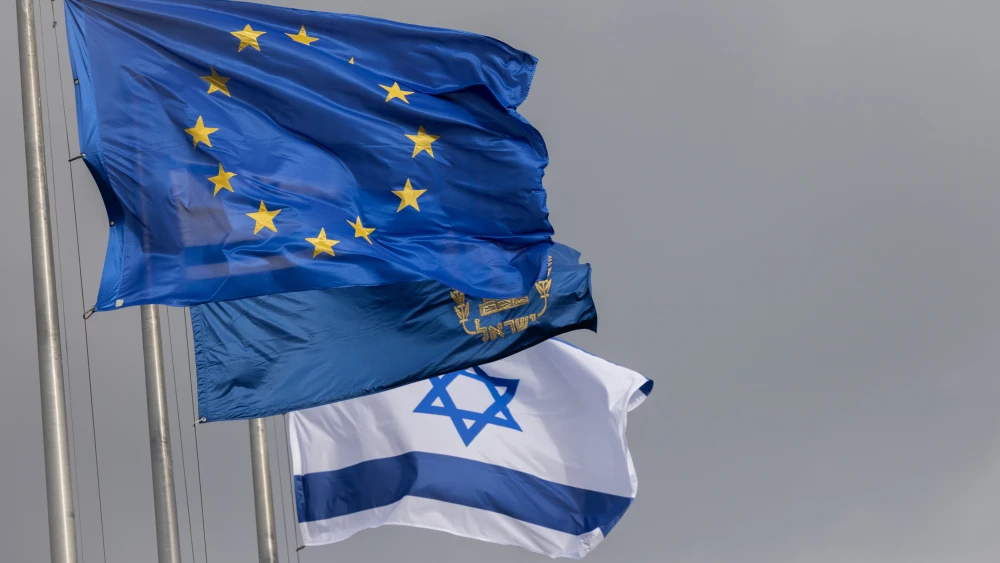

When European Union foreign-policy chief Kaja Kallas wrote on X after meeting Turkish President Recep Tayyip Erdoğan that Ankara was “a key partner on security, migration and energy,” praised its role protecting NATO’s eastern flank, and voiced hope for closer relations between Brussels and Ankara, Israeli Foreign Minister Gideon Sa’ar answered within hours.
Kallas’s message, he noted, said nothing about Turkey’s deteriorating democratic record: mounting pressure on opposition politicians, journalists and peaceful protesters. “A masterclass in hypocrisy,” he called it.
Whether Sa’ar’s criticism was fair is not the central question. The exchange became the latest episode in a relationship between Jerusalem and Brussels that has grown steadily more strained. But focusing on the question of double standards risks missing something more consequential, something that has drawn almost no attention: Israel is still engaging an outdated image of Europe.
Just days earlier, the European Union published the spring 2026 Standard Eurobarometer. The findings deserved more notice than another spat on social media. A majority of Europeans, 51%, now trust the European Union, three points higher than in the autumn 2025 survey. Some 73% see it as a place of stability in a troubled world, and 81% support a common defense and security policy among member states.
The significance of these findings extends well beyond public opinion. Trust is also a source of political legitimacy. Institutions that enjoy growing public confidence acquire greater authority to act, both internally and internationally. For Israel, this means that the European Union is not merely a forum for familiar diplomatic arguments; it is becoming a more legitimate and more consequential actor.
This suggests that Israeli thinking about the union still rests on assumptions many Europeans no longer hold. That view once made perfect sense. For much of the past decade, those assumptions closely reflected the union’s political trajectory.
The sovereign debt crisis exposed deep economic strain. The refugee crisis laid bare sharp political divisions. Brexit seemed to confirm an integration project heading toward irreversible decline. Populist parties gained ground across the continent, while constant disputes among member states reinforced the image of a bloc too fragmented to operate with purpose. Years of this encouraged Israeli policymakers to view the European Union primarily as a divided economic club, rather than as an increasingly consequential geopolitical actor.
That is not the entity taking shape now.
Europe has become more integrated in strategically important fields, more confident in its institutions and more willing to act collectively.
Russia’s war of aggression against Ukraine reshaped the course of European integration. Instead of fragmenting, the European Union coordinated sweeping sanctions against Russia; financed military assistance to Ukraine; expanded defense investment; diversified energy supplies; and invested heavily in industrial resilience and advanced technologies. Doubts about future American leadership have only accelerated this process.
The Eurobarometer survey shows that this transformation extends well beyond Brussels. E.U. citizens increasingly support it. They recognize that security, migration, technological competition, climate change and geopolitical instability require collective European action.
That reality should matter greatly in Jerusalem.
Israeli foreign policy continues to devote much of its attention to bilateral relations with European capitals. Those relationships remain indispensable. Germany, Italy, Greece, Czechia, Cyprus, Bulgaria, Romania, Hungary and other member states will always remain essential partners.
But today’s European Union can no longer be understood through national capitals alone. Many of the decisions shaping Israel’s strategic environment are increasingly negotiated and adopted in Brussels. Trade policy, Horizon Europe research funding, AI, digital regulation, sanctions, environmental standards, industrial strategy and expanding areas of foreign policy now emerge from common E.U. institutions.
This is one of the most important transformations in European politics over the past two decades. Israeli diplomacy has not fully caught up.
Israel continues to approach the union primarily through bilateral channels, even as Brussels acquires greater influence over issues that directly affect Israeli economic, scientific, technological and diplomatic interests. The result is a widening gap between the Europe that Israel believes it is engaging and the Europe that increasingly shapes decisions affecting Israel’s interests.
The recent suspension of Israeli contacts with Kaja Kallas illustrates this broader challenge. Whatever its immediate diplomatic logic, reducing engagement with Brussels does not diminish the union’s influence. It merely limits Israel’s opportunities to influence decisions before they are taken.
This has become particularly evident since October 2023. Disagreements over Gaza, humanitarian assistance, violent settlers, international law and the prospects for peace have strained relations between Israel and several European institutions. At the same time, antisemitism has surged across Europe, leaving Jewish communities increasingly vulnerable to violence and hostility generated by events unfolding thousands of kilometers away.
These developments have understandably generated deep frustration in Israel. Frustration, however, is not a strategy.
Too much of the Israeli debate still reflects the union of the Brexit era rather than the union that exists today.
Many Israelis now dismiss Brussels as politically irrelevant. The Eurobarometer survey suggests precisely the opposite. Institutions that enjoy rising public confidence tend to gain political authority rather than lose it. Governments become more willing to act through them, and international partners have even greater reason to engage them seriously. As the European Union assumes a larger role in security, defense, technology and economic policy, Israel has a greater interest in engaging Brussels rather than bypassing it.
None of this requires accepting every European criticism. Democracies disagree, particularly during war. Israel has every right to challenge positions it considers unfair, inconsistent or detached from regional realities; however, disagreement is not a substitute for understanding.
A more effective Israeli approach would not abandon bilateral diplomacy. It would complement it with a more serious Brussels strategy. That means sustained engagement with the European External Action Service, the European Commission, the High Representative’s office and the European Parliament; treating E.U. regulatory, research and sanctions debates as strategic files; and entering conversations early to shape outcomes rather than merely react to them.
The case for doing so is practical, not sentimental. The European Union remains Israel’s largest trading partner, accounting for nearly a third of Israel’s total goods trade. Its research programs provide Israeli universities, scientists and industry with unparalleled opportunities for cooperation. Israeli innovation strengthens Europe in cybersecurity, health care, agriculture, water technology, climate adaptation and AI. These shared interests have become more important, not less.
Too much of the Israeli debate still reflects the union of the Brexit era rather than the union that exists today. Europe has become more integrated in strategically important fields, more confident in its institutions and more willing to act collectively. It’s becoming more cohesive and more confident. These changes are already reshaping the continent.
Successful foreign policy begins with an accurate understanding of political realities. The costliest strategic mistakes rarely result from underestimating adversaries. More often, they stem from misreading partners.
The latest exchange between Gideon Sa’ar and Kaja Kallas will soon fade from the headlines. The larger strategic challenge will remain.